Ley lines
Ley lines are proposed alignments between landscape features. Compare Alfred Watkins’s theory of ancient trackways with Dion Fortune’s lines of force.
In this article
What did Watkins think ley lines were for?
A ley line is a proposed straight alignment between features in a landscape. Alfred Watkins argued in Early British Trackways, published in 1922, that such lines guided early British travellers. He thought they could sight a distant hill and stay on course using features such as a mound, pool or standing stone. [1]
A ruler can show an alignment on a map. Establishing an ancient route also requires evidence that the sites existed at the same time and were related. Excavation and survey at Avebury, for example, let archaeologists ask what was built first and how the different parts of the site developed. [1][2]
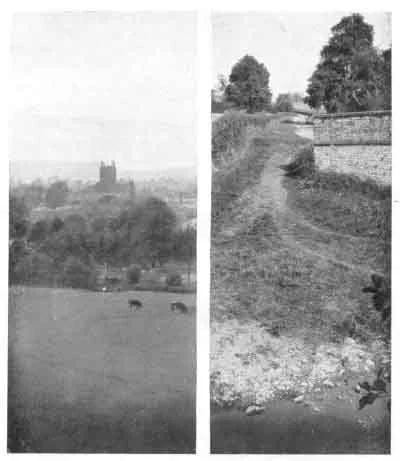
Plate IV from Alfred Watkins’s Early British Trackways (1922). The photographs illustrate how he looked for a line linking a pond, a cathedral tower and a distant height, or a ford, road and mound.
Alfred Watkins, Early British Trackways, The Watkins Meter Co., 1922, Plate IV. · Image source ↗ · Public Domain
Lines of force in The Goat-Foot God
In Dion Fortune’s The Goat-Foot God, Mona directs Hugh’s ruler from Tintagel through Avebury towards St Albans, and from Lindisfarne through Avebury towards St Alban’s Head. Mona treats these as lines of force between places long associated with worship. She suggests looking along a line for a secluded site. [4][5][6][7]
Mona looks for standing stones on high ground and pools below. At the yew grove, Hugh imagines a line from the dam in the valley to the abbey that passes through the central stone. He takes the alignment as evidence of an earlier arrangement and chooses the clearing for his rite. [8][9][10][11][12]
See references (9)
- The Goat-Foot God, Reader page 80
- The Goat-Foot God, Reader page 81
- The Goat-Foot God, Reader page 82
- The Goat-Foot God, Reader page 83
- The Goat-Foot God, Reader page 84
- The Goat-Foot God, Reader page 85
- The Goat-Foot God, Reader page 334
- The Goat-Foot God, Reader page 335
- The Goat-Foot God, Reader page 336
A sighting line and a line of force
Watkins treats water and stones as markers a traveller might see and follow. Fortune’s characters also care about visibility, but they see an occult connection between places of worship. That connection belongs to the novel’s view of the landscape. [1][7][8][11]
Read further in the library
The Goat-Foot God
Reading note
The separately titled account draws on exact passages in the consulted Library edition.
Sources
See references (12)
- Alfred Watkins, Early British Trackways, introduction and Plate IV ↗Alfred Watkins, Early British Trackways (1922), introduction, printed pp. 9–11 and Plate IV.Return to text ↑
- The origins of Avebury, Antiquity ↗Mark Gillings and colleagues, The origins of Avebury, Antiquity (2019), research on the Southern Inner Circle and the chronology of the monument.Return to text ↑
- Early British Trackways, Plate IV ↗Alfred Watkins, Early British Trackways, The Watkins Meter Co., 1922, Plate IV.
- The Goat-Foot God, Reader page 80Dion Fortune, The Goat-Foot God. Undated digital Library edition IMJ-0643-E001. Numbered references use the Library Reader sequence.Read this page in The Goat-Foot God ↗Return to text ↑
- The Goat-Foot God, Reader page 81Dion Fortune, The Goat-Foot God. Undated digital Library edition IMJ-0643-E001. Numbered references use the Library Reader sequence.Read this page in The Goat-Foot God ↗Return to text ↑
- The Goat-Foot God, Reader page 82Dion Fortune, The Goat-Foot God. Undated digital Library edition IMJ-0643-E001. Numbered references use the Library Reader sequence.Read this page in The Goat-Foot God ↗Return to text ↑
- The Goat-Foot God, Reader page 83Dion Fortune, The Goat-Foot God. Undated digital Library edition IMJ-0643-E001. Numbered references use the Library Reader sequence.Read this page in The Goat-Foot God ↗Return to text ↑
- The Goat-Foot God, Reader page 84Dion Fortune, The Goat-Foot God. Undated digital Library edition IMJ-0643-E001. Numbered references use the Library Reader sequence.Read this page in The Goat-Foot God ↗Return to text ↑
- The Goat-Foot God, Reader page 85Dion Fortune, The Goat-Foot God. Undated digital Library edition IMJ-0643-E001. Numbered references use the Library Reader sequence.Read this page in The Goat-Foot God ↗Return to text ↑
- The Goat-Foot God, Reader page 334Dion Fortune, The Goat-Foot God. Undated digital Library edition IMJ-0643-E001. Numbered references use the Library Reader sequence.Read this page in The Goat-Foot God ↗Return to text ↑
- The Goat-Foot God, Reader page 335Dion Fortune, The Goat-Foot God. Undated digital Library edition IMJ-0643-E001. Numbered references use the Library Reader sequence.Read this page in The Goat-Foot God ↗Return to text ↑
- The Goat-Foot God, Reader page 336Dion Fortune, The Goat-Foot God. Undated digital Library edition IMJ-0643-E001. Numbered references use the Library Reader sequence.Read this page in The Goat-Foot God ↗Return to text ↑