Kundalini and sexual energy
How does Arundale relate Kundalini to sexual energy? Read his Theosophical account of creative power and compare Pūrṇānanda’s goddess imagery.
In this article
Understanding the concept
The relationship between Kundalini and sexual energy depends on the tradition and text. George S. Arundale connects the two as forms of creative power. In his Theosophical account, the aim is for an individual’s creative life to take on a wider purpose. [5][6][7]
Kundalini: An Occult Experience by George S. Arundale
In his chapter on dangers, George S. Arundale says that stirring Kundalini can also stir sexual vitality because he regards both as creative powers. He treats sexual life as sacred and expects someone prepared for the development he describes to have very little sexual tendency. His idea of preparation involves unusually strict restraint. [5][6]
In his discussion of purpose, Arundale imagines a shift from the personal creative impulse to a universal creative life. He reports no sexual disturbance in the experience he describes there. His stated aim is for higher consciousness and intuition to become part of waking life. [7][5][8]
Ṣaṭcakranirūpaṇa by Pūrṇānanda, translated by Arthur Avalon
Pūrṇānanda’s Ṣaṭcakranirūpaṇa, translated by Arthur Avalon with Kālīcaraṇa’s commentary, pictures a sleeping goddess coiled at the root lotus. The later verses place her ascent within a teacher-guided path and describe union with Śiva. [1][2][3]
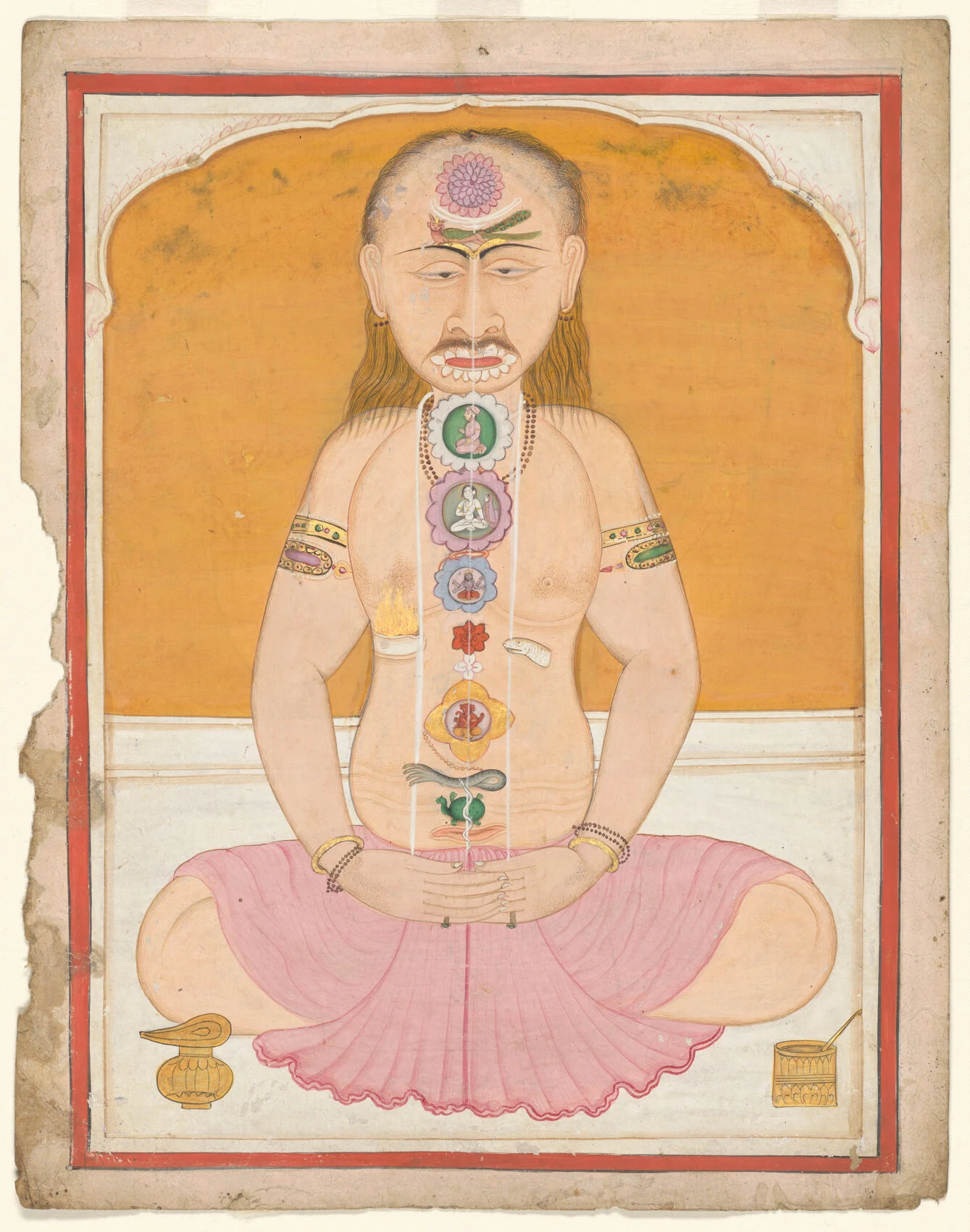
A figure with centres marked down the body in Wellcome MS Hindi (Indic) beta 511. The painting gives historical context to the image of an ascent through yogic centres.
Wellcome Collection, MS Hindi (Indic) beta 511, recto. Public Domain Mark. Source image resized by IIIF and converted to WebP; no crop or recolouring. · Image source ↗ · Public Domain
Creative power and the image of the goddess
Pūrṇānanda gives Kundalini a divine form and places her ascent within a religious account of liberation. Arundale uses feminine imagery too and develops his own account of sexual vitality and the redirection of creative power. The passages answer different questions about what the awakening is supposed to accomplish. [1][2][3][9][5][7][6][8]
See references (8)
- Pūrṇānanda, Ṣaṭcakranirūpaṇa, verses 10–11, translated by Arthur Avalon
- Pūrṇānanda, Ṣaṭcakranirūpaṇa, verse 50 and Kālīcaraṇa’s commentary, translated by Arthur Avalon
- Pūrṇānanda, Ṣaṭcakranirūpaṇa, verse 51 and Kālīcaraṇa’s commentary, translated by Arthur Avalon
- Kundalini: An Occult Experience, printed p. 21, Reader page 37
- Kundalini: An Occult Experience, printed p. 22, Reader page 38
- Kundalini: An Occult Experience, printed p. 64, Reader page 66
- Kundalini: An Occult Experience, printed p. 65, Reader page 67
- Kundalini: An Occult Experience, printed p. 4, Reader page 20
Read further in the library

Kundalini: An Occult Experience
Reading note
The separately titled account draws on exact passages in the consulted Library edition.
Sources
See references (9)
- Pūrṇānanda, Ṣaṭcakranirūpaṇa, verses 10–11, translated by Arthur Avalon ↗Pūrṇānanda, Ṣaṭcakranirūpaṇa; Arthur Avalon (John Woodroffe), English translation with Kālīcaraṇa’s commentary in The Serpent Power. Verse reference identifies the primary text, separately from its commentary.Return to text ↑
- Pūrṇānanda, Ṣaṭcakranirūpaṇa, verse 50 and Kālīcaraṇa’s commentary, translated by Arthur Avalon ↗Pūrṇānanda, Ṣaṭcakranirūpaṇa; Arthur Avalon (John Woodroffe), English translation with Kālīcaraṇa’s commentary in The Serpent Power. Verse reference identifies the primary text, separately from its commentary.Return to text ↑
- Pūrṇānanda, Ṣaṭcakranirūpaṇa, verse 51 and Kālīcaraṇa’s commentary, translated by Arthur Avalon ↗Primary verse and its separately identified commentary. The passage describes the goddess’s approach to Śiva and the bliss of liberation.Return to text ↑
- Wellcome Collection, MS Hindi (Indic) beta 511, natural-colour recto ↗Wellcome Collection. Current collection catalogue and IIIF manifest designate this digital image Public Domain Mark; creator and date are not supplied in the consulted catalogue.
- Kundalini: An Occult Experience, printed p. 21, Reader page 37George S. Arundale, Kundalini: An Occult Experience, The Theosophical Publishing House, Adyar, Madras, India, 1938. Consulted Library edition IMJ-0227-E001.Read this page in Kundalini: An Occult Experience ↗Return to text ↑
- Kundalini: An Occult Experience, printed p. 22, Reader page 38George S. Arundale, Kundalini: An Occult Experience, The Theosophical Publishing House, Adyar, Madras, India, 1938. Consulted Library edition IMJ-0227-E001.Read this page in Kundalini: An Occult Experience ↗Return to text ↑
- Kundalini: An Occult Experience, printed p. 64, Reader page 66George S. Arundale, Kundalini: An Occult Experience, The Theosophical Publishing House, Adyar, Madras, India, 1938. Consulted Library edition IMJ-0227-E001.Read this page in Kundalini: An Occult Experience ↗Return to text ↑
- Kundalini: An Occult Experience, printed p. 65, Reader page 67George S. Arundale, Kundalini: An Occult Experience, The Theosophical Publishing House, Adyar, Madras, India, 1938. Consulted Library edition IMJ-0227-E001.Read this page in Kundalini: An Occult Experience ↗Return to text ↑
- Kundalini: An Occult Experience, printed p. 4, Reader page 20George S. Arundale, Kundalini: An Occult Experience, The Theosophical Publishing House, Adyar, Madras, India, 1938. Consulted Library edition IMJ-0227-E001.Read this page in Kundalini: An Occult Experience ↗Return to text ↑