Kōyasan
Kōyasan is the mountain religious centre founded by Kūkai and a major place of pilgrimage in Japanese Shingon Buddhism.
In this article
What is Kōyasan?
Kōyasan is a sacred mountain district in Wakayama where Kūkai established a centre of Shingon Buddhism in the early ninth century. Its temples, pilgrimage paths and the cemetery and mausoleum at Okunoin serve different parts of religious life. [1][2]
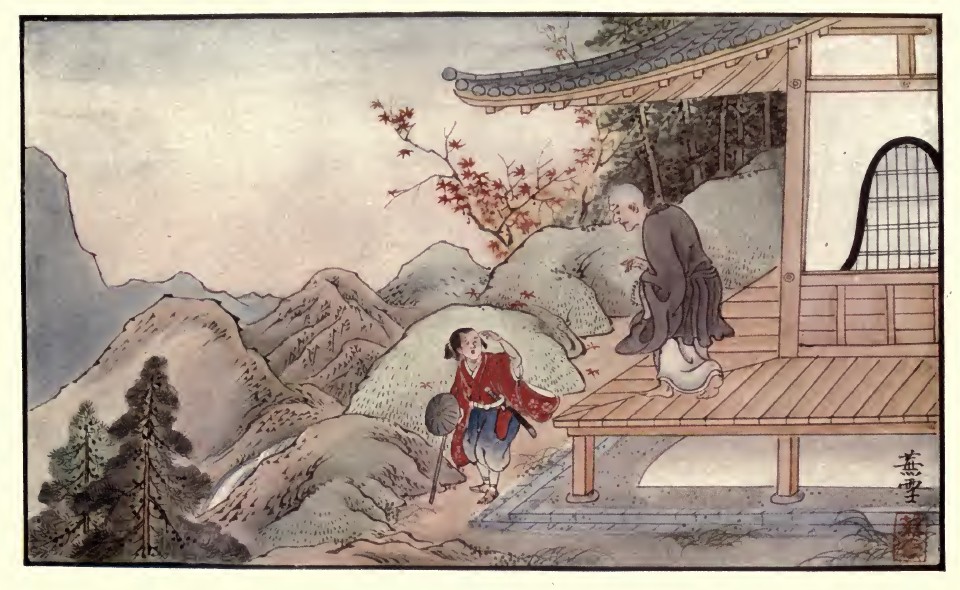
The 1908 illustration places Ishidomaro outside the room where he encounters the monk he believes to be his father.
Mo-No-Yuki, after a sketch by Richard Gordon Smith, Ishidomaro meets his father, 1908. California Digital Library scan via Internet Archive. Public domain. · Image source ↗ · Public Domain
See references (2)
In Ancient Tales and Folk-lore of Japan
Richard Gordon Smith sets a family’s search at Kōyasan in The Story of Kato Sayemon. Ishidomaro’s mother has to wait outside the restricted precinct. He goes on alone, finds the monk he recognises as his father and is turned away. The boundary makes the first separation in the scene. [4][5]
In The Hermit’s Cave, villagers far from Kōyasan wonder whether an old healer is a sennin. They recall Kūkai’s reputed healing powers. His place in their conversation shows how the founder’s reputation travels beyond the mountain. [6]
Where women could worship
Kongōbu-ji describes the halls at entrances where women could worship during the restriction, which it dates as ending in 1872. The Nyonin Michi follows routes around the old precinct. Smith shows one family stopped by the rule. The paths and halls show how women continued to make pilgrimages. [4][5][2][3]
In the library
Ancient Tales and Folk-lore of Japan
Reading note
Read Richard Gordon Smith’s account in the verified 1908 Library edition.
Sources
See references (7)
- Koyasan, Exploring Japanese Landmarks ↗National Diet Library
- Highlights, Nyonindo and Okunoin ↗Kongōbu-ji
- About the Nyonin Michi (Women’s Pilgrimage Route) ↗Japan Tourism Agency
- Ancient Tales and Folklore of Japan, printed p. 78, Reader page 120Richard Gordon Smith, Ancient Tales and Folklore of Japan. A. & C. Black, London, 1908. Lumitheca Library edition IMJ-0588-E001.Read this page in Ancient Tales and Folk-lore of Japan ↗
- Ancient Tales and Folklore of Japan, printed p. 80, Reader page 122Richard Gordon Smith, Ancient Tales and Folklore of Japan. A. & C. Black, London, 1908. Lumitheca Library edition IMJ-0588-E001.Read this page in Ancient Tales and Folk-lore of Japan ↗
- Ancient Tales and Folklore of Japan, printed p. 186, Reader page 266Richard Gordon Smith, Ancient Tales and Folklore of Japan. A. & C. Black, London, 1908. Lumitheca Library edition IMJ-0588-E001.Read this page in Ancient Tales and Folk-lore of Japan ↗
- Ishidomaro meets his father ↗Mo-No-Yuki, after a sketch by Richard Gordon Smith, Ishidomaro meets his father, 1908. California Digital Library scan via Internet Archive. Public domain.