Why Jung Wrote About The Secret of the Golden Flower
C. G. Jung wrote a commentary on The Secret of the Golden Flower at Richard Wilhelm’s request. Jung used it to examine parallels between the Chinese alchemical text and images that appeared in his psychological work.
In this article
Why did Jung write the commentary?
Richard Wilhelm asked C. G. Jung to comment on The Secret of the Golden Flower, a Chinese work of inner alchemy. Jung thought its imagery resembled forms he had encountered in his patients’ drawings and fantasies. In the commentary he asks how those resemblances might help a European reader understand aspects of the book. [1][4][8][10]
Jung’s stated purpose in The Secret of the Golden Flower
Jung writes from his experience as a European reader and psychologist. He argues that borrowing the outward forms of Chinese practice would leave important differences in experience unexamined. His commentary asks what the imagery could mean in the setting he knew. [2][3][7]
Drawings and fantasies lead Jung to ask how symbols can make changes in psychological life visible. He relates the Chinese images to a growing contact between conscious and unconscious life. In his conclusion he explains that this is why he concentrates on symbolic patterns and leaves the technical instructions aside. [4][5][8]
See references (6)
- The Secret of the Golden Flower, printed p. 77, Reader page 76
- The Secret of the Golden Flower, printed p. 79, Reader page 78
- The Secret of the Golden Flower, printed p. 83, Reader page 82
- The Secret of the Golden Flower, printed p. 96, Reader page 95
- The Secret of the Golden Flower, printed p. 128, Reader page 127
- The Secret of the Golden Flower, printed p. 136, Reader page 135
Jung’s memorial address for Wilhelm
Cary F. Baynes also includes Jung’s later memorial address for Wilhelm in the English volume. In that essay Jung returns to Wilhelm’s choice of Meaning for Dao and asks what it would involve to carry that understanding into one’s life. [1][9]
The role of Jung’s comparison today
Danke Zhang’s study of a longer Chinese version follows the golden flower through images of luminosity and cultivation. Jung’s commentary follows the flower into his discussions of the psyche. Reading the two accounts separately makes it easier to see what each brings to the same image. [11][5]
A Christian figure in Jung’s comparison
The engraving portrays Jakob Böhme, whose diagram of the soul Jung cites. The diagram enters the commentary as a Christian example of a centred figure. Jung compares such forms with designs emerging in his own practice. [12][6]
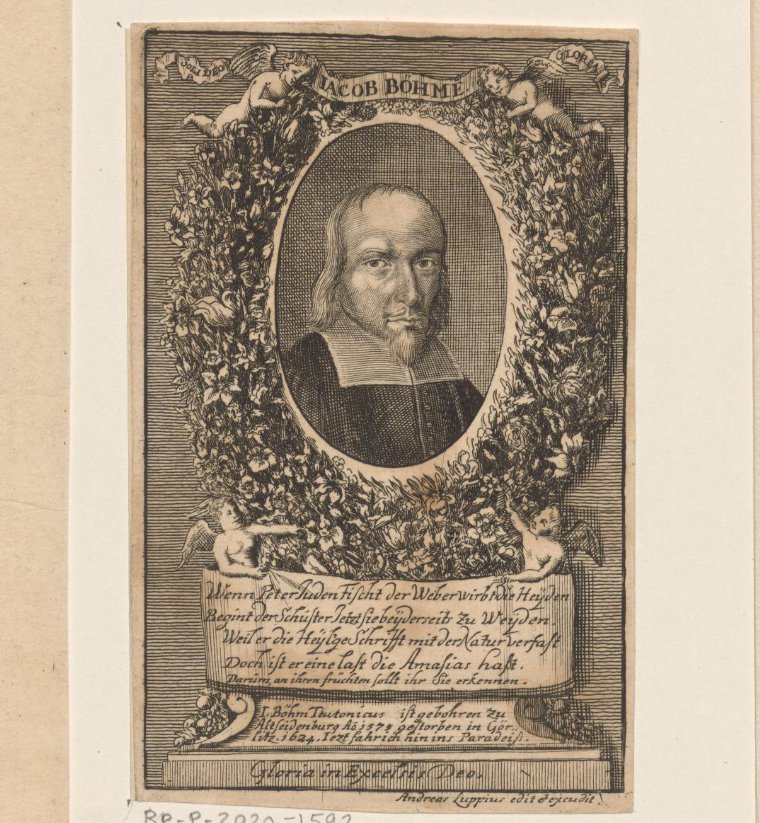
Portrait of Jakob Böhme, anonymous engraving, 1694–1703. His diagram of the soul is one of Jung’s examples of a centred image outside the Chinese treatise.
Rijksmuseum, anonymous engraving, 1694–1703. Public domain. · Image source ↗ · Public Domain
In the library
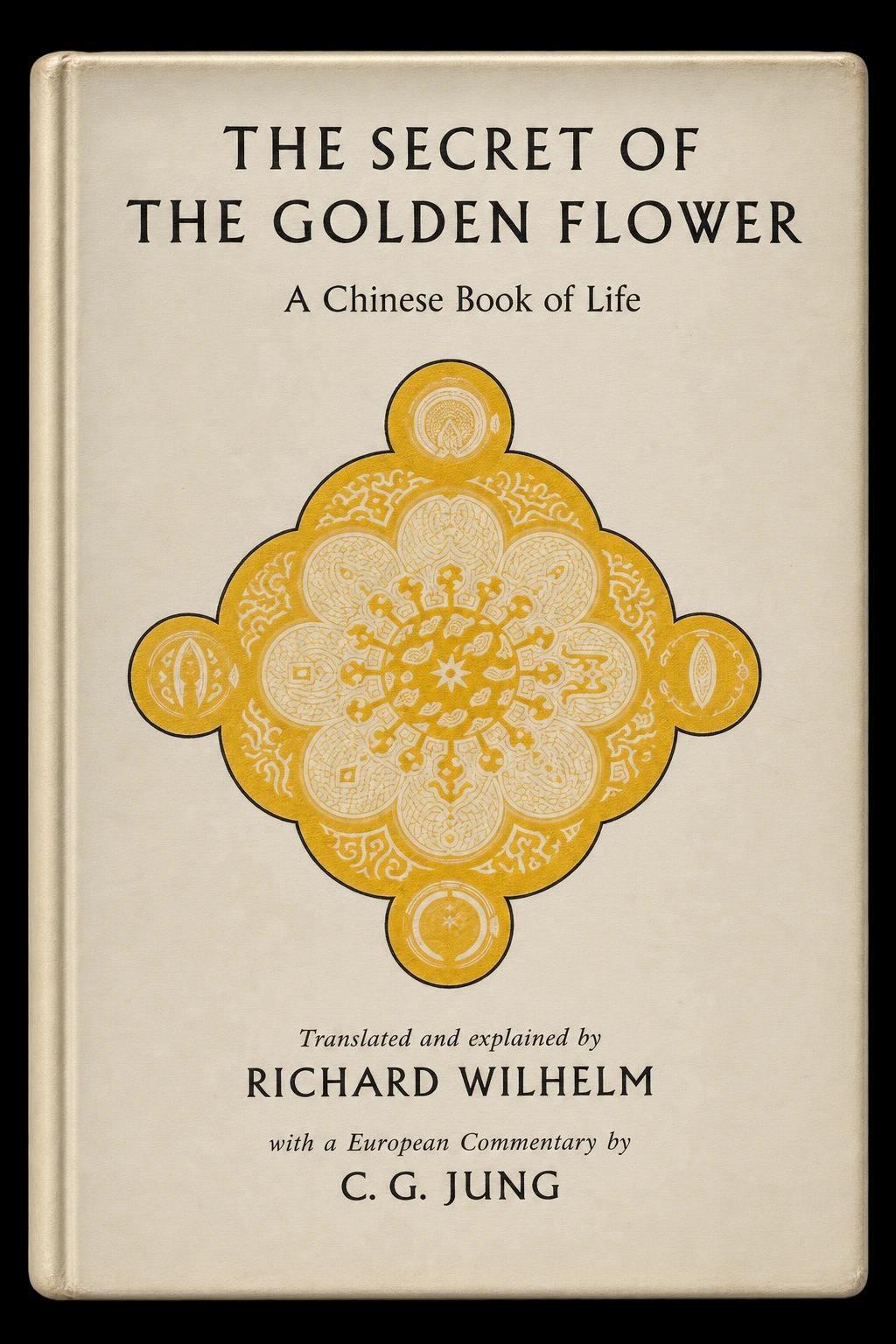
The Secret of the Golden Flower
Reading note
Read the account of Jung and The Secret of the Golden Flower in the Wilhelm and Baynes edition.
Sources
See references (12)
- The Secret of the Golden Flower, printed p. vii, Reader page 7The Secret of the Golden Flower: A Chinese Book of Life. Chinese text translated and explained by Richard Wilhelm, English translation by Cary F. Baynes, with separate commentary by C. G. Jung. London, Kegan Paul, Trench, Trubner & Co. Lumitheca Library edition IMJ-0596-E001.Read this page in The Secret of the Golden Flower ↗
- The Secret of the Golden Flower, printed p. 77, Reader page 76The Secret of the Golden Flower: A Chinese Book of Life. Chinese text translated and explained by Richard Wilhelm, English translation by Cary F. Baynes, with separate commentary by C. G. Jung. London, Kegan Paul, Trench, Trubner & Co. Lumitheca Library edition IMJ-0596-E001.Read this page in The Secret of the Golden Flower ↗
- The Secret of the Golden Flower, printed p. 79, Reader page 78The Secret of the Golden Flower: A Chinese Book of Life. Chinese text translated and explained by Richard Wilhelm, English translation by Cary F. Baynes, with separate commentary by C. G. Jung. London, Kegan Paul, Trench, Trubner & Co. Lumitheca Library edition IMJ-0596-E001.Read this page in The Secret of the Golden Flower ↗
- The Secret of the Golden Flower, printed p. 83, Reader page 82The Secret of the Golden Flower: A Chinese Book of Life. Chinese text translated and explained by Richard Wilhelm, English translation by Cary F. Baynes, with separate commentary by C. G. Jung. London, Kegan Paul, Trench, Trubner & Co. Lumitheca Library edition IMJ-0596-E001.Read this page in The Secret of the Golden Flower ↗
- The Secret of the Golden Flower, printed p. 96, Reader page 95The Secret of the Golden Flower: A Chinese Book of Life. Chinese text translated and explained by Richard Wilhelm, English translation by Cary F. Baynes, with separate commentary by C. G. Jung. London, Kegan Paul, Trench, Trubner & Co. Lumitheca Library edition IMJ-0596-E001.Read this page in The Secret of the Golden Flower ↗
- The Secret of the Golden Flower, printed p. 97, Reader page 96The Secret of the Golden Flower: A Chinese Book of Life. Chinese text translated and explained by Richard Wilhelm, English translation by Cary F. Baynes, with separate commentary by C. G. Jung. London, Kegan Paul, Trench, Trubner & Co. Lumitheca Library edition IMJ-0596-E001.Read this page in The Secret of the Golden Flower ↗
- The Secret of the Golden Flower, printed p. 128, Reader page 127The Secret of the Golden Flower: A Chinese Book of Life. Chinese text translated and explained by Richard Wilhelm, English translation by Cary F. Baynes, with separate commentary by C. G. Jung. London, Kegan Paul, Trench, Trubner & Co. Lumitheca Library edition IMJ-0596-E001.Read this page in The Secret of the Golden Flower ↗
- The Secret of the Golden Flower, printed p. 136, Reader page 135The Secret of the Golden Flower: A Chinese Book of Life. Chinese text translated and explained by Richard Wilhelm, English translation by Cary F. Baynes, with separate commentary by C. G. Jung. London, Kegan Paul, Trench, Trubner & Co. Lumitheca Library edition IMJ-0596-E001.Read this page in The Secret of the Golden Flower ↗
- The Secret of the Golden Flower, printed p. 147, Reader page 146The Secret of the Golden Flower: A Chinese Book of Life. Chinese text translated and explained by Richard Wilhelm, English translation by Cary F. Baynes, with separate commentary by C. G. Jung. London, Kegan Paul, Trench, Trubner & Co. Lumitheca Library edition IMJ-0596-E001.Read this page in The Secret of the Golden Flower ↗
- The Red Book and Beyond, “Secret of the Golden Flower” exhibition section ↗Library of Congress exhibition on the origins and influence of Carl G. Jung’s Red Book.
- Symbolic Transfigurations of Jinhua in The Secret of the Golden Flower, introduction ↗Danke Zhang, Religions 17(1), 113 (2026).
- Portrait of Jakob Böhme ↗Rijksmuseum, anonymous engraving, 1694–1703. Public domain.