The Golden Flower in Daoist Alchemy and Jung’s Commentary
The golden flower is an image of light in the Daoist text that bears its name. The Chinese text describes it as budding, opening and crystallising. C. G. Jung reads the image psychologically through the circular and floral drawings he compares with mandalas.
In this article
What does the golden flower represent?
The golden flower is an image of light in the Daoist text The Secret of the Golden Flower. It can bud, open and crystallise. These changes give visible form to how the text imagines light gathering in the course of inner cultivation. [1][8]
In The Secret of the Golden Flower
In Richard Wilhelm’s translation, rendered into English by Cary F. Baynes, the flower is associated with the light of the Great One. The text describes that light returning and gathering. It draws on the growth of a seed and the formation of a pearl as well as the opening of a flower. [1][2][6]
The chapter on signs of progress describes the flower as crystallised when the brightness of the spirit is stable even amid things that would usually disturb a person. It also records several other experiences. The range of signs gives the flower a place within a larger account of change. [3][4][5]
See references (6)
- The Secret of the Golden Flower, printed p. 23, Reader page 30
- The Secret of the Golden Flower, printed p. 34, Reader page 39
- The Secret of the Golden Flower, Confirmatory Experiences chapter, Reader page 55
- The Secret of the Golden Flower, printed p. 55, Reader page 56
- The Secret of the Golden Flower, printed p. 56, Reader page 57
- The Secret of the Golden Flower, printed p. 60, Reader page 61
Jung’s reading of the flower
C. G. Jung recalls seeing related forms in his patients’ drawings. Some resemble geometric ornaments seen from above and others bright flowers growing in darkness. He reads the golden flower as a mandala symbol. Danke Zhang’s study of a longer Chinese version examines how the same term expresses luminosity in Daoist internal alchemy. [7][8]
What a historical mandala adds to the comparison
This Tibetan mandala arranges petals and concentric rings around a square palace with a goddess at the centre. The arrangement gives a concrete example of the centred form that interested Jung. The figures and their places also carry meanings specific to the Buddhist practice for which the painting was made. [9][7]
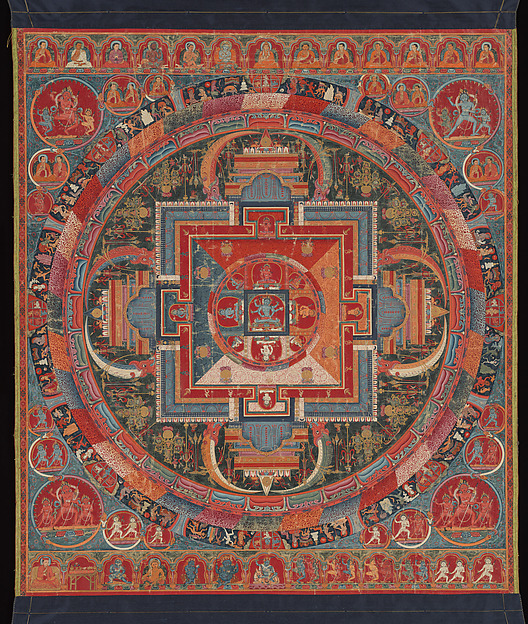
A late fourteenth-century Tibetan mandala of Jñānaḍākinī. This ritual painting provides a historical comparison for the circular layout Jung discusses.
The Metropolitan Museum of Art, Purchase, Lita Annenberg Hazen Charitable Trust Gift, 1987, 1987.16. CC0. · Image source ↗ · CC0
In the library
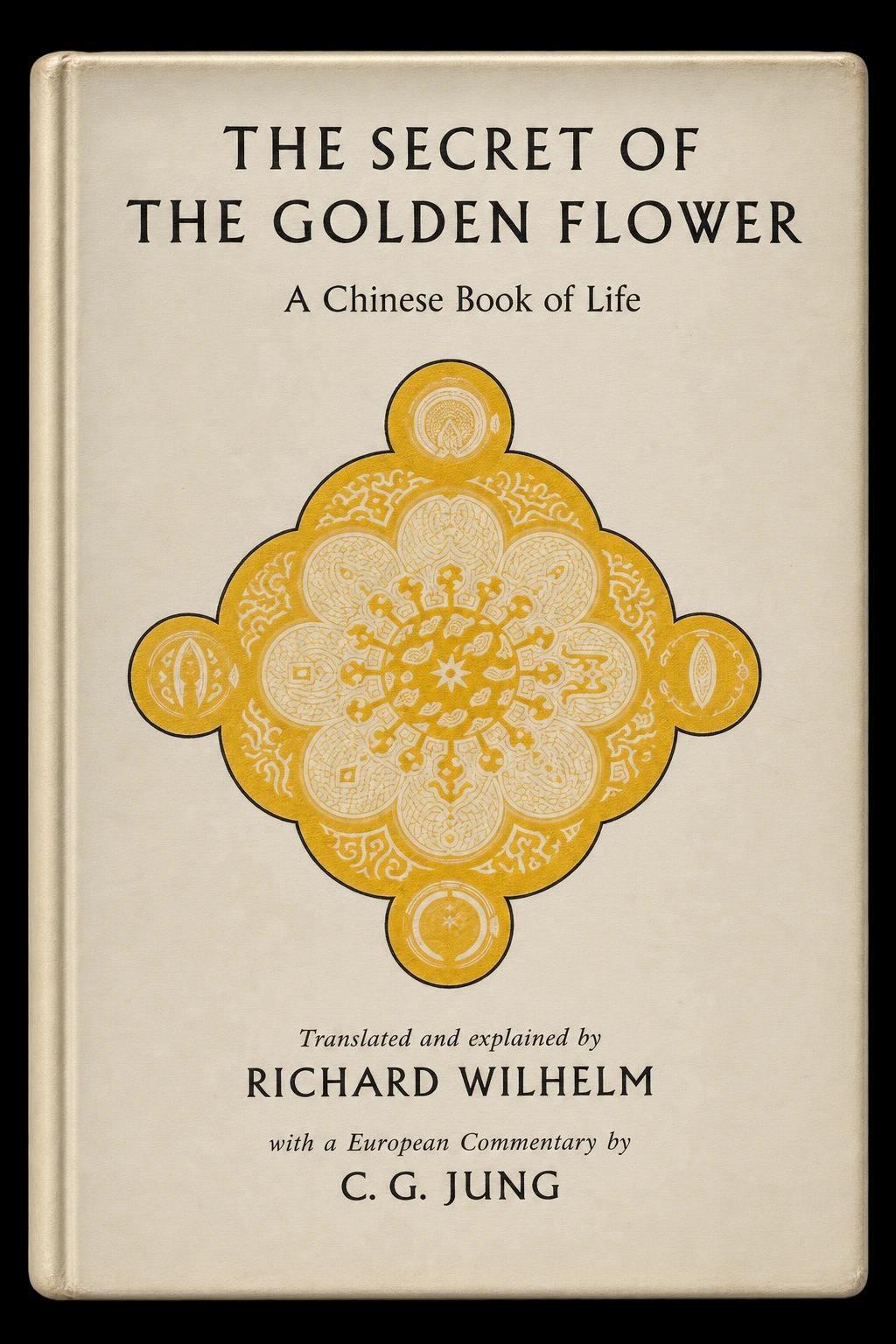
The Secret of the Golden Flower
Reading note
Read the specific account of Golden flower in Daoist alchemy in the Wilhelm–Baynes edition.
Sources
See references (9)
- The Secret of the Golden Flower, printed p. 23, Reader page 30The Secret of the Golden Flower: A Chinese Book of Life. Chinese text translated and explained by Richard Wilhelm, English translation by Cary F. Baynes, with separate commentary by C. G. Jung. London, Kegan Paul, Trench, Trubner & Co. Lumitheca Library edition IMJ-0596-E001.Read this page in The Secret of the Golden Flower ↗
- The Secret of the Golden Flower, printed p. 34, Reader page 39The Secret of the Golden Flower: A Chinese Book of Life. Chinese text translated and explained by Richard Wilhelm, English translation by Cary F. Baynes, with separate commentary by C. G. Jung. London, Kegan Paul, Trench, Trubner & Co. Lumitheca Library edition IMJ-0596-E001.Read this page in The Secret of the Golden Flower ↗
- The Secret of the Golden Flower, Confirmatory Experiences chapter, Reader page 55The Secret of the Golden Flower: A Chinese Book of Life. Chinese text translated and explained by Richard Wilhelm, English translation by Cary F. Baynes, with separate commentary by C. G. Jung. London, Kegan Paul, Trench, Trubner & Co. Lumitheca Library edition IMJ-0596-E001.Read this page in The Secret of the Golden Flower ↗
- The Secret of the Golden Flower, printed p. 55, Reader page 56The Secret of the Golden Flower: A Chinese Book of Life. Chinese text translated and explained by Richard Wilhelm, English translation by Cary F. Baynes, with separate commentary by C. G. Jung. London, Kegan Paul, Trench, Trubner & Co. Lumitheca Library edition IMJ-0596-E001.Read this page in The Secret of the Golden Flower ↗
- The Secret of the Golden Flower, printed p. 56, Reader page 57The Secret of the Golden Flower: A Chinese Book of Life. Chinese text translated and explained by Richard Wilhelm, English translation by Cary F. Baynes, with separate commentary by C. G. Jung. London, Kegan Paul, Trench, Trubner & Co. Lumitheca Library edition IMJ-0596-E001.Read this page in The Secret of the Golden Flower ↗
- The Secret of the Golden Flower, printed p. 60, Reader page 61The Secret of the Golden Flower: A Chinese Book of Life. Chinese text translated and explained by Richard Wilhelm, English translation by Cary F. Baynes, with separate commentary by C. G. Jung. London, Kegan Paul, Trench, Trubner & Co. Lumitheca Library edition IMJ-0596-E001.Read this page in The Secret of the Golden Flower ↗
- The Secret of the Golden Flower, printed p. 98, Reader page 97The Secret of the Golden Flower: A Chinese Book of Life. Chinese text translated and explained by Richard Wilhelm, English translation by Cary F. Baynes, with separate commentary by C. G. Jung. London, Kegan Paul, Trench, Trubner & Co. Lumitheca Library edition IMJ-0596-E001.Read this page in The Secret of the Golden Flower ↗
- Danke Zhang, Symbolic Transfigurations of Jinhua in The Secret of the Golden Flower, §§2–3 ↗Danke Zhang, Religions 17(1), article 113
- Mandala of Jnanadakini ↗The Metropolitan Museum of Art, Purchase, Lita Annenberg Hazen Charitable Trust Gift, 1987, 1987.16. CC0.