Hun and Po: The Two Souls in Chinese Thought
Hun and po name two aspects of the soul in Chinese ritual and Daoist thought. Hun is associated with ascent and yang, while po is linked with the body, the earth and yin. The Secret of the Golden Flower adapts this older distinction to inner cultivation.
In this article
What are hun and po?
Hun (魂) and po (魄) are two aspects of spirit in Chinese thought. A passage in the Book of Rites describes the spirit associated with hun as rising after death and the bodily aspect associated with po as returning to earth. Daoist writers use the same pair to describe awareness and bodily life during cultivation. [1][2][7]
Hun and po in The Secret of the Golden Flower
In the edition rendered into English by Cary F. Baynes, Richard Wilhelm uses animus for hun and anima for po. His exposition links hun to light and ascent and po to the body and descent. Baynes follows that terminology in her summary. [1][2][4]
The translated text places the lighter aspect in the Heavenly Heart and links the heavier aspect with the bodily heart. It speaks of refining darkness into light. The movement that ritual accounts associate with death is part of the alchemical work undertaken during life. [3]
Po in Jung’s commentary
In his separate commentary, C. G. Jung reads po through his psychological concept of the anima. He draws a parallel with powerful feelings that can seem to have a character and will of their own. The comparison belongs to his account of the psyche. [5][6]
The two aspects in the Book of Rites
In James Legge’s translation of the Book of Rites, the chapter on border sacrifices sends the spirit heavenward and the body and po back to earth. The two movements explain why ritual seeks the departed in both the bright realm above and the dark realm below. [7][1]
Hun and po in an alchemical woodcut
The inscription on this Xingming guizhi woodcut names hun and po alongside a furnace and cauldron. It relates the two souls to the refining of essence and spirit. The image places them within work on the living body. [8][3]
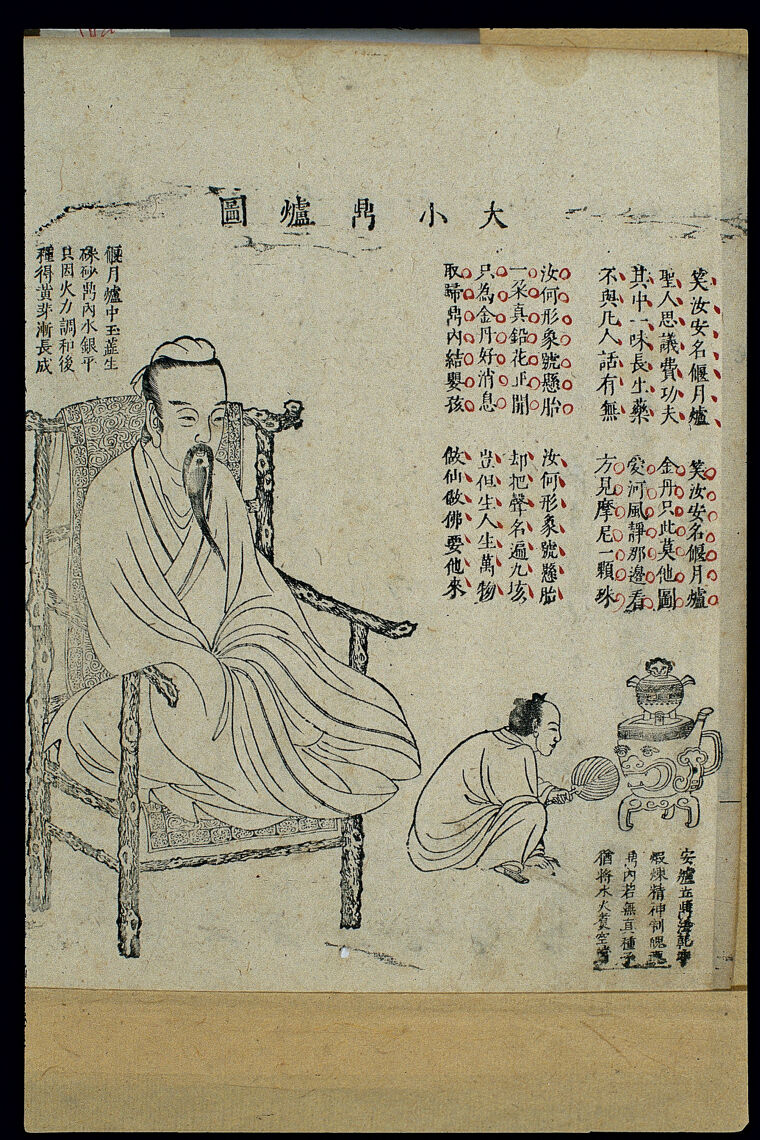
The Great and Small Cauldron and Furnace, from Xingming guizhi, published in 1615. The inscription mentions hun and po alongside the refining of essence and spirit.
Wellcome Collection, Chinese woodcut: Daoist internal alchemy (3). Public Domain Mark. · Image source ↗ · Public Domain
In the library
The Secret of the Golden Flower
Reading note
Read the specific account of Hun and Po in the Wilhelm–Baynes edition.
Sources
See references (8)
- The Secret of the Golden Flower, printed p. 15, Reader page 23The Secret of the Golden Flower: A Chinese Book of Life. Chinese text translated and explained by Richard Wilhelm, English translation by Cary F. Baynes, with separate commentary by C. G. Jung. London, Kegan Paul, Trench, Trubner & Co. Lumitheca Library edition IMJ-0596-E001.Read this page in The Secret of the Golden Flower ↗
- The Secret of the Golden Flower, printed p. 16, Reader page 24The Secret of the Golden Flower: A Chinese Book of Life. Chinese text translated and explained by Richard Wilhelm, English translation by Cary F. Baynes, with separate commentary by C. G. Jung. London, Kegan Paul, Trench, Trubner & Co. Lumitheca Library edition IMJ-0596-E001.Read this page in The Secret of the Golden Flower ↗
- The Secret of the Golden Flower, printed p. 31, Reader page 36The Secret of the Golden Flower: A Chinese Book of Life. Chinese text translated and explained by Richard Wilhelm, English translation by Cary F. Baynes, with separate commentary by C. G. Jung. London, Kegan Paul, Trench, Trubner & Co. Lumitheca Library edition IMJ-0596-E001.Read this page in The Secret of the Golden Flower ↗
- The Secret of the Golden Flower, printed p. 73, Reader page 72The Secret of the Golden Flower: A Chinese Book of Life. Chinese text translated and explained by Richard Wilhelm, English translation by Cary F. Baynes, with separate commentary by C. G. Jung. London, Kegan Paul, Trench, Trubner & Co. Lumitheca Library edition IMJ-0596-E001.Read this page in The Secret of the Golden Flower ↗
- The Secret of the Golden Flower, printed p. 114, Reader page 113The Secret of the Golden Flower: A Chinese Book of Life. Chinese text translated and explained by Richard Wilhelm, English translation by Cary F. Baynes, with separate commentary by C. G. Jung. London, Kegan Paul, Trench, Trubner & Co. Lumitheca Library edition IMJ-0596-E001.Read this page in The Secret of the Golden Flower ↗
- The Secret of the Golden Flower, printed p. 115, Reader page 114The Secret of the Golden Flower: A Chinese Book of Life. Chinese text translated and explained by Richard Wilhelm, English translation by Cary F. Baynes, with separate commentary by C. G. Jung. London, Kegan Paul, Trench, Trubner & Co. Lumitheca Library edition IMJ-0596-E001.Read this page in The Secret of the Golden Flower ↗
- Book of Rites, James Legge translation, Book IX, § 17, printed p. 444 ↗James Legge, The Lî Kî, Part I, Sacred Books of the East 27 (1885).
- Chinese woodcut: Daoist internal alchemy (3) ↗Wellcome Collection, Chinese woodcut: Daoist internal alchemy (3). Public Domain Mark.