The Heavenly Heart in Daoist Inner Alchemy
The Heavenly Heart is a centre of awareness in Daoist inner cultivation. The Secret of the Golden Flower describes it through the space between the eyes and asks how attention can remain centred amid changing sights, thoughts and feelings.
In this article
What is the Heavenly Heart?
The Heavenly Heart is a centre of awareness in The Secret of the Golden Flower. The text locates it symbolically between the eyes, where attention can gather. It gives the ordinary heart a different role, describing how it races in fright or responds to things a person finds appealing. [1][2]
The Heavenly Heart in The Secret of the Golden Flower
In Richard Wilhelm’s translation, rendered into English by Cary F. Baynes, the eyes are the sun and moon and the field between them is called the square inch. The Heavenly Heart is the dwelling and light is its master. Later, the text pictures the ordinary heart as a commander who can usurp the ruler’s authority. [1][2]
The book compares the first point of visual alignment to a mason’s plumb line. Once set, the line lets the mason get on with the work. The account then turns to noticing where a thought begins and fades. A note in the edition connects this combination of steadiness and observation with Tiantai Buddhist meditation. [3][4][6]
Movement has two meanings in the book. It can describe attention scattered by what the eyes and ears follow. In the later alchemical account it can also describe a stirring after stillness, when the light returns and the child comes to life. [2][5]
See references (6)
- The Secret of the Golden Flower, printed p. 24, Reader page 31
- The Secret of the Golden Flower, printed p. 27, Reader page 34
- The Secret of the Golden Flower, printed p. 38, Reader page 43
- The Secret of the Golden Flower, printed p. 39, Reader page 44
- The Secret of the Golden Flower, Backward-Flowing Method chapter, Reader page 62
- The Secret of the Golden Flower, printed p. 72, Reader page 71
The centre in the Three Teachings
In the longer Chinese version studied by Danke Zhang, the author sets Buddhist, Confucian and Daoist names for a centre side by side. Zhang relates the Confucian empty centre to cultivating a balanced disposition. The comparison shows how the text draws on the Three Teachings to explain its own language. [1][7]
How another Daoist text pictures the child
In this Xingming guizhi woodcut, the alchemical infant appears at the abdomen. The Golden Flower associates the child coming to life with a stirring of the Heavenly Heart. The two works place the image of birth at different points in their accounts of inner cultivation. [8][5]
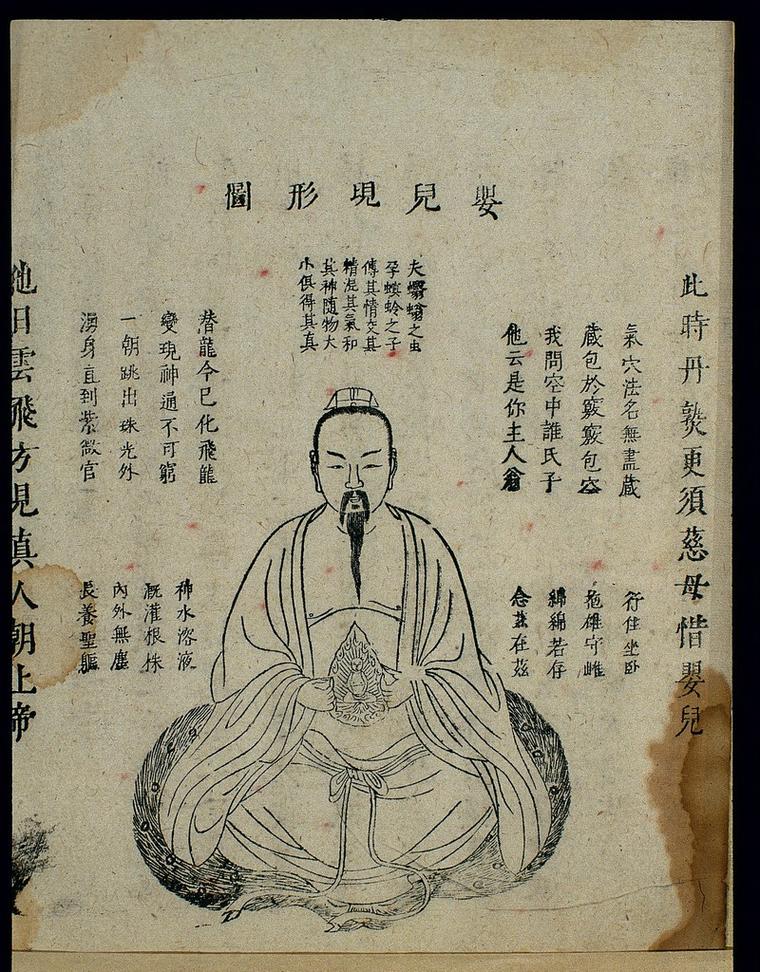
The infant takes form and appears, from the Daoist alchemical work Xingming guizhi, published in 1615. This woodcut provides a comparison for the child imagery in the Golden Flower meditation text.
Wellcome Collection, Chinese woodcut: Daoist internal alchemy (12). Public Domain Mark. · Image source ↗ · Public Domain
In the library
The Secret of the Golden Flower
Reading note
Read the specific account of Heavenly Heart in the Wilhelm–Baynes edition.
Sources
See references (8)
- The Secret of the Golden Flower, printed p. 24, Reader page 31The Secret of the Golden Flower: A Chinese Book of Life. Chinese text translated and explained by Richard Wilhelm, English translation by Cary F. Baynes, with separate commentary by C. G. Jung. London, Kegan Paul, Trench, Trubner & Co. Lumitheca Library edition IMJ-0596-E001.Read this page in The Secret of the Golden Flower ↗
- The Secret of the Golden Flower, printed p. 27, Reader page 34The Secret of the Golden Flower: A Chinese Book of Life. Chinese text translated and explained by Richard Wilhelm, English translation by Cary F. Baynes, with separate commentary by C. G. Jung. London, Kegan Paul, Trench, Trubner & Co. Lumitheca Library edition IMJ-0596-E001.Read this page in The Secret of the Golden Flower ↗
- The Secret of the Golden Flower, printed p. 38, Reader page 43The Secret of the Golden Flower: A Chinese Book of Life. Chinese text translated and explained by Richard Wilhelm, English translation by Cary F. Baynes, with separate commentary by C. G. Jung. London, Kegan Paul, Trench, Trubner & Co. Lumitheca Library edition IMJ-0596-E001.Read this page in The Secret of the Golden Flower ↗
- The Secret of the Golden Flower, printed p. 39, Reader page 44The Secret of the Golden Flower: A Chinese Book of Life. Chinese text translated and explained by Richard Wilhelm, English translation by Cary F. Baynes, with separate commentary by C. G. Jung. London, Kegan Paul, Trench, Trubner & Co. Lumitheca Library edition IMJ-0596-E001.Read this page in The Secret of the Golden Flower ↗
- The Secret of the Golden Flower, Backward-Flowing Method chapter, Reader page 62The Secret of the Golden Flower: A Chinese Book of Life. Chinese text translated and explained by Richard Wilhelm, English translation by Cary F. Baynes, with separate commentary by C. G. Jung. London, Kegan Paul, Trench, Trubner & Co. Lumitheca Library edition IMJ-0596-E001.Read this page in The Secret of the Golden Flower ↗
- The Secret of the Golden Flower, printed p. 72, Reader page 71The Secret of the Golden Flower: A Chinese Book of Life. Chinese text translated and explained by Richard Wilhelm, English translation by Cary F. Baynes, with separate commentary by C. G. Jung. London, Kegan Paul, Trench, Trubner & Co. Lumitheca Library edition IMJ-0596-E001.Read this page in The Secret of the Golden Flower ↗
- Symbolic Transfigurations of Jinhua in The Secret of the Golden Flower, section 4.2 ↗Danke Zhang, Religions 17(1), 113 (2026).
- The infant takes form and appears ↗Wellcome Collection, Chinese woodcut: Daoist internal alchemy (12). Public Domain Mark.