How to Read a Shinto Shrine
Follow an illustrated route through Tokyo’s Meiji Jingū and learn what the torii, purification basin, guardian figures and worship buildings do.
In this article
Follow the southern approach at Meiji Jingū
Use this route to recognise what you pass and where visitors pause. Select a stop for the building or practice it introduces.
- From Harajuku
Southern entrance torii
Pass through the first wooden gate
The southern route begins under the torii with three chrysanthemum crests. - On the approach
Great torii
Follow the forest path to the junction
The north and south approaches meet at the ōtorii. - Before worship
Temizuya
Pause for water purification
Meiji Jingū describes washing the hands and rinsing the mouth here. - At the courtyard
Third torii and Minami Shinmon
Enter the main shrine enclosure
The roofed southern gate follows the third torii. - At the main shrine
Outer worship hall
Stop at the visitor prayer area
The gehaiden is the visitor prayer area. The kami are enshrined in the honden.
What does the torii mark?
At the Harajuku end of Meiji Jingū’s southern approach, a wooden torii marks entry into the shrine precinct. Stand back far enough to see the two upright posts, both horizontal members and the curve of the upper lintel. Three chrysanthemum crests connect the entrance to the shrine’s imperial association. Visitors may bow before passing through. [1][5][8]
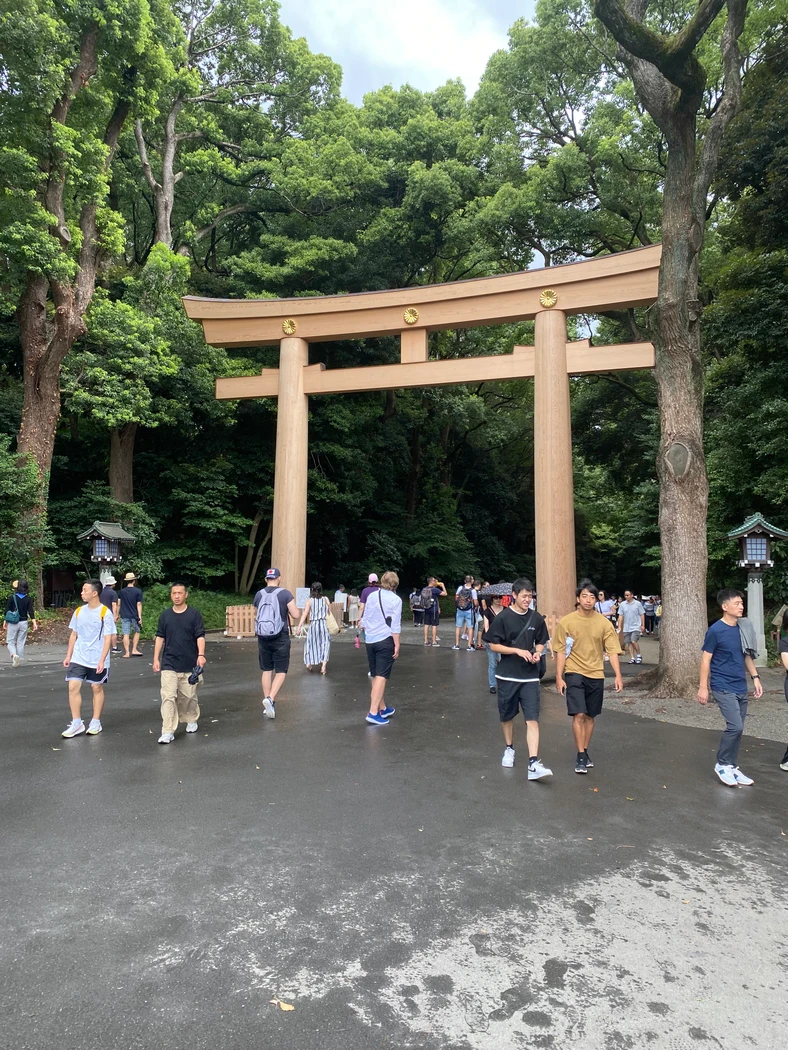
At Meiji Jingū’s southern entrance, the curved lintel and three gold chrysanthemum crests distinguish the first torii on the route.
Immanuelle, Meiji Jingu entrance torii, 14 August 2023, Wikimedia Commons. Resized and converted to WebP. CC BY-SA 4.0. · Image source ↗ · CC BY-SA 4.0
Why are there several torii on the route?
Farther along the approach, the path meets the great torii, or ōtorii. Meiji Jingū identifies it by the junction of the northern and southern approaches. A second gate along the same route shows how a torii can mark a further threshold inside a precinct already entered. [1][2]
What happens at the temizuya?
Before the main shrine buildings, look for the temizuya, the shelter for ritual washing. Meiji Jingū describes washing the hands and rinsing the mouth before prayer and welcomes participation regardless of faith. The shrine’s illustrated guidance shows the sequence it currently asks visitors to follow. At the basin itself, use the directions posted for the facilities available that day. [1][3]
From the inner torii to the southern gate
After the third torii comes the Minami Shinmon, the two-storey southern gate. The torii’s open form marks a crossing. The roofed shinmon admits visitors to the enclosure around the main shrine buildings. Look at what changes as the open forest path becomes a courtyard with a defined entrance. [1][2]
Which building is for prayer?
The haiden is a worship hall. At Meiji Jingū, the gehaiden, or outer worship hall, is where visitors pray. The honden is the most sacred building, where the kami are enshrined. Read the two names together when looking at a plan. They help explain why a visitor’s stopping point and the inner sanctuary occupy different places. [1]
At the worship area, Meiji Jingū describes two bows, two claps and a final bow. It also asks visitors to keep photos and videos away from the main sanctuary where people pray. These instructions describe this shrine. Follow the guidance of the shrine you are visiting, especially when a ceremony is in progress. [3][4]
How to recognise komainu
Komainu are guardian lion-dogs often associated with the approach to a shrine. Begin with the mouths on the two Kamakura-period figures. The open and closed forms make a pair. The museum compares this pattern with the paired guardians of Buddhist temples. Keep the object, its date and its museum record in view, since a matching feature alone cannot tell you where an individual sculpture stood. [7][9]
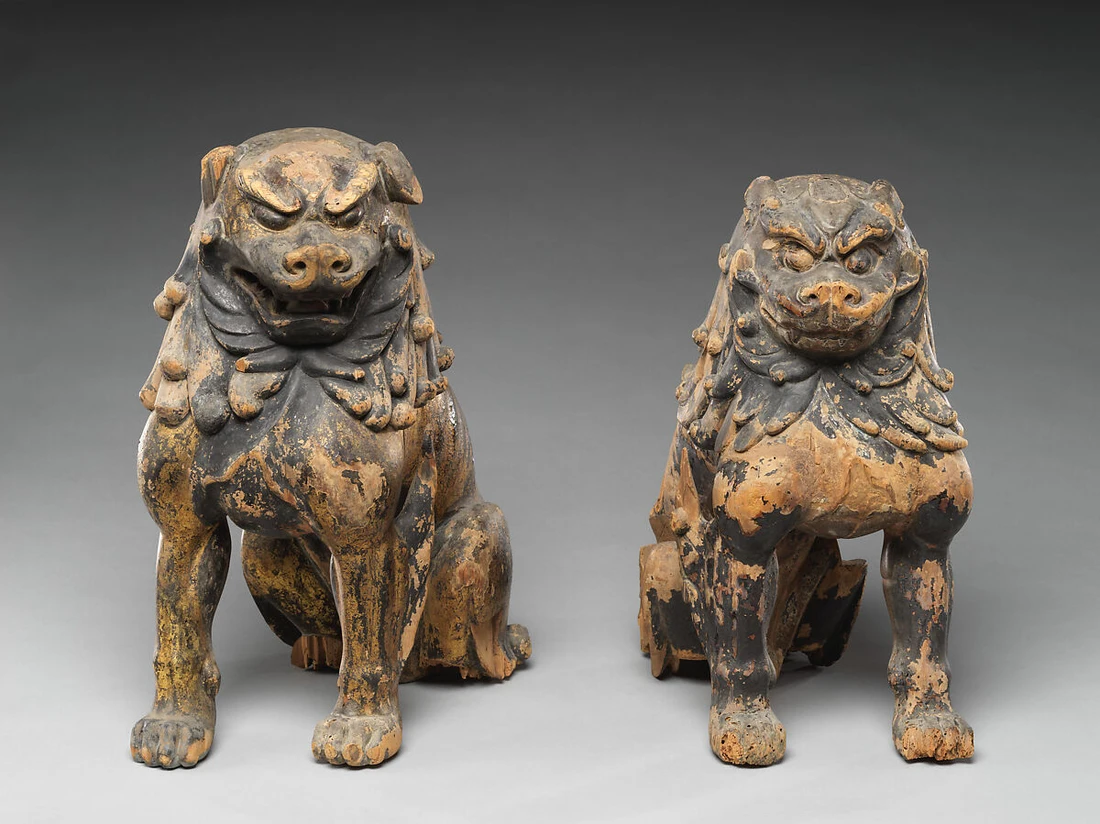
Compare the mouths of the two lion-dogs. One opens to form a; the other closes for un. The museum pair illustrates the guardian type independently of the Meiji Jingū route.
Japan, Kamakura period, mid-thirteenth century. Cypress with lacquer, gold leaf and colour. The Metropolitan Museum of Art, 2015.300.257a, b. Public domain. · Image source ↗ · Public Domain
See references (2)
Why shrine approaches differ
At Ise Jingū’s Naikū, the visitor route begins with Uji Bridge. The shrine directs readers to the Isuzu River ritual washing place, in a setting shaped by the river. Compare this with the purification shelter near Meiji Jingū’s main buildings. Both approaches connect movement through a landscape with ritual preparation, using different features of the grounds. [6][1]
Hadland Davis records a bird-perch origin story for torii and also quotes writers who dispute it. On the next page, he turns to the waterside torii at Itsukushima. Read those pages as a historical record of competing interpretations, then return to the modern precinct map for the documented function of each gate at Meiji Jingū. [11][12][1]
In Hokusai’s print, visitors and a shrine approach share the image. It offers an earlier artistic view of shrine-going. Compare the print’s attention to visitors with the contemporary gate photograph and the plan, each of which makes a different detail of the visit visible. [10][8][1]
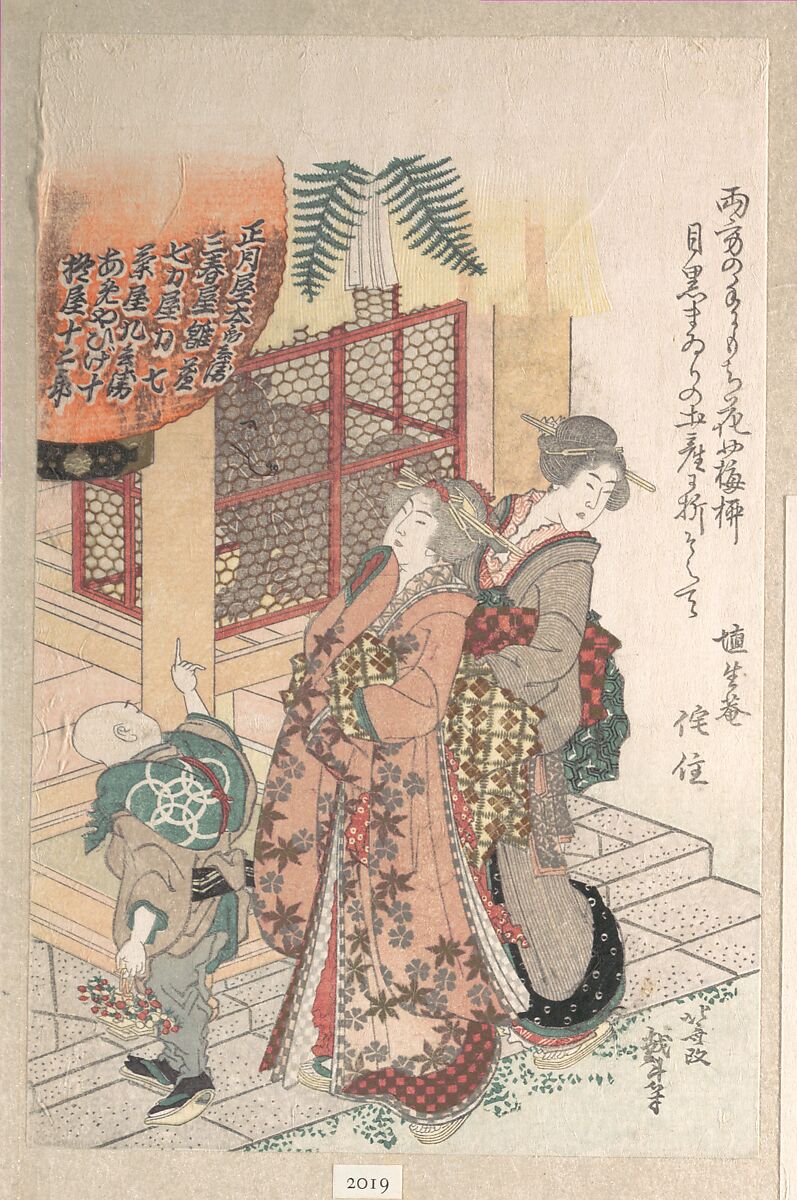
Katsushika Hokusai, Young Women Visiting a Shinto Shrine, 1814. This colour woodblock print depicts a New Year shrine visit in the Edo period.
The Metropolitan Museum of Art, JP2019. H. O. Havemeyer Collection, Bequest of Mrs. H. O. Havemeyer, 1929. · Image source ↗ · CC0
See references (6)
Read further in the library

Myths and Legends of Japan
Reading note
Read how Hadland Davis recorded competing origin stories and described the torii at Itsukushima.
Sources
See references (12)
- Meiji Jingū’s precinct map and building descriptions ↗Meiji Jingū.Return to text ↑
- The southern approach and entrance to the main shrine ↗Meiji Jingū Forest Festival of Art.Return to text ↑
- Meiji Jingū’s guidance on purification and prayer ↗Meiji Jingū’s Japanese visitor guide.Return to text ↑
- Meiji Jingū’s precinct etiquette ↗Meiji Jingū.Return to text ↑
- Entering a Jinja ↗Jinja Honchō, Association of Shinto Shrines.Return to text ↑
- Naikū model route, Uji Bridge and the Isuzu River ↗Ise Jingū.Return to text ↑
- Komainu ↗Encyclopedia of Shinto, Kokugakuin University.Return to text ↑
- 2023 photograph of the southern entrance torii ↗Immanuelle, Meiji Jingu entrance torii, 14 August 2023, Wikimedia Commons. Resized and converted to WebP. CC BY-SA 4.0.Return to text ↑
- Guardian Lion-Dogs ↗Japan, Kamakura period, mid-thirteenth century. Cypress with lacquer, gold leaf and colour. The Metropolitan Museum of Art, 2015.300.257a, b. Public domain.Return to text ↑
- Young Women Visiting a Shinto Shrine ↗The Metropolitan Museum of Art, JP2019. H. O. Havemeyer Collection, Bequest of Mrs. H. O. Havemeyer, 1929.Return to text ↑
- The torii and competing origin stories · printed p. 226F. Hadland Davis, Myths and Legends of Japan, Chapter XI, Lumitheca Library facsimile.Read this page in Myths and Legends of Japan ↗Return to text ↑
- Itsukushima’s waterside torii · printed p. 227F. Hadland Davis, Myths and Legends of Japan, Chapter XI, Lumitheca Library facsimile.Read this page in Myths and Legends of Japan ↗Return to text ↑