Holy Orders
What are Holy Orders? Explore bishops, priests and deacons, the laying on of hands, and Leadbeater’s account of what ordination confers.
In this article
What are Holy Orders?
Holy Orders is the sacrament through which bishops, priests and deacons enter an ordained ministry. Roman Catholic and Orthodox churches recognize these three orders. The Church of England likewise has separate ordination services for them. Prayer and the laying on of hands are central to the rites. [1][2][3]
A bishop oversees the life of the Church, a priest has particular responsibility for preaching and sacramental worship, and a deacon is ordained to serve. The duties and how they are shared vary by church. [1][3]
The Science of the Sacraments by Charles W. Leadbeater
Charles W. Leadbeater treats ordination as giving someone capacities suited to their office. In his diagram, a deacon can draw on the rim of a spiritual reservoir and a priest on its main body. He gives the priest powers of blessing, absolution and celebrating the Eucharist, and says how well a person uses them depends on the individual. [4][5][6][7]
Leadbeater gives the laying on of hands and the anointing distinct roles. In his account, laying hands on a priest opens a relationship with Christ. Anointing the new priest’s hands sets them apart for what they will do, including touching the consecrated Host. The photograph shows the laying on of hands at a bishop’s consecration. [8][9][10][11][12][13][14]
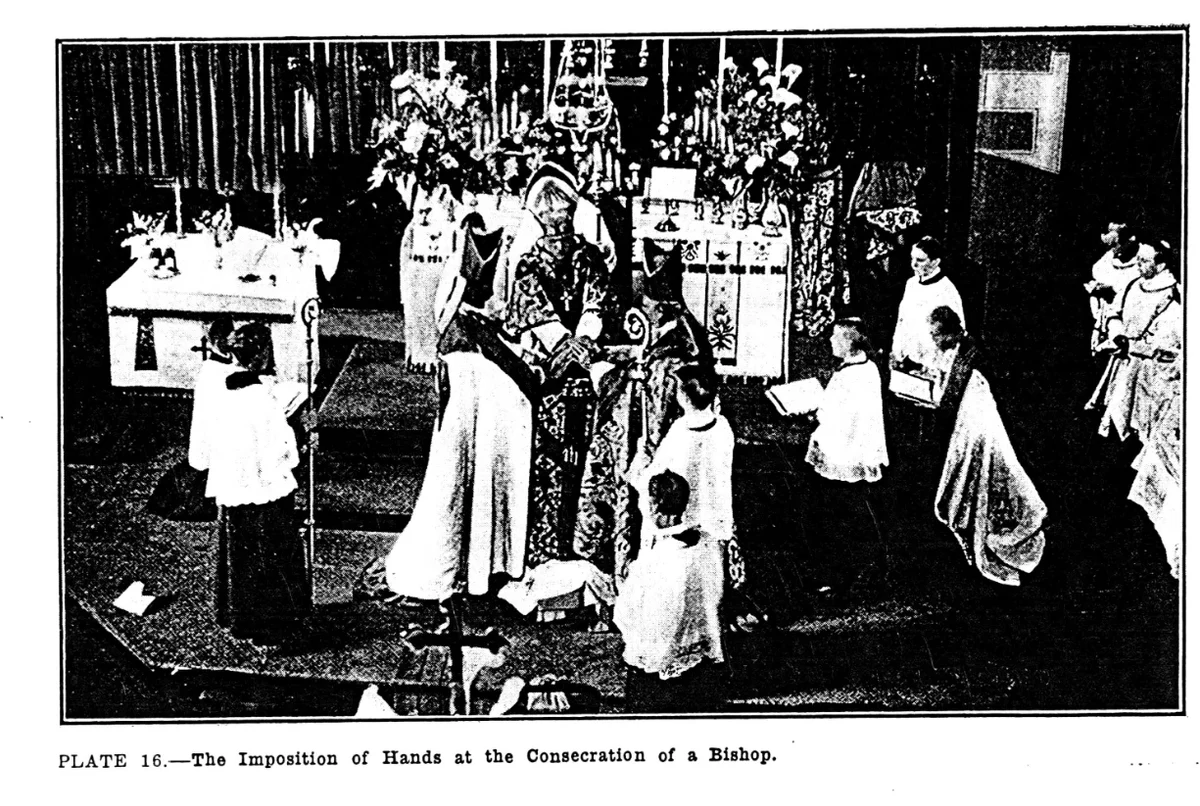
Plate 16, facing printed page 356, shows the imposition of hands at the consecration of a bishop.
The Science of the Sacraments by Charles W. Leadbeater, The St. Alban Press, 1920. Library facsimile. · Image source ↗ · Public Domain
See references (11)
- The Science of the Sacraments, printed p. 308, Reader page 320
- The Science of the Sacraments, printed p. 309, Reader page 321
- The Science of the Sacraments, printed p. 310, Reader page 322
- The Science of the Sacraments, printed p. 311, Reader page 323
- The Science of the Sacraments, printed p. 338, Reader page 350
- The Science of the Sacraments, printed p. 339, Reader page 351
- The Science of the Sacraments, printed p. 340, Reader page 352
- The Science of the Sacraments, printed p. 342, Reader page 354
- The Science of the Sacraments, printed p. 344, Reader page 356
- The Science of the Sacraments, printed p. 345, Reader page 357
- The Science of the Sacraments, Reader page 369
The office and the capacity to serve
The Church of England’s ordination services name the duties of an office and pray for the Spirit’s aid. Leadbeater also describes service and uses the reservoir image to explain the capacities he believes ordination confers. [3][4][5][6][8]
See references (5)
In the library
The Science of the Sacraments
Reading note
The separately titled account draws on exact passages in the consulted Library edition.
Sources
See references (14)
- Catechism of the Catholic Church, §§1554–1571 ↗Holy See, Catechism of the Catholic Church, English edition.
- The Orthodox Faith, Holy Orders ↗Orthodox Church in America, The Orthodox Faith, vol. II.
- Common Worship Ordination Services ↗Church of England, Common Worship.
- The Science of the Sacraments, printed p. 308, Reader page 320Charles W. Leadbeater, The Science of the Sacraments, The St. Alban Press, 1920. Exact Library edition IMJ-0615-E001.Read this page in The Science of the Sacraments ↗
- The Science of the Sacraments, printed p. 309, Reader page 321Charles W. Leadbeater, The Science of the Sacraments, The St. Alban Press, 1920. Exact Library edition IMJ-0615-E001.Read this page in The Science of the Sacraments ↗
- The Science of the Sacraments, printed p. 310, Reader page 322Charles W. Leadbeater, The Science of the Sacraments, The St. Alban Press, 1920. Exact Library edition IMJ-0615-E001.Read this page in The Science of the Sacraments ↗
- The Science of the Sacraments, printed p. 311, Reader page 323Charles W. Leadbeater, The Science of the Sacraments, The St. Alban Press, 1920. Exact Library edition IMJ-0615-E001.Read this page in The Science of the Sacraments ↗
- The Science of the Sacraments, printed p. 338, Reader page 350Charles W. Leadbeater, The Science of the Sacraments, The St. Alban Press, 1920. Exact Library edition IMJ-0615-E001.Read this page in The Science of the Sacraments ↗
- The Science of the Sacraments, printed p. 339, Reader page 351Charles W. Leadbeater, The Science of the Sacraments, The St. Alban Press, 1920. Exact Library edition IMJ-0615-E001.Read this page in The Science of the Sacraments ↗
- The Science of the Sacraments, printed p. 340, Reader page 352Charles W. Leadbeater, The Science of the Sacraments, The St. Alban Press, 1920. Exact Library edition IMJ-0615-E001.Read this page in The Science of the Sacraments ↗
- The Science of the Sacraments, printed p. 342, Reader page 354Charles W. Leadbeater, The Science of the Sacraments, The St. Alban Press, 1920. Exact Library edition IMJ-0615-E001.Read this page in The Science of the Sacraments ↗
- The Science of the Sacraments, printed p. 344, Reader page 356Charles W. Leadbeater, The Science of the Sacraments, The St. Alban Press, 1920. Exact Library edition IMJ-0615-E001.Read this page in The Science of the Sacraments ↗
- The Science of the Sacraments, printed p. 345, Reader page 357Charles W. Leadbeater, The Science of the Sacraments, The St. Alban Press, 1920. Exact Library edition IMJ-0615-E001.Read this page in The Science of the Sacraments ↗
- The Science of the Sacraments, Reader page 369Charles W. Leadbeater, The Science of the Sacraments, The St. Alban Press, 1920. Exact Library edition IMJ-0615-E001.Read this page in The Science of the Sacraments ↗