Hibutsu
A hibutsu is a Japanese Buddhist image usually kept from view, sometimes unveiled on special occasions.
In this article
What is a hibutsu?
A hibutsu is a Buddhist image that a Japanese temple usually keeps concealed. It can be the temple’s principal object of worship even while housed in a closed shrine. Devotees may pray before a separate visible image, and the hidden one may be unveiled on particular occasions. [1][3]
In Ancient Tales and Folk-lore of Japan
In Richard Gordon Smith’s The Spirit of Yenoki, the temple’s image of Fudō Myōō remains concealed even from Yenoki, who has helped guard it for twenty years. When he finds the shrine door ajar, he looks inside and sees nothing. He turns back to the light and discovers he has lost sight in that eye. [2][3]
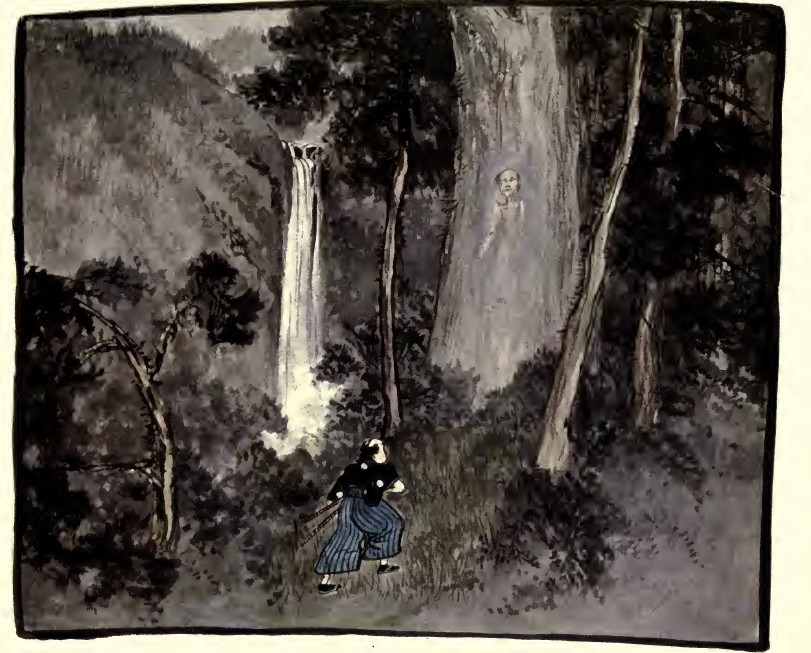
The 1908 plate depicts Yenoki’s appearance later in the story. Fudō’s concealed image stays out of view.
Mo-No-Yuki, after a sketch by Richard Gordon Smith, The spirit of Yenoki appears to Sonobe, 1908. California Digital Library scan via Internet Archive. Public domain. · Image source ↗ · Public Domain
In the library
Ancient Tales and Folk-lore of Japan
Reading note
Read Richard Gordon Smith’s account in the verified 1908 Library edition.
Sources
See references (4)
- The Unveiling of the Sacred Kannon ↗Ishiyamadera
- Ancient Tales and Folklore of Japan, printed p. 259, Reader page 359Richard Gordon Smith, Ancient Tales and Folklore of Japan. A. & C. Black, London, 1908. Lumitheca Library edition IMJ-0588-E001.Read this page in Ancient Tales and Folk-lore of Japan ↗
- Ancient Tales and Folklore of Japan, printed p. 260, Reader page 360Richard Gordon Smith, Ancient Tales and Folklore of Japan. A. & C. Black, London, 1908. Lumitheca Library edition IMJ-0588-E001.Read this page in Ancient Tales and Folk-lore of Japan ↗
- The spirit of Yenoki appears to Sonobe ↗Mo-No-Yuki, after a sketch by Richard Gordon Smith, The spirit of Yenoki appears to Sonobe, 1908. California Digital Library scan via Internet Archive. Public domain.