Hermeticism and The Kybalion
Compare ancient Hermetic dialogues with the seven principles of The Kybalion, and trace mind, correspondence and rebirth to their sources.
In this article
Read the sources side by side
Open the texts first, then compare how each account uses mind, analogy and transformation.
Ancient Hermetic dialogues and the 1908 book
Each row paraphrases the original passages. Use the links to read the selections directly.
Mind
- Corpus Hermeticum
- Poimandres leads the narrator through a vision and interprets what he sees.
- The Kybalion
- The first principle and chapter V describe the universe as a creation in the mind of the All.
How knowledge is organised
- Corpus Hermeticum
- The selections follow separate dialogues with their own speakers and purposes.
- The Kybalion
- Chapter II presents seven principles as a single organising scheme.
Transformation
- Corpus Hermeticum
- In Corpus Hermeticum XIII, Tat learns about rebirth and the arrival of divine powers.
- The Kybalion
- Chapter III defines mental transmutation as changing states and conditions of mind.
How do Hermeticism and The Kybalion differ?
The Corpus Hermeticum is a collection of ancient Greek dialogues and discourses attributed to Hermes Trismegistus. The Kybalion is a book published in Chicago in 1908 under the name Three Initiates. Its seven principles are the organising scheme of that book. Call both Hermetic only if you also say which texts and period you mean. [1][2][7][3]
The most revealing comparisons come from words both traditions use. Read what each passage asks the reader to understand or do. That brings out differences which a list of shared terms can conceal. [1][2][3][4]
Divine mind and the mental universe
The first Hermetic dialogue begins with an encounter. The narrator’s ordinary senses grow quiet and Poimandres teaches through a vision of light, darkness and a cosmos coming into being. Mind matters to how the vision is understood. The narrative moves between seeing, asking and learning. [1]
The Kybalion makes Mentalism its first principle. Chapter V asks readers to think of the universe as existing in the mind of the All and uses the formation of a mental image as an analogy. The ancient dialogue discloses its ideas through an encounter, while the modern chapter develops a proposition through a comparison with ordinary thinking. [1][3][5]
Where does “as above, so below” belong?
The Emerald Tablet supplies an older comparison between what is above and what is below. In Isaac Newton’s English manuscript, the clause belongs to a short alchemical text. Look at what follows it, including separation, ascent and descent. The Kybalion sets a similar phrase under its second principle and uses it to explain correspondence across physical, mental and spiritual planes. [8][3][6]
On printed pages 106–107 of Transcendental Magic, Lévi quotes the Tablet’s directions for separating and recombining and reads the first operation as interior work. On the second page he explicitly uses analogy between what is above and what is below. These pages give an example of Hermetic reception before the 1908 book. They also show that one historical reader could relate alchemy and ethical self-formation in a single passage. [11][12][6]
Spiritual rebirth and mental transmutation
In Corpus Hermeticum XIII, Tat asks Hermes about rebirth. The dialogue describes powers entering and driving out afflictions. The process changes what Tat understands himself to be and ends in praise. Read the movement from question to transformation to hymn before comparing it with a later technique. [2]
Chapter III of The Kybalion defines mental transmutation as changing mental states and conditions. Its language is that of an art to be learned. The ancient dialogue and the modern chapter both promise transformation, but place it in different settings and give different accounts of what changes. [2][4]
From ancient dialogues to the Chicago edition
The Venetian leaf and the Chicago title page give the comparison two visible dates. The first belongs to Ficino’s Latin transmission of ancient dialogues. The second belongs to a separately published English book with its own authorship statement and structure. Read the imprints together to see how each object locates itself for a new audience. [9][10][7]
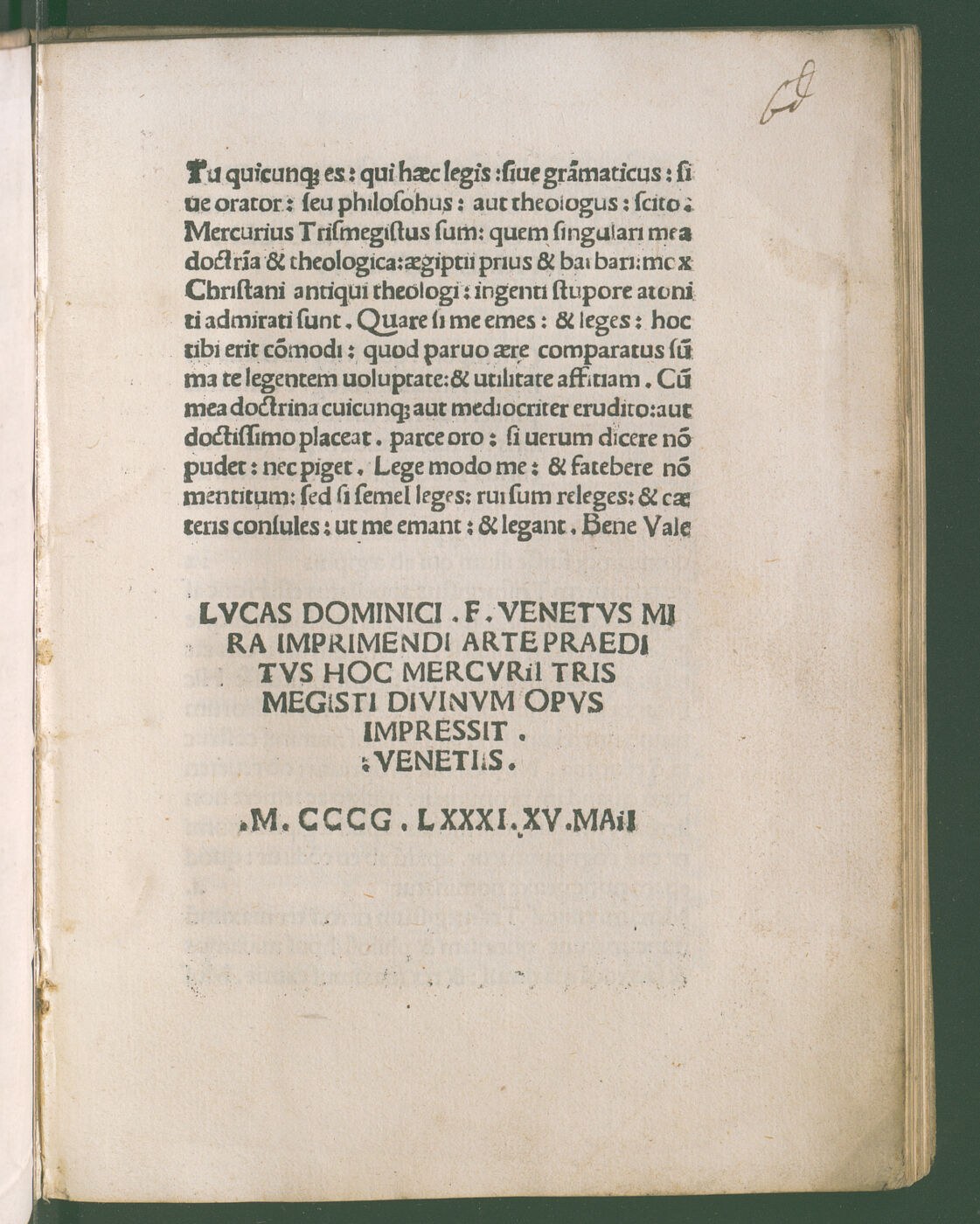
Leaf with a Latin address to readers and the printer’s imprint. Marsilio Ficino’s Latin translation, printed in Venice in 1481.
Wellcome Collection. Public Domain. · Image source ↗ · Public Domain
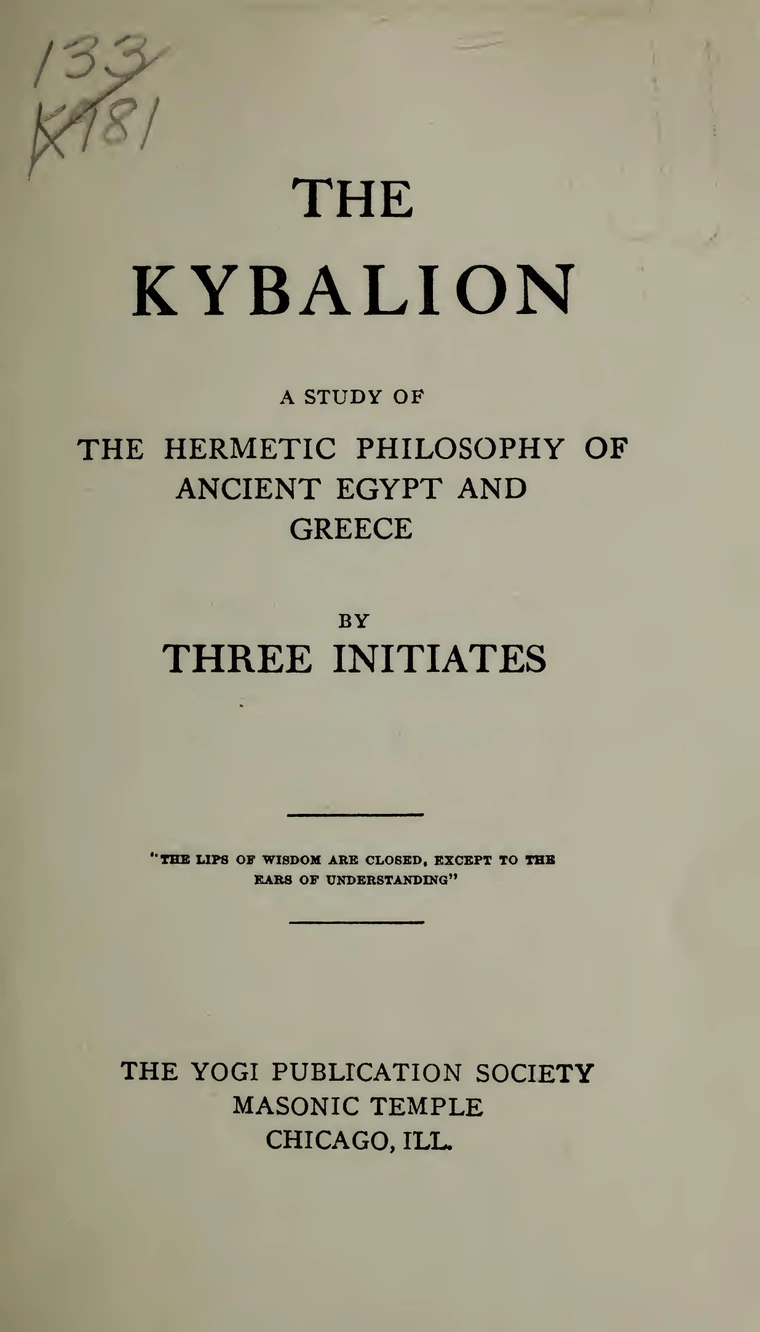
The title page names Three Initiates and gives the Yogi Publication Society’s address at Chicago’s Masonic Temple.
Three Initiates, The Kybalion. Chicago, Yogi Publication Society, 1908. Internet Archive via Wikimedia Commons. Public domain. · Image source ↗ · Public Domain
- Roman period
Greek Hermetic dialogues circulate
Poimandres frames divine knowledge as a revelation and dialogue. [1]
- 1481
Ficino’s Latin Pimander appears in Venice
The surviving Venetian printing documents one stage of the dialogues’ Latin reception. [9]
- 1896
- 1908
See references (7)
- Corpus Hermeticum I · Poimandres, selections from §§1–7
- The Kybalion II · The Seven Hermetic Principles
- The Kybalion · historic Chicago edition
- Ficino’s Latin Pimander, Venice, 1481
- The title page of The Kybalion, Chicago, 1908
- Transcendental Magic, printed p. 106, Reader page 132
- Transcendental Magic, printed p. 107, Reader page 133
Read further in the library
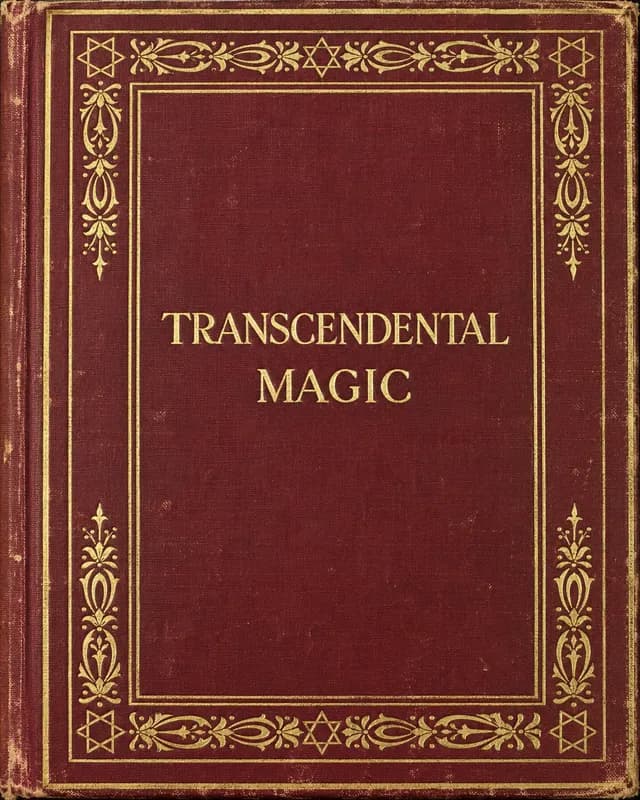
Transcendental Magic
Reading note
Compare the Emerald Tablet with Lévi’s interpretation of the Great Work in the 1896 English edition.
Sources
See references (12)
- Corpus Hermeticum I · Poimandres, selections from §§1–7 ↗Matthew Andrews, selections translated from the Greek, Harvard Center for the Study of World Religions.Return to text ↑
- Corpus Hermeticum XIII · rebirth and the powers ↗Harvard Center for the Study of World Religions, Greek Hermetic excerpts and commentary.Return to text ↑
- The Kybalion II · The Seven Hermetic Principles ↗Three Initiates, The Kybalion (1908).Return to text ↑
- The Kybalion III · Mental Transmutation ↗Three Initiates, The Kybalion (1908).Return to text ↑
- The Kybalion V · The Mental Universe ↗Three Initiates, The Kybalion (1908).Return to text ↑
- The Kybalion VIII · Planes of Correspondence ↗Three Initiates, The Kybalion (1908).Return to text ↑
- The Kybalion · historic Chicago edition ↗Three Initiates, Yogi Publication Society, Chicago, 1908.Return to text ↑
- Keynes MS 28, fol. 2r · Newton’s English Emerald Tablet ↗The Chymistry of Isaac Newton Project, Indiana University.Return to text ↑
- Ficino’s Latin Pimander, Venice, 1481 ↗Wellcome Collection. Public Domain.Return to text ↑
- The title page of The Kybalion, Chicago, 1908 ↗Three Initiates, The Kybalion. Chicago, Yogi Publication Society, 1908. Internet Archive via Wikimedia Commons. Public domain.Return to text ↑
- Transcendental Magic, printed p. 106, Reader page 132Éliphas Lévi, translated by Arthur Edward WaiteReturn to text ↑
Examine the original Library page
inscribed upon an emerald tablet
Open the original page in Transcendental Magic ↗Scan leaf 138 · Éliphas Lévi
- Transcendental Magic, printed p. 107, Reader page 133Éliphas Lévi, translated by Arthur Edward WaiteReturn to text ↑
Examine the original Library page
That which is above is proportional to that which is below
Open the original page in Transcendental Magic ↗Scan leaf 139 · Éliphas Lévi