Heiau
A heiau is a Hawaiian place of worship or ceremony. Compare Puʻukoholā, the royal burial site at Hōnaunau and places for surfing and chiefly worship.
In this article
What is a heiau?
A heiau is a Hawaiian place of worship or ceremony. Some were associated with fishing or surfing, while others served chiefly rites. At Keolonāhihi in Kona, a record drawing on local kūpuna knowledge describes a named place associated with surfing, a place of worship for aliʻi wāhine and a luakini for rites of the highest chiefs. [6][1][3]
Puʻukoholā Heiau and Hale o Keawe
At Kawaihae, Kamehameha built Puʻukoholā Heiau in 1790–1791 and dedicated it to his family’s war god, Kūkāʻilimoku. At Hōnaunau, Hale o Keawe is a reconstructed consecrated house on the site where chiefly remains were cared for. Hawaiians still revere the place and sometimes leave hoʻokupu, or offerings. [4][3][16]
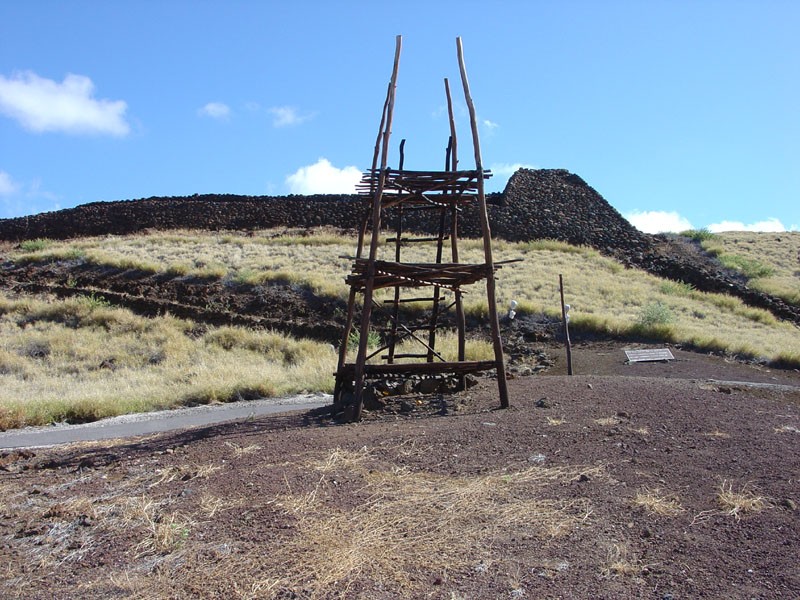
Puʻukoholā Heiau at Kawaihae, with an offering platform in the foreground. Photographed around 2003.
Photograph by Phil Stoffer, USGS. Public domain. · Image source ↗ · Public Domain
The Legends and Myths of Hawaii by David Kalākaua
In the introduction to David Kalākaua’s The Legends and Myths of Hawaii, Rollin Mallory Daggett describes the stone walls, altar and oracle enclosure of major heiau. Elsewhere he describes smaller shrines associated with fishing. [6][7]
In the story of ʻUmi, Līloa takes a high priest to reconsecrate Manini. A long prayer accompanies the dedication. Later, at Paʻakalani, a ruler asks for an augury and the narrative eventually identifies Nunu as the voice from the enclosure. [8][9][10][11][12]
Paʻakalani also contains a sanctuary in the story of Kīha-pū. When a prisoner is brought there, the chief has to reckon with the protection the place can give him. [13][14]
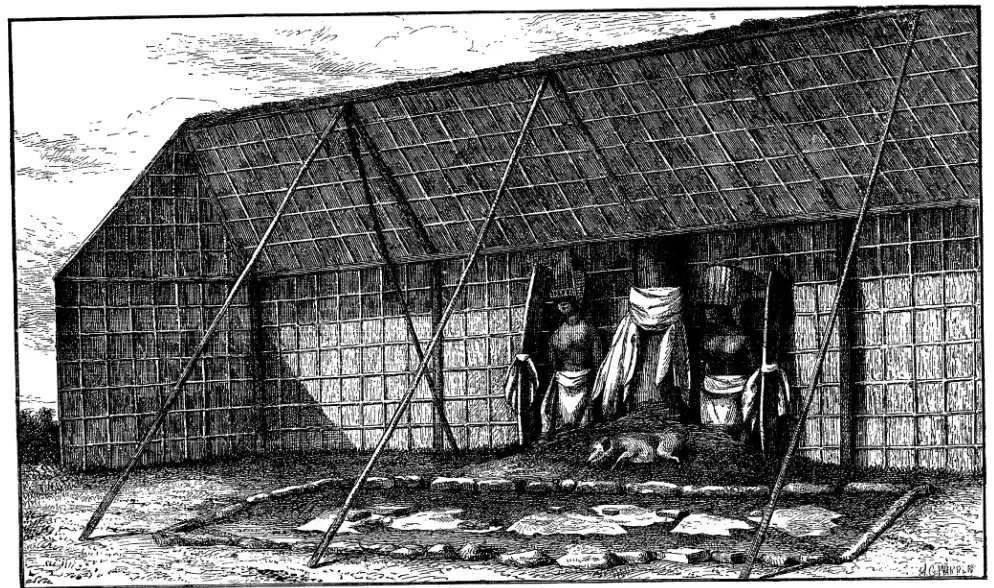
Interior of an Ancient Temple, an illustration reproduced in the 1888 edition.
The Legends and Myths of Hawaii, Charles L. Webster & Company, 1888. Public domain. Cropped from the Library scan. · Image source ↗ · Public Domain
See references (9)
- The Legends and Myths of Hawaii, Reader page 45
- The Legends and Myths of Hawaii, printed p. 45, Reader page 46
- The Legends and Myths of Hawaii, Reader page 268
- The Legends and Myths of Hawaii, Reader page 299
- The Legends and Myths of Hawaii, Reader page 300
- The Legends and Myths of Hawaii, Reader page 301
- The Legends and Myths of Hawaii, Reader page 302
- The Legends and Myths of Hawaii, Reader page 265
- The Legends and Myths of Hawaii, Reader page 266
Who worshipped at each heiau?
Daggett describes limits on women’s participation in the ceremonies he discusses. At Keolonāhihi, the local record names a site used for the worship of chiefly women. Both accounts describe access in connection with particular places and rites. [7][15][1]
At Puʻukoholā the dedication is tied to chiefly power. At Hōnaunau, care for ancestors and the nearby refuge shaped how the site was used. Stone walls and altars can help identify a place, and its history explains what people came there to do. [7][15][2][3]
Read further in the library
The Legends and Myths of Hawaii
Reading note
The separately titled account draws on exact passages in the consulted Library edition.
Sources
See references (16)
- Echoing Wahi Kūpuna ↗Kaʻiwakīloumoku, Hawaiian Cultural Center, account of Keolonāhihi based on Henry P. Kekahuna’s records and local kūpuna knowledge.Return to text ↑
- Puʻuhonua o Hōnaunau National Historical Park Foundation Document ↗National Park Service, park significance statements concerning sanctuary, cultural continuity and the stone wall.Return to text ↑
- Hale o Keawe and the Great Wall in the park collections ↗National Park Service, “Hale o Keawe” and “The Great Wall” sections.Return to text ↑
- Puʻukoholā Heiau, Kawaihae ↗National Park Service site history, construction dates and the dedication to Kamehameha’s family war god.Return to text ↑
- Interior of an Ancient Temple ↗The Legends and Myths of Hawaii, Charles L. Webster & Company, 1888. Public domain. Cropped from the Library scan.
- The Legends and Myths of Hawaii, Reader page 45David Kalākaua, The Legends and Myths of Hawaii, edited with an introduction by Rollin Mallory Daggett, Charles L. Webster & Company, 1888. Exact Library edition IMJ-0646-E001. When the introduction or a signed editorial passage is used, its author is identified in the article.Read this page in The Legends and Myths of Hawaii ↗Return to text ↑
- The Legends and Myths of Hawaii, printed p. 45, Reader page 46David Kalākaua, The Legends and Myths of Hawaii, edited with an introduction by Rollin Mallory Daggett, Charles L. Webster & Company, 1888. Exact Library edition IMJ-0646-E001. When the introduction or a signed editorial passage is used, its author is identified in the article.Read this page in The Legends and Myths of Hawaii ↗Return to text ↑
- The Legends and Myths of Hawaii, Reader page 268David Kalākaua, The Legends and Myths of Hawaii, edited with an introduction by Rollin Mallory Daggett, Charles L. Webster & Company, 1888. Exact Library edition IMJ-0646-E001. When the introduction or a signed editorial passage is used, its author is identified in the article.Read this page in The Legends and Myths of Hawaii ↗Return to text ↑
- The Legends and Myths of Hawaii, Reader page 299David Kalākaua, The Legends and Myths of Hawaii, edited with an introduction by Rollin Mallory Daggett, Charles L. Webster & Company, 1888. Exact Library edition IMJ-0646-E001. When the introduction or a signed editorial passage is used, its author is identified in the article.Read this page in The Legends and Myths of Hawaii ↗Return to text ↑
- The Legends and Myths of Hawaii, Reader page 300David Kalākaua, The Legends and Myths of Hawaii, edited with an introduction by Rollin Mallory Daggett, Charles L. Webster & Company, 1888. Exact Library edition IMJ-0646-E001. When the introduction or a signed editorial passage is used, its author is identified in the article.Read this page in The Legends and Myths of Hawaii ↗Return to text ↑
- The Legends and Myths of Hawaii, Reader page 301David Kalākaua, The Legends and Myths of Hawaii, edited with an introduction by Rollin Mallory Daggett, Charles L. Webster & Company, 1888. Exact Library edition IMJ-0646-E001. When the introduction or a signed editorial passage is used, its author is identified in the article.Read this page in The Legends and Myths of Hawaii ↗Return to text ↑
- The Legends and Myths of Hawaii, Reader page 302David Kalākaua, The Legends and Myths of Hawaii, edited with an introduction by Rollin Mallory Daggett, Charles L. Webster & Company, 1888. Exact Library edition IMJ-0646-E001. When the introduction or a signed editorial passage is used, its author is identified in the article.Read this page in The Legends and Myths of Hawaii ↗Return to text ↑
- The Legends and Myths of Hawaii, Reader page 265David Kalākaua, The Legends and Myths of Hawaii, edited with an introduction by Rollin Mallory Daggett, Charles L. Webster & Company, 1888. Exact Library edition IMJ-0646-E001. When the introduction or a signed editorial passage is used, its author is identified in the article.Read this page in The Legends and Myths of Hawaii ↗Return to text ↑
- The Legends and Myths of Hawaii, Reader page 266David Kalākaua, The Legends and Myths of Hawaii, edited with an introduction by Rollin Mallory Daggett, Charles L. Webster & Company, 1888. Exact Library edition IMJ-0646-E001. When the introduction or a signed editorial passage is used, its author is identified in the article.Read this page in The Legends and Myths of Hawaii ↗Return to text ↑
- The Legends and Myths of Hawaii, Reader page 47David Kalākaua, The Legends and Myths of Hawaii, edited with an introduction by Rollin Mallory Daggett, Charles L. Webster & Company, 1888. Exact Library edition IMJ-0646-E001. When the introduction or a signed editorial passage is used, its author is identified in the article.Read this page in The Legends and Myths of Hawaii ↗Return to text ↑
- Phil Stoffer, Puʻukoholā Heiau and offering platform, U.S. Geological Survey, c. 2003 ↗Photograph by Phil Stoffer, USGS. Public domain.Return to text ↑