The twelve hours in order
Start with the sun boat in the middle register. The figures above and below it help identify each episode. The links open the corresponding chapter and illustrations in E. A. Wallis Budge’s 1905 edition.
The western entrance
The ram-headed sun god enters in a boat. Gatekeepers, singers and light-bearing serpents mark the passage into the night.
Read hour 1The waters of Urnes
The solar boat crosses a watery region in company with other vessels. The attendants and the things they carry are part of the scene.
Read hour 2A procession of boats
Three boats precede the sun god’s vessel. In Budge’s edition the leading boat carries several hawk-headed forms of Horus.
Read hour 3The winding road
A zigzag passage cuts through the registers in the desert region of Sokar. The boat takes on the form of a serpent and is pulled along.
Read hour 4The region of Sokar
Gods and goddesses tow the boat past the hidden domain of Sokar. Look for the enclosed scene below the towing party.
Read hour 5The deepest point
At the midpoint, the sun’s renewal depends on its union with Osiris. The scene includes a recumbent body sheltered by a many-headed serpent.
Read hour 6The obstruction of Apep
Apep blocks the boat’s way. Isis’s words help it advance, while figures restrain the serpent. A protective serpent also appears around the sun god.
Read hour 7The hidden chambers
The boat is towed under the protection of Mehen. Re calls to the inhabitants of enclosed chambers as he passes.
Read hour 8The divine sailors
Divine sailors join the boat. Other groups tend to the needs of the dead as the voyage continues towards dawn.
Read hour 9Preparations for sunrise
The inhabitants of the Duat prepare for the return of light. In the lower register of Budge’s edition, Horus addresses people who have drowned.
Read hour 10The last dangers
The voyage approaches the limit of night. The registers include the serpent associated with time and scenes of punishment.
Read hour 11Birth at the horizon
The company draws the boat through a great serpent. The sun emerges as Khepri, while the form of Osiris remains below.
Read hour 12
Compare the drawings in two papyri
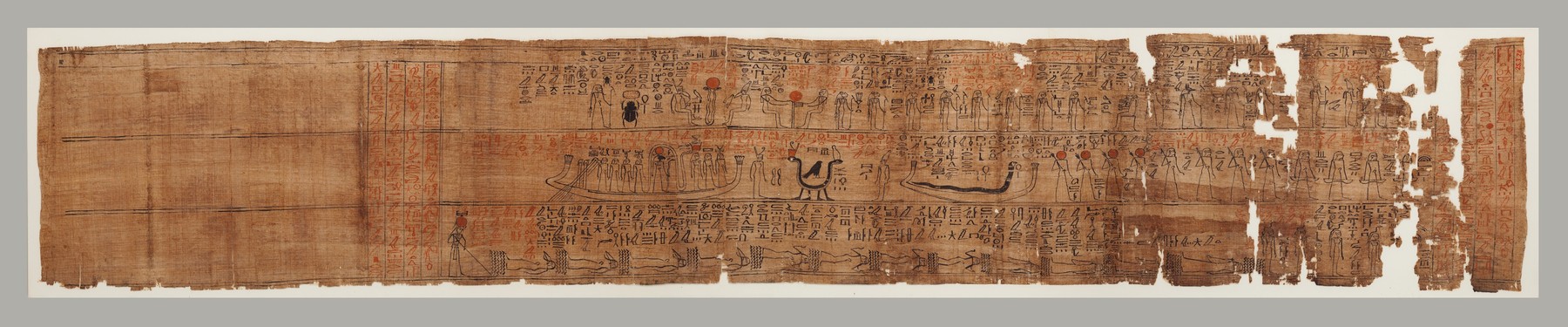
Henettawy’s papyrus presents one moment in the twelve-hour sequence. The anonymous copy in Turin gives another view of how the writing and figures fit together. Lines separate the horizontal registers, and strips of writing mark changes within the image. The red text and the black outlines are features of this particular copy.
In the Turin detail, follow the band with the solar vessel before looking at the beings in the register below. The difference between the two bands is easier to see in the original photograph. For the last two hours, The Met’s record of Djedmutesankh’s papyrus identifies the scarab of the rising sun beside Shu, the figure who holds up the heavens.

Read a single hour across the registers
The horizontal bands are called registers. A register can hold the boat and its crew, while figures in adjoining bands show inhabitants and scenes the text relates to the voyage. Treat the central vessel as a recurring point of orientation. Deities and objects may appear again with changed companions or roles, so a distinctive feature can be more helpful than a familiar face.
The fourth hour gives a striking example. In Nesmin’s papyrus, the route cuts across the ordinary bands in a zigzag. The Royal Collection identifies the serpent-shaped boat as a way to cross the country of Sokar. The geometry of this image tells the reader something important about the terrain. Compare the zigzag with the longer horizontal registers of Henettawy’s tenth hour to see how the artist’s arrangement responds to the episode.
Why midnight and the defeat of Apep belong together
The sixth hour makes the middle of the night a place of renewal. In the account summarised by The Met, Re joins with Osiris in the deepest part of the Duat so that he can be born again. At this point the journey depends on what occurs below the horizon. When following Budge’s illustration, look at the enclosed figure and the serpent around it as well as at the solar vessel.
The seventh hour gives the voyage another kind of difficulty. Apep threatens the passage of the boat, and the text describes Isis’s words and the figures that restrain the serpent. The drawing gives the obstruction a visual position in relation to the vessel. Reading the scenes together helps explain the movement from renewal at midnight to the continuing work of reaching dawn.
How to identify an Amduat manuscript
The Met’s papyrus belonged to Henettawy and was found rolled up in her burial. The surviving drawing shown here is the tenth hour. Papyrus copies can preserve a selected portion of the composition. A single museum image can therefore give rich evidence for one scene while the illustrated edition of Budge offers the wider sequence.
The Book of Gates also follows a solar journey and gives prominent places to its successive gates. The Book of the Dead contains different compositions arranged as spells suited to the deceased. Begin by reading the object’s title and identifying the scene it actually preserves. Museum records also use several familiar transliterations. Budge writes Seker and Khepera in places where a newer account may use Sokar and Khepri.