Guardian of the Threshold
The Guardian of the Threshold marks a change in spiritual responsibility. Read Steiner’s Lesser and Greater Guardians beside Bulwer-Lytton and Dante.
In this article
Understanding the concept
A Guardian of the Threshold is a figure encountered at a boundary of spiritual development in occult writing. Rudolf Steiner describes two. The Lesser Guardian gives a person’s past deeds and dispositions a visible form. The Greater Guardian asks what they will do with their new freedom. [1][2][3][4][5]
The threshold changes what a person is responsible for. One encounter asks the learner to face what they have become. The other asks whether they will use what they have gained for anyone besides themselves. [6][7][8][9]
See references (9)
- Initiation and Its Results, printed p. 107, Reader page 104
- Initiation and Its Results, printed p. 109, Reader page 106
- Initiation and Its Results, printed p. 129, Reader page 125
- Initiation and Its Results, printed p. 130, Reader page 126
- Initiation and Its Results, Reader page 127
- Initiation and Its Results, printed p. 108, Reader page 105
- Initiation and Its Results, printed p. 110, Reader page 107
- Initiation and Its Results, printed p. 111, Reader page 108
- Initiation and Its Results, printed p. 118, Reader page 115
Steiner’s two Guardians
Initiation and Its Results by Rudolf Steiner
Rudolf Steiner’s Initiation and Its Results first places the Lesser Guardian at the loosening of the links between thinking, feeling and willing in the etheric and astral bodies. He calls it an independent being created by the individual, which had not previously existed in that separate form. [1]
Its frightful appearance gives bodily form to the record of the person’s actions, thoughts and qualities. In the narrative speech, the Guardian explains that invisible karmic powers previously ordered their effects. The person must now take over a portion of that responsibility and work towards transforming the being’s appearance. [6][2][7]
Steiner treats the encounter as real within his account of spiritual perception and gives the Guardian a speaking part. It remains beside the student so the effects of their later choices can be seen against the character it embodies. [7][10][11][12]
The threshold is also associated with fear of responsibility. The Guardian forbids a premature crossing and later describes the withdrawal of familiar guidance through an image of extinguished lights. Readiness concerns sustaining one’s own orientation, not merely daring to witness a terrifying form. [8][9][13]
The surrounding chapter also speaks of family, national and racial spirits. Later, the text ranks national and racial forms as supposed stages towards an ideal humanity. These claims are part of Steiner’s historical evolutionary scheme. They should be identified as a racial hierarchy in the source, rather than presented as a neutral classification of living peoples. [14][15][16][17]
The Greater Guardian appears later as a luminous form, when the separation of the three powers is said to extend to their physical connections. The person has won a freedom from the sense world but must decide how to use it. In the narrative, the Guardian opposes a merely private entrance into higher happiness. [3][4]
Its demand is service. Powers developed through a shared earthly life are to be used for the liberation of others. The text likens the Guardian to a cherub with a fiery sword barring Paradise, and makes further entry depend on applying the acquired powers to the world the student might otherwise leave behind. [4][5][18]
The final difficulty is what to do with the freedom acquired. A private spiritual happiness can compete with work for other people. In the Guardian’s speech the initiate chooses which use of that freedom to pursue. [18][19][20]
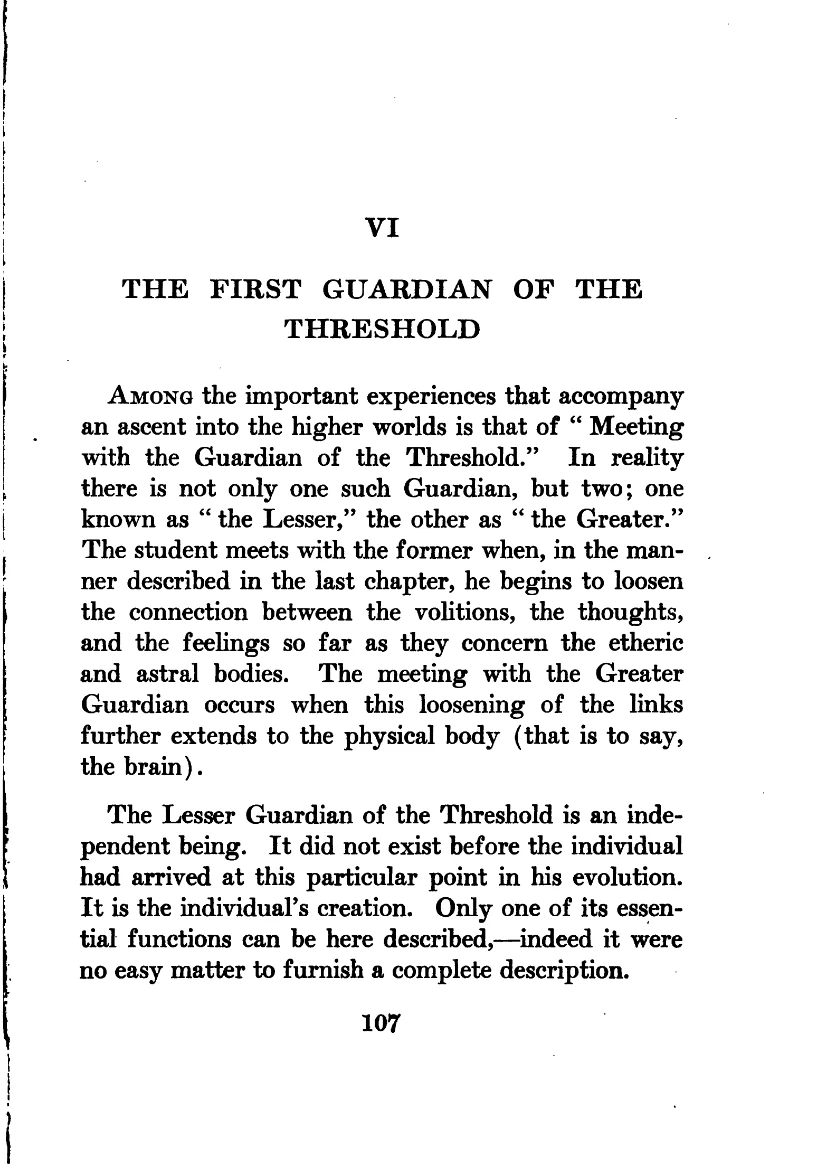
Source facsimile: Initiation and Its Results (1909), printed p. 107, Reader page 104.
Rudolf Steiner, Initiation and Its Results, Clifford Bax translation, First American Edition, 1909. Public-domain historical page from the checksum-verified Library PDF. · Image source ↗ · Public Domain
- The Lesser Guardian
- The person’s accumulated deeds and character are said to become a separate being, placing their transformation under conscious responsibility.
- The Greater Guardian
- A luminous figure makes further spiritual entry depend on using acquired powers in service to others.
See references (20)
- Initiation and Its Results, printed p. 107, Reader page 104
- Initiation and Its Results, printed p. 109, Reader page 106
- Initiation and Its Results, printed p. 129, Reader page 125
- Initiation and Its Results, printed p. 130, Reader page 126
- Initiation and Its Results, Reader page 127
- Initiation and Its Results, printed p. 108, Reader page 105
- Initiation and Its Results, printed p. 110, Reader page 107
- Initiation and Its Results, printed p. 111, Reader page 108
- Initiation and Its Results, printed p. 118, Reader page 115
- Initiation and Its Results, printed p. 112, Reader page 109
- Initiation and Its Results, printed p. 113, Reader page 110
- Initiation and Its Results, printed p. 114, Reader page 111
- Initiation and Its Results, printed p. 119, Reader page 116
- Initiation and Its Results, printed p. 115, Reader page 112
- Initiation and Its Results, printed p. 116, Reader page 113
- Initiation and Its Results, printed p. 117, Reader page 114
- Initiation and Its Results, printed p. 128, Reader page 124
- Initiation and Its Results, printed p. 132, Reader page 128
- Initiation and Its Results, printed p. 133, Reader page 129
- Initiation and Its Results, Reader page 130
Knowledge of the Higher Worlds by Rudolf Steiner
Rudolf Steiner distinguishes a lesser and a greater Guardian. The first meeting is placed where the connections between thinking, feeling and willing begin to loosen. He describes the lesser Guardian through a narrative speech, then explicitly says the encounter is intended as a supersensible reality rather than an allegory. [26][27][28]
The lesser Guardian embodies the student’s past character and deeds. Recognizing it is meant to bring responsibility for what had previously been regulated through hidden powers of karma. The frightening form is something the person must understand and transform, rather than simply defeat as an unrelated hostile being. [27][29][28][30]
The surrounding cosmology also assigns family, national and racial destinies to spiritual beings. Later, the text explicitly ranks national and racial forms within an account of evolution. That racial hierarchy is part of the source’s historically situated ideology; the article does not adopt it as a measure of human worth or rewrite it as a harmless description of cultural variety. [30][31][32][33]
The greater Guardian places individual liberation beside responsibility for others. The liberated powers are to be returned to the shared world and used in its development. Steiner compares the barred threshold to the cherubim’s fiery sword, then distinguishes a path of selfless service from one devoted to personal spiritual felicity. [34][35][36][37][38]
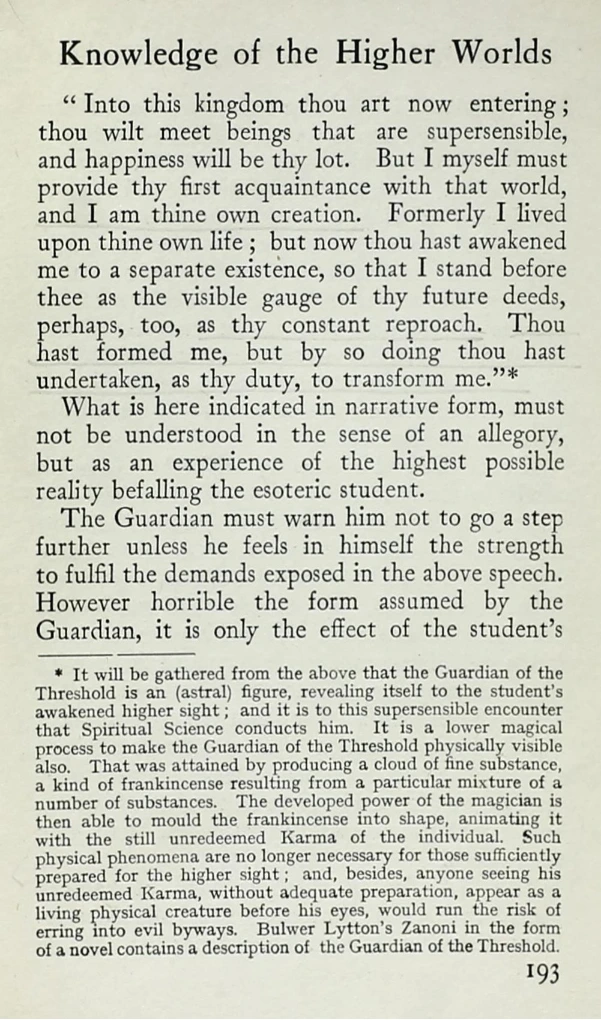
Source facsimile: Knowledge of the Higher Worlds, Reader page 197. The narrative of the lesser Guardian is intended as a real supersensible encounter in the author’s account.
Rudolf Steiner, G. Metaxa translation, edited by Harry Collison. Historical public-domain source facsimile from the exact checksum-verified Library edition. Repository date 1932; the inspected title page is undated. · Image source ↗ · Public Domain
See references (13)
- Knowledge of the Higher Worlds and Its Attainment, Reader page 192
- Knowledge of the Higher Worlds and Its Attainment, Reader page 193
- Knowledge of the Higher Worlds and Its Attainment, Reader page 197
- Knowledge of the Higher Worlds and Its Attainment, Reader page 195
- Knowledge of the Higher Worlds and Its Attainment, Reader page 198
- Knowledge of the Higher Worlds and Its Attainment, Reader page 199
- Knowledge of the Higher Worlds and Its Attainment, Reader page 202
- Knowledge of the Higher Worlds and Its Attainment, Reader page 210
- Knowledge of the Higher Worlds and Its Attainment, Reader page 211
- Knowledge of the Higher Worlds and Its Attainment, Reader page 212
- Knowledge of the Higher Worlds and Its Attainment, Reader page 213
- Knowledge of the Higher Worlds and Its Attainment, Reader page 214
- Knowledge of the Higher Worlds and Its Attainment, Reader page 215
Literary thresholds
The Dweller in Bulwer-Lytton’s Zanoni
In Zanoni, Mejnour tells Glyndon that he is approaching a barrier and may eventually confront the Dweller of the Threshold. The warning makes readiness a dramatic question. Steiner cites the novel in a footnote as a literary portrayal of a Guardian. [39][11]
The Divine Comedy by Dante Alighieri
Dante Alighieri’s Purgatory IX places an angel at the gate, with steps, a sword and keys governing entrance. The pilgrim submits to a rite of admission and begins the ascent through purgation. The scene gives moral preparation a visible setting at a guarded boundary. [22][23][24]
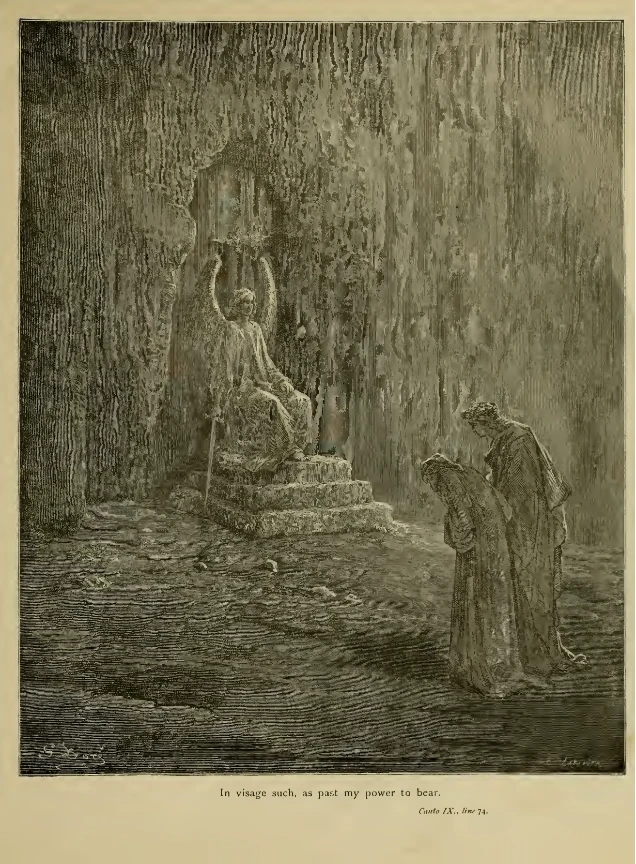
Gustave Doré, Purgatorio IX. The angel at the gate holds the keys to entry.
Purgatory and Paradise, 1901. Dante Alighieri, translated by Henry Francis Cary, designs by Gustave Doré. Thompson & Thomas, Chicago. Historical text and original designs Public Domain. · Image source ↗ · Public Domain
What each threshold asks of the traveller
Steiner uses the Lesser Guardian to bring the initiate’s past into view. The Greater Guardian places the future use of spiritual capacities before the initiate. Looking at what each figure asks keeps the two encounters distinct. [1][2][21][3][4][5][11]
Bulwer-Lytton gives a pupil a warning before the encounter. Dante has a gatekeeper admit the pilgrim to further correction. Steiner turns the boundary into an encounter with the person’s own history and then a choice about using what they have gained. [11][22][23][24][1][2][8][3][4][5][25][26][28][39]
In the Greater Guardian’s speech the two paths turn on egoism and joining in the liberation of others. The book also makes racial rankings elsewhere in the account. Those historical hierarchies belong to Steiner’s cosmology and remain visible where the text supplies them. [33][36][37][38]
See references (19)
- Initiation and Its Results, printed p. 107, Reader page 104
- Initiation and Its Results, printed p. 109, Reader page 106
- Initiation and Its Results, printed p. 129, Reader page 125
- Initiation and Its Results, printed p. 130, Reader page 126
- Initiation and Its Results, Reader page 127
- Initiation and Its Results, printed p. 111, Reader page 108
- Initiation and Its Results, printed p. 113, Reader page 110
- Initiation and Its Results, printed p. 127, Reader page 123
- Purgatory and Paradise, Reader page 58
- Purgatory and Paradise, Reader page 59
- Purgatory and Paradise, Reader page 63
- Rudolf Steiner Archive: GA 10 publication and translation history
- Knowledge of the Higher Worlds and Its Attainment, Reader page 192
- Knowledge of the Higher Worlds and Its Attainment, Reader page 197
- Knowledge of the Higher Worlds and Its Attainment, Reader page 210
- Knowledge of the Higher Worlds and Its Attainment, Reader page 213
- Knowledge of the Higher Worlds and Its Attainment, Reader page 214
- Knowledge of the Higher Worlds and Its Attainment, Reader page 215
- Edward Bulwer-Lytton, Zanoni, Book IV, chapter V
Read further in the library

Initiation and Its Results
Reading note
The separately titled account draws on exact passages in the consulted Library edition.

Purgatory and Paradise: The Vision of Dante
Reading note
Separately attributed comparison with exact previously researched Library passages.

Knowledge of the Higher Worlds and Its Attainment
Reading note
The separately titled account draws on exact passages in the consulted Library edition.
Sources
See references (39)
- Initiation and Its Results, printed p. 107, Reader page 104Rudolf Steiner, Initiation and Its Results: A Sequel to The Way of Initiation, translated by Clifford Bax. First American Edition, 1909. Macoy Publishing and Masonic Supply Co., New York; Max Gysi, London. Claims of clairvoyant perception and subtle organs remain attributed. References identify the exact consulted Library edition.Read this page in Initiation and Its Results ↗Return to text ↑
- Initiation and Its Results, printed p. 109, Reader page 106Rudolf Steiner, Initiation and Its Results: A Sequel to The Way of Initiation, translated by Clifford Bax. First American Edition, 1909. Macoy Publishing and Masonic Supply Co., New York; Max Gysi, London. Claims of clairvoyant perception and subtle organs remain attributed. References identify the exact consulted Library edition.Read this page in Initiation and Its Results ↗Return to text ↑
- Initiation and Its Results, printed p. 129, Reader page 125Rudolf Steiner, Initiation and Its Results: A Sequel to The Way of Initiation, translated by Clifford Bax. First American Edition, 1909. Macoy Publishing and Masonic Supply Co., New York; Max Gysi, London. Claims of clairvoyant perception and subtle organs remain attributed. References identify the exact consulted Library edition.Read this page in Initiation and Its Results ↗Return to text ↑
- Initiation and Its Results, printed p. 130, Reader page 126Rudolf Steiner, Initiation and Its Results: A Sequel to The Way of Initiation, translated by Clifford Bax. First American Edition, 1909. Macoy Publishing and Masonic Supply Co., New York; Max Gysi, London. Claims of clairvoyant perception and subtle organs remain attributed. References identify the exact consulted Library edition.Read this page in Initiation and Its Results ↗Return to text ↑
- Initiation and Its Results, Reader page 127Rudolf Steiner, Initiation and Its Results: A Sequel to The Way of Initiation, translated by Clifford Bax. First American Edition, 1909. Macoy Publishing and Masonic Supply Co., New York; Max Gysi, London. Claims of clairvoyant perception and subtle organs remain attributed. References identify the exact consulted Library edition.Read this page in Initiation and Its Results ↗Return to text ↑
- Initiation and Its Results, printed p. 108, Reader page 105Rudolf Steiner, Initiation and Its Results: A Sequel to The Way of Initiation, translated by Clifford Bax. First American Edition, 1909. Macoy Publishing and Masonic Supply Co., New York; Max Gysi, London. Claims of clairvoyant perception and subtle organs remain attributed. References identify the exact consulted Library edition.Read this page in Initiation and Its Results ↗Return to text ↑
- Initiation and Its Results, printed p. 110, Reader page 107Rudolf Steiner, Initiation and Its Results: A Sequel to The Way of Initiation, translated by Clifford Bax. First American Edition, 1909. Macoy Publishing and Masonic Supply Co., New York; Max Gysi, London. Claims of clairvoyant perception and subtle organs remain attributed. References identify the exact consulted Library edition.Read this page in Initiation and Its Results ↗Return to text ↑
- Initiation and Its Results, printed p. 111, Reader page 108Rudolf Steiner, Initiation and Its Results: A Sequel to The Way of Initiation, translated by Clifford Bax. First American Edition, 1909. Macoy Publishing and Masonic Supply Co., New York; Max Gysi, London. Claims of clairvoyant perception and subtle organs remain attributed. References identify the exact consulted Library edition.Read this page in Initiation and Its Results ↗Return to text ↑
- Initiation and Its Results, printed p. 118, Reader page 115Rudolf Steiner, Initiation and Its Results: A Sequel to The Way of Initiation, translated by Clifford Bax. First American Edition, 1909. Macoy Publishing and Masonic Supply Co., New York; Max Gysi, London. Claims of clairvoyant perception and subtle organs remain attributed. References identify the exact consulted Library edition.Read this page in Initiation and Its Results ↗Return to text ↑
- Initiation and Its Results, printed p. 112, Reader page 109Rudolf Steiner, Initiation and Its Results: A Sequel to The Way of Initiation, translated by Clifford Bax. First American Edition, 1909. Macoy Publishing and Masonic Supply Co., New York; Max Gysi, London. Claims of clairvoyant perception and subtle organs remain attributed. References identify the exact consulted Library edition.Read this page in Initiation and Its Results ↗Return to text ↑
- Initiation and Its Results, printed p. 113, Reader page 110Rudolf Steiner, Initiation and Its Results: A Sequel to The Way of Initiation, translated by Clifford Bax. First American Edition, 1909. Macoy Publishing and Masonic Supply Co., New York; Max Gysi, London. Claims of clairvoyant perception and subtle organs remain attributed. References identify the exact consulted Library edition.Read this page in Initiation and Its Results ↗Return to text ↑
- Initiation and Its Results, printed p. 114, Reader page 111Rudolf Steiner, Initiation and Its Results: A Sequel to The Way of Initiation, translated by Clifford Bax. First American Edition, 1909. Macoy Publishing and Masonic Supply Co., New York; Max Gysi, London. Claims of clairvoyant perception and subtle organs remain attributed. References identify the exact consulted Library edition.Read this page in Initiation and Its Results ↗Return to text ↑
- Initiation and Its Results, printed p. 119, Reader page 116Rudolf Steiner, Initiation and Its Results: A Sequel to The Way of Initiation, translated by Clifford Bax. First American Edition, 1909. Macoy Publishing and Masonic Supply Co., New York; Max Gysi, London. Claims of clairvoyant perception and subtle organs remain attributed. References identify the exact consulted Library edition.Read this page in Initiation and Its Results ↗Return to text ↑
- Initiation and Its Results, printed p. 115, Reader page 112Rudolf Steiner, Initiation and Its Results: A Sequel to The Way of Initiation, translated by Clifford Bax. First American Edition, 1909. Macoy Publishing and Masonic Supply Co., New York; Max Gysi, London. Claims of clairvoyant perception and subtle organs remain attributed. References identify the exact consulted Library edition.Read this page in Initiation and Its Results ↗Return to text ↑
- Initiation and Its Results, printed p. 116, Reader page 113Rudolf Steiner, Initiation and Its Results: A Sequel to The Way of Initiation, translated by Clifford Bax. First American Edition, 1909. Macoy Publishing and Masonic Supply Co., New York; Max Gysi, London. Claims of clairvoyant perception and subtle organs remain attributed. References identify the exact consulted Library edition.Read this page in Initiation and Its Results ↗Return to text ↑
- Initiation and Its Results, printed p. 117, Reader page 114Rudolf Steiner, Initiation and Its Results: A Sequel to The Way of Initiation, translated by Clifford Bax. First American Edition, 1909. Macoy Publishing and Masonic Supply Co., New York; Max Gysi, London. Claims of clairvoyant perception and subtle organs remain attributed. References identify the exact consulted Library edition.Read this page in Initiation and Its Results ↗Return to text ↑
- Initiation and Its Results, printed p. 128, Reader page 124Rudolf Steiner, Initiation and Its Results: A Sequel to The Way of Initiation, translated by Clifford Bax. First American Edition, 1909. Macoy Publishing and Masonic Supply Co., New York; Max Gysi, London. Claims of clairvoyant perception and subtle organs remain attributed. References identify the exact consulted Library edition.Read this page in Initiation and Its Results ↗Return to text ↑
- Initiation and Its Results, printed p. 132, Reader page 128Rudolf Steiner, Initiation and Its Results: A Sequel to The Way of Initiation, translated by Clifford Bax. First American Edition, 1909. Macoy Publishing and Masonic Supply Co., New York; Max Gysi, London. Claims of clairvoyant perception and subtle organs remain attributed. References identify the exact consulted Library edition.Read this page in Initiation and Its Results ↗Return to text ↑
- Initiation and Its Results, printed p. 133, Reader page 129Rudolf Steiner, Initiation and Its Results: A Sequel to The Way of Initiation, translated by Clifford Bax. First American Edition, 1909. Macoy Publishing and Masonic Supply Co., New York; Max Gysi, London. Claims of clairvoyant perception and subtle organs remain attributed. References identify the exact consulted Library edition.Read this page in Initiation and Its Results ↗Return to text ↑
- Initiation and Its Results, Reader page 130Rudolf Steiner, Initiation and Its Results: A Sequel to The Way of Initiation, translated by Clifford Bax. First American Edition, 1909. Macoy Publishing and Masonic Supply Co., New York; Max Gysi, London. Claims of clairvoyant perception and subtle organs remain attributed. References identify the exact consulted Library edition.Read this page in Initiation and Its Results ↗Return to text ↑
- Initiation and Its Results, printed p. 127, Reader page 123Rudolf Steiner, Initiation and Its Results: A Sequel to The Way of Initiation, translated by Clifford Bax. First American Edition, 1909. Macoy Publishing and Masonic Supply Co., New York; Max Gysi, London. Claims of clairvoyant perception and subtle organs remain attributed. References identify the exact consulted Library edition.Read this page in Initiation and Its Results ↗Return to text ↑
- Purgatory and Paradise, Reader page 58Dante Alighieri, The Divine Comedy, translated by Henry Francis Cary, designs by Gustave Doré. Inferno: undated New Edition, Thompson & Thomas, Chicago. Purgatory and Paradise: New Edition, Thompson & Thomas, Chicago, 1901. Canto arguments are editorial matter and are distinguished from the poem.Read this page in Purgatory and Paradise: The Vision of Dante ↗Return to text ↑
- Purgatory and Paradise, Reader page 59Dante Alighieri, The Divine Comedy, translated by Henry Francis Cary, designs by Gustave Doré. Inferno: undated New Edition, Thompson & Thomas, Chicago. Purgatory and Paradise: New Edition, Thompson & Thomas, Chicago, 1901. Canto arguments are editorial matter and are distinguished from the poem.Read this page in Purgatory and Paradise: The Vision of Dante ↗Return to text ↑
- Purgatory and Paradise, Reader page 63Dante Alighieri, The Divine Comedy, translated by Henry Francis Cary, designs by Gustave Doré. Inferno: undated New Edition, Thompson & Thomas, Chicago. Purgatory and Paradise: New Edition, Thompson & Thomas, Chicago, 1901. Canto arguments are editorial matter and are distinguished from the poem.Read this page in Purgatory and Paradise: The Vision of Dante ↗Return to text ↑
- Rudolf Steiner Archive: GA 10 publication and translation history ↗Steiner Online Library, Rudolf Steiner Archive, GA 10 bibliography. Used only for publication relationships, not independent confirmation of spiritual claims.Return to text ↑
- Knowledge of the Higher Worlds and Its Attainment, Reader page 192Rudolf Steiner, Knowledge of the Higher Worlds and Its Attainment, authorized English translation by G. Metaxa, edited by Harry Collison, Anthroposophic Press, New York City. Exact Library edition IMJ-0513-E001. No publication year is visible on the inspected title page; the repository assigns 1932. Claims of supersensible perception remain attributed to Steiner.Read this page in Knowledge of the Higher Worlds and Its Attainment ↗Return to text ↑
- Knowledge of the Higher Worlds and Its Attainment, Reader page 193Rudolf Steiner, Knowledge of the Higher Worlds and Its Attainment, authorized English translation by G. Metaxa, edited by Harry Collison, Anthroposophic Press, New York City. Exact Library edition IMJ-0513-E001. No publication year is visible on the inspected title page; the repository assigns 1932. Claims of supersensible perception remain attributed to Steiner.Read this page in Knowledge of the Higher Worlds and Its Attainment ↗Return to text ↑
- Knowledge of the Higher Worlds and Its Attainment, Reader page 197Rudolf Steiner, Knowledge of the Higher Worlds and Its Attainment, authorized English translation by G. Metaxa, edited by Harry Collison, Anthroposophic Press, New York City. Exact Library edition IMJ-0513-E001. No publication year is visible on the inspected title page; the repository assigns 1932. Claims of supersensible perception remain attributed to Steiner.Read this page in Knowledge of the Higher Worlds and Its Attainment ↗Return to text ↑
- Knowledge of the Higher Worlds and Its Attainment, Reader page 195Rudolf Steiner, Knowledge of the Higher Worlds and Its Attainment, authorized English translation by G. Metaxa, edited by Harry Collison, Anthroposophic Press, New York City. Exact Library edition IMJ-0513-E001. No publication year is visible on the inspected title page; the repository assigns 1932. Claims of supersensible perception remain attributed to Steiner.Read this page in Knowledge of the Higher Worlds and Its Attainment ↗Return to text ↑
- Knowledge of the Higher Worlds and Its Attainment, Reader page 198Rudolf Steiner, Knowledge of the Higher Worlds and Its Attainment, authorized English translation by G. Metaxa, edited by Harry Collison, Anthroposophic Press, New York City. Exact Library edition IMJ-0513-E001. No publication year is visible on the inspected title page; the repository assigns 1932. Claims of supersensible perception remain attributed to Steiner.Read this page in Knowledge of the Higher Worlds and Its Attainment ↗Return to text ↑
- Knowledge of the Higher Worlds and Its Attainment, Reader page 199Rudolf Steiner, Knowledge of the Higher Worlds and Its Attainment, authorized English translation by G. Metaxa, edited by Harry Collison, Anthroposophic Press, New York City. Exact Library edition IMJ-0513-E001. No publication year is visible on the inspected title page; the repository assigns 1932. Claims of supersensible perception remain attributed to Steiner.Read this page in Knowledge of the Higher Worlds and Its Attainment ↗Return to text ↑
- Knowledge of the Higher Worlds and Its Attainment, Reader page 202Rudolf Steiner, Knowledge of the Higher Worlds and Its Attainment, authorized English translation by G. Metaxa, edited by Harry Collison, Anthroposophic Press, New York City. Exact Library edition IMJ-0513-E001. No publication year is visible on the inspected title page; the repository assigns 1932. Claims of supersensible perception remain attributed to Steiner.Read this page in Knowledge of the Higher Worlds and Its Attainment ↗Return to text ↑
- Knowledge of the Higher Worlds and Its Attainment, Reader page 210Rudolf Steiner, Knowledge of the Higher Worlds and Its Attainment, authorized English translation by G. Metaxa, edited by Harry Collison, Anthroposophic Press, New York City. Exact Library edition IMJ-0513-E001. No publication year is visible on the inspected title page; the repository assigns 1932. Claims of supersensible perception remain attributed to Steiner.Read this page in Knowledge of the Higher Worlds and Its Attainment ↗Return to text ↑
- Knowledge of the Higher Worlds and Its Attainment, Reader page 211Rudolf Steiner, Knowledge of the Higher Worlds and Its Attainment, authorized English translation by G. Metaxa, edited by Harry Collison, Anthroposophic Press, New York City. Exact Library edition IMJ-0513-E001. No publication year is visible on the inspected title page; the repository assigns 1932. Claims of supersensible perception remain attributed to Steiner.Read this page in Knowledge of the Higher Worlds and Its Attainment ↗Return to text ↑
- Knowledge of the Higher Worlds and Its Attainment, Reader page 212Rudolf Steiner, Knowledge of the Higher Worlds and Its Attainment, authorized English translation by G. Metaxa, edited by Harry Collison, Anthroposophic Press, New York City. Exact Library edition IMJ-0513-E001. No publication year is visible on the inspected title page; the repository assigns 1932. Claims of supersensible perception remain attributed to Steiner.Read this page in Knowledge of the Higher Worlds and Its Attainment ↗Return to text ↑
- Knowledge of the Higher Worlds and Its Attainment, Reader page 213Rudolf Steiner, Knowledge of the Higher Worlds and Its Attainment, authorized English translation by G. Metaxa, edited by Harry Collison, Anthroposophic Press, New York City. Exact Library edition IMJ-0513-E001. No publication year is visible on the inspected title page; the repository assigns 1932. Claims of supersensible perception remain attributed to Steiner.Read this page in Knowledge of the Higher Worlds and Its Attainment ↗Return to text ↑
- Knowledge of the Higher Worlds and Its Attainment, Reader page 214Rudolf Steiner, Knowledge of the Higher Worlds and Its Attainment, authorized English translation by G. Metaxa, edited by Harry Collison, Anthroposophic Press, New York City. Exact Library edition IMJ-0513-E001. No publication year is visible on the inspected title page; the repository assigns 1932. Claims of supersensible perception remain attributed to Steiner.Read this page in Knowledge of the Higher Worlds and Its Attainment ↗Return to text ↑
- Knowledge of the Higher Worlds and Its Attainment, Reader page 215Rudolf Steiner, Knowledge of the Higher Worlds and Its Attainment, authorized English translation by G. Metaxa, edited by Harry Collison, Anthroposophic Press, New York City. Exact Library edition IMJ-0513-E001. No publication year is visible on the inspected title page; the repository assigns 1932. Claims of supersensible perception remain attributed to Steiner.Read this page in Knowledge of the Higher Worlds and Its Attainment ↗Return to text ↑
- Edward Bulwer-Lytton, Zanoni, Book IV, chapter V ↗Edward Bulwer-Lytton, Zanoni (1842), Book IV, chapter V.Return to text ↑