Thinking, Feeling and Willing
Thinking, feeling and willing describe how ideas, emotions and actions relate. Compare Steiner’s account of coordination with Virgil’s account of assent.
In this article
Understanding the concept
Thinking, feeling and willing describe forming an idea, experiencing a feeling and directing an action. Rudolf Steiner begins with their close connection in ordinary life. He asks what would change if a person had to link those capacities deliberately. [1][2][3][4]
Initiation and Its Results by Rudolf Steiner
Steiner begins with a stuffy room and the decision to open a window. Hearing one’s name produces another familiar response. The examples give him a way to describe how a perception and an action can normally follow one another with very little deliberation. [2][3]
He then makes a specifically esoteric claim: initiation loosens the threads joining these powers in the finer bodies. At a later stage, he also describes a threefold division of the brain, which he says is invisible to ordinary observation and physical instruments. The passage therefore belongs to his claimed clairvoyant physiology, not an anatomical diagram of three verified brain compartments. [3]
A thought might be considered without setting off its usual action. An object might be noticed without immediately bringing back a familiar attachment or dislike. Steiner calls this freedom and makes a person increasingly responsible for how the three powers come back into relation. [4][5][6]
He describes three imbalances: an unchecked will moving from action to action, feeling becoming a dependent or extravagant absorption, and thinking withdrawing into a cold pursuit of knowledge detached from life. His ideal is their balanced development, rather than the triumph of one power over the others. [6][7][8]
The book’s language of dissociation and nervous illness reflects its period. Its examples explain the danger Steiner sees in unbalanced development; they are not modern diagnostic criteria. His practical emphasis returns to presence of mind, an ordered daily life and a stable relation to ordinary responsibilities. [8][9][10]
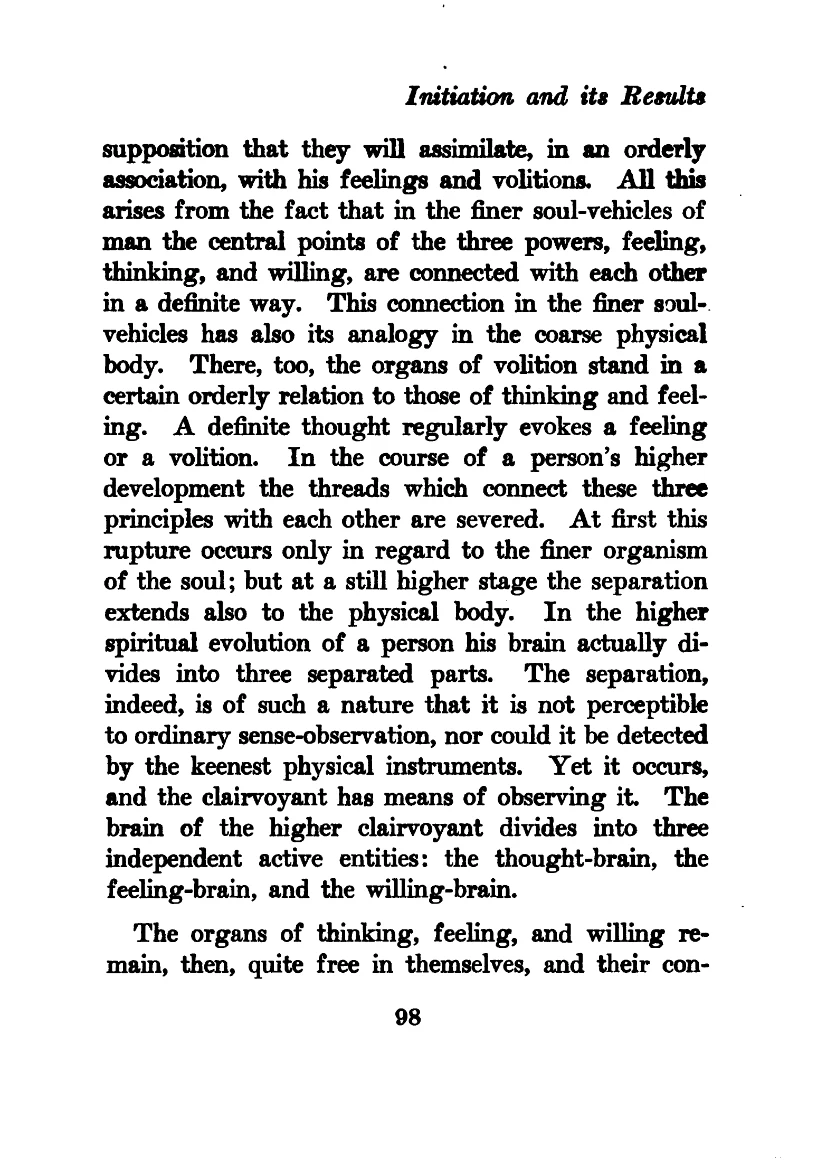
Initiation and Its Results (1909), printed p. 98, Library Reader page 96. Steiner connects the loosening of habitual responses with responsibility for their coordination.
Rudolf Steiner, Initiation and Its Results, Clifford Bax translation, First American Edition, 1909. Public-domain historical page from the checksum-verified Library PDF. · Image source ↗ · Public Domain
- Thinking
- Ideas and judgements. Steiner’s imbalance is knowledge pursued without feeling or participation in life.
- Feeling
- Affective responses. His imbalance is an absorption that overwhelms independent thought and action.
- Willing
- The direction of action. His imbalance is an unchecked drive that repeatedly overpowers its possessor.
See references (9)
- Initiation and Its Results, printed p. 97, Reader page 95
- Initiation and Its Results, printed p. 98, Reader page 96
- Initiation and Its Results, printed p. 99, Reader page 97
- Initiation and Its Results, printed p. 100, Reader page 98
- Initiation and Its Results, printed p. 101, Reader page 99
- Initiation and Its Results, printed p. 102, Reader page 100
- Initiation and Its Results, printed p. 103, Reader page 101
- Initiation and Its Results, printed p. 104, Reader page 102
- Initiation and Its Results, printed p. 105, Reader page 103
Knowledge of the Higher Worlds by Rudolf Steiner
Rudolf Steiner begins with familiar connections among ideas, feelings and actions: a stuffy room prompts someone to open a window, or hearing one’s name prompts a response. He interprets these connections as an ordinary coordination of three forces of the soul. [16]
Initiation is said to loosen their connections, first within the finer bodies and later in a claimed threefold division of the brain. The text expressly says that physical instruments cannot demonstrate the division. It is part of Steiner’s asserted clairvoyant physiology, rather than a description of three verified anatomical compartments. [17]
The proposed result is a greater freedom over the relation between a thought, a feeling and a decision. Coordination then becomes the individual’s responsibility. His account warns against three imbalances: an uncontrolled will, feeling that becomes dependence, or thought withdrawing into cold isolation from life. [18][19][20][21]
The medical vocabulary of the warning belongs to its period. The passage’s references to insanity and neurasthenia are not used here to diagnose a reader or explain an illness through supposed spiritual development. The account’s stated practical aim is a coherent daily life and presence of mind. [21][22][23]
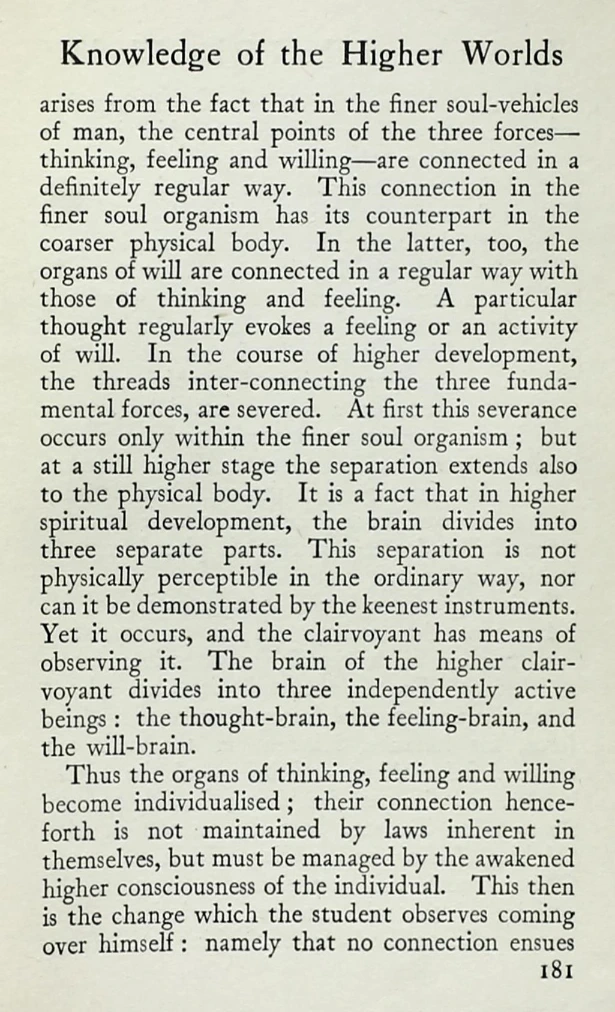
Source facsimile: Knowledge of the Higher Worlds, Reader page 185. The claimed threefold brain division is explicitly said to be invisible to physical instruments.
Rudolf Steiner, G. Metaxa translation, edited by Harry Collison. Historical public-domain source facsimile from the exact checksum-verified Library edition. Repository date 1932; the inspected title page is undated. · Image source ↗ · Public Domain
See references (8)
- Knowledge of the Higher Worlds and Its Attainment, Reader page 184
- Knowledge of the Higher Worlds and Its Attainment, Reader page 185
- Knowledge of the Higher Worlds and Its Attainment, Reader page 186
- Knowledge of the Higher Worlds and Its Attainment, Reader page 187
- Knowledge of the Higher Worlds and Its Attainment, Reader page 188
- Knowledge of the Higher Worlds and Its Attainment, Reader page 189
- Knowledge of the Higher Worlds and Its Attainment, Reader page 190
- Knowledge of the Higher Worlds and Its Attainment, Reader page 191
The Divine Comedy by Dante Alighieri
In Purgatory XVIII of Dante Alighieri’s Divine Comedy, Virgil distinguishes an attraction first arising in the soul from the assent that allows it to govern conduct. An apprehended good can awaken desire without removing responsibility for the response. [13][14]
The space between an impulse and a decision
Steiner gives coordination the central role. Further autonomy can produce imbalance when thought, desire or action takes over. The Guardians of the Threshold appear at later stages of a development in which the individual is meant to carry more responsibility. [4][7][8][11][12]
Dante’s Virgil gives the soul time between the attraction that arises and the assent it gives. Steiner proposes a change in the links among several capacities. Both create space to explain a deliberate response, and Dante does so without Steiner’s account of subtle bodies. [13][14][2][3][4][6][7][15][17][18]
See references (13)
- Initiation and Its Results, printed p. 97, Reader page 95
- Initiation and Its Results, printed p. 98, Reader page 96
- Initiation and Its Results, printed p. 99, Reader page 97
- Initiation and Its Results, printed p. 101, Reader page 99
- Initiation and Its Results, printed p. 102, Reader page 100
- Initiation and Its Results, printed p. 103, Reader page 101
- Initiation and Its Results, printed p. 107, Reader page 104
- Initiation and Its Results, printed p. 129, Reader page 125
- Purgatory and Paradise, Purgatory XVIII, Reader page 108
- Purgatory and Paradise, Purgatory XVIII, Reader page 109
- Rudolf Steiner Archive: GA 10 publication and translation history
- Knowledge of the Higher Worlds and Its Attainment, Reader page 185
- Knowledge of the Higher Worlds and Its Attainment, Reader page 186
Read further in the library

Initiation and Its Results
Reading note
The separately titled account draws on exact passages in the consulted Library edition.

Purgatory and Paradise: The Vision of Dante
Reading note
Separately attributed comparison with exact previously researched Library passages.

Knowledge of the Higher Worlds and Its Attainment
Reading note
The separately titled account draws on exact passages in the consulted Library edition.
Sources
See references (23)
- Initiation and Its Results, printed p. 96, Reader page 94Rudolf Steiner, Initiation and Its Results: A Sequel to The Way of Initiation, translated by Clifford Bax. First American Edition, 1909. Macoy Publishing and Masonic Supply Co., New York; Max Gysi, London. Claims of clairvoyant perception and subtle organs remain attributed. References identify the exact consulted Library edition.Read this page in Initiation and Its Results ↗Return to text ↑
- Initiation and Its Results, printed p. 97, Reader page 95Rudolf Steiner, Initiation and Its Results: A Sequel to The Way of Initiation, translated by Clifford Bax. First American Edition, 1909. Macoy Publishing and Masonic Supply Co., New York; Max Gysi, London. Claims of clairvoyant perception and subtle organs remain attributed. References identify the exact consulted Library edition.Read this page in Initiation and Its Results ↗Return to text ↑
- Initiation and Its Results, printed p. 98, Reader page 96Rudolf Steiner, Initiation and Its Results: A Sequel to The Way of Initiation, translated by Clifford Bax. First American Edition, 1909. Macoy Publishing and Masonic Supply Co., New York; Max Gysi, London. Claims of clairvoyant perception and subtle organs remain attributed. References identify the exact consulted Library edition.Read this page in Initiation and Its Results ↗Return to text ↑
- Initiation and Its Results, printed p. 99, Reader page 97Rudolf Steiner, Initiation and Its Results: A Sequel to The Way of Initiation, translated by Clifford Bax. First American Edition, 1909. Macoy Publishing and Masonic Supply Co., New York; Max Gysi, London. Claims of clairvoyant perception and subtle organs remain attributed. References identify the exact consulted Library edition.Read this page in Initiation and Its Results ↗Return to text ↑
- Initiation and Its Results, printed p. 100, Reader page 98Rudolf Steiner, Initiation and Its Results: A Sequel to The Way of Initiation, translated by Clifford Bax. First American Edition, 1909. Macoy Publishing and Masonic Supply Co., New York; Max Gysi, London. Claims of clairvoyant perception and subtle organs remain attributed. References identify the exact consulted Library edition.Read this page in Initiation and Its Results ↗Return to text ↑
- Initiation and Its Results, printed p. 101, Reader page 99Rudolf Steiner, Initiation and Its Results: A Sequel to The Way of Initiation, translated by Clifford Bax. First American Edition, 1909. Macoy Publishing and Masonic Supply Co., New York; Max Gysi, London. Claims of clairvoyant perception and subtle organs remain attributed. References identify the exact consulted Library edition.Read this page in Initiation and Its Results ↗Return to text ↑
- Initiation and Its Results, printed p. 102, Reader page 100Rudolf Steiner, Initiation and Its Results: A Sequel to The Way of Initiation, translated by Clifford Bax. First American Edition, 1909. Macoy Publishing and Masonic Supply Co., New York; Max Gysi, London. Claims of clairvoyant perception and subtle organs remain attributed. References identify the exact consulted Library edition.Read this page in Initiation and Its Results ↗Return to text ↑
- Initiation and Its Results, printed p. 103, Reader page 101Rudolf Steiner, Initiation and Its Results: A Sequel to The Way of Initiation, translated by Clifford Bax. First American Edition, 1909. Macoy Publishing and Masonic Supply Co., New York; Max Gysi, London. Claims of clairvoyant perception and subtle organs remain attributed. References identify the exact consulted Library edition.Read this page in Initiation and Its Results ↗Return to text ↑
- Initiation and Its Results, printed p. 104, Reader page 102Rudolf Steiner, Initiation and Its Results: A Sequel to The Way of Initiation, translated by Clifford Bax. First American Edition, 1909. Macoy Publishing and Masonic Supply Co., New York; Max Gysi, London. Claims of clairvoyant perception and subtle organs remain attributed. References identify the exact consulted Library edition.Read this page in Initiation and Its Results ↗Return to text ↑
- Initiation and Its Results, printed p. 105, Reader page 103Rudolf Steiner, Initiation and Its Results: A Sequel to The Way of Initiation, translated by Clifford Bax. First American Edition, 1909. Macoy Publishing and Masonic Supply Co., New York; Max Gysi, London. Claims of clairvoyant perception and subtle organs remain attributed. References identify the exact consulted Library edition.Read this page in Initiation and Its Results ↗Return to text ↑
- Initiation and Its Results, printed p. 107, Reader page 104Rudolf Steiner, Initiation and Its Results: A Sequel to The Way of Initiation, translated by Clifford Bax. First American Edition, 1909. Macoy Publishing and Masonic Supply Co., New York; Max Gysi, London. Claims of clairvoyant perception and subtle organs remain attributed. References identify the exact consulted Library edition.Read this page in Initiation and Its Results ↗Return to text ↑
- Initiation and Its Results, printed p. 129, Reader page 125Rudolf Steiner, Initiation and Its Results: A Sequel to The Way of Initiation, translated by Clifford Bax. First American Edition, 1909. Macoy Publishing and Masonic Supply Co., New York; Max Gysi, London. Claims of clairvoyant perception and subtle organs remain attributed. References identify the exact consulted Library edition.Read this page in Initiation and Its Results ↗Return to text ↑
- Purgatory and Paradise, Purgatory XVIII, Reader page 108Dante Alighieri, The Divine Comedy, translated by Henry Francis Cary. Inferno: undated New Edition, Thompson & Thomas, Chicago. Purgatory and Paradise: New Edition, Thompson & Thomas, Chicago, 1901. Designs by Gustave Doré.Read this page in Purgatory and Paradise: The Vision of Dante ↗Return to text ↑
- Purgatory and Paradise, Purgatory XVIII, Reader page 109Dante Alighieri, The Divine Comedy, translated by Henry Francis Cary. Inferno: undated New Edition, Thompson & Thomas, Chicago. Purgatory and Paradise: New Edition, Thompson & Thomas, Chicago, 1901. Designs by Gustave Doré.Read this page in Purgatory and Paradise: The Vision of Dante ↗Return to text ↑
- Rudolf Steiner Archive: GA 10 publication and translation history ↗Steiner Online Library, Rudolf Steiner Archive, GA 10 bibliography. Used only for publication relationships, not independent confirmation of spiritual claims.Return to text ↑
- Knowledge of the Higher Worlds and Its Attainment, Reader page 184Rudolf Steiner, Knowledge of the Higher Worlds and Its Attainment, authorized English translation by G. Metaxa, edited by Harry Collison, Anthroposophic Press, New York City. Exact Library edition IMJ-0513-E001. No publication year is visible on the inspected title page; the repository assigns 1932. Claims of supersensible perception remain attributed to Steiner.Read this page in Knowledge of the Higher Worlds and Its Attainment ↗Return to text ↑
- Knowledge of the Higher Worlds and Its Attainment, Reader page 185Rudolf Steiner, Knowledge of the Higher Worlds and Its Attainment, authorized English translation by G. Metaxa, edited by Harry Collison, Anthroposophic Press, New York City. Exact Library edition IMJ-0513-E001. No publication year is visible on the inspected title page; the repository assigns 1932. Claims of supersensible perception remain attributed to Steiner.Read this page in Knowledge of the Higher Worlds and Its Attainment ↗Return to text ↑
- Knowledge of the Higher Worlds and Its Attainment, Reader page 186Rudolf Steiner, Knowledge of the Higher Worlds and Its Attainment, authorized English translation by G. Metaxa, edited by Harry Collison, Anthroposophic Press, New York City. Exact Library edition IMJ-0513-E001. No publication year is visible on the inspected title page; the repository assigns 1932. Claims of supersensible perception remain attributed to Steiner.Read this page in Knowledge of the Higher Worlds and Its Attainment ↗Return to text ↑
- Knowledge of the Higher Worlds and Its Attainment, Reader page 187Rudolf Steiner, Knowledge of the Higher Worlds and Its Attainment, authorized English translation by G. Metaxa, edited by Harry Collison, Anthroposophic Press, New York City. Exact Library edition IMJ-0513-E001. No publication year is visible on the inspected title page; the repository assigns 1932. Claims of supersensible perception remain attributed to Steiner.Read this page in Knowledge of the Higher Worlds and Its Attainment ↗Return to text ↑
- Knowledge of the Higher Worlds and Its Attainment, Reader page 188Rudolf Steiner, Knowledge of the Higher Worlds and Its Attainment, authorized English translation by G. Metaxa, edited by Harry Collison, Anthroposophic Press, New York City. Exact Library edition IMJ-0513-E001. No publication year is visible on the inspected title page; the repository assigns 1932. Claims of supersensible perception remain attributed to Steiner.Read this page in Knowledge of the Higher Worlds and Its Attainment ↗Return to text ↑
- Knowledge of the Higher Worlds and Its Attainment, Reader page 189Rudolf Steiner, Knowledge of the Higher Worlds and Its Attainment, authorized English translation by G. Metaxa, edited by Harry Collison, Anthroposophic Press, New York City. Exact Library edition IMJ-0513-E001. No publication year is visible on the inspected title page; the repository assigns 1932. Claims of supersensible perception remain attributed to Steiner.Read this page in Knowledge of the Higher Worlds and Its Attainment ↗Return to text ↑
- Knowledge of the Higher Worlds and Its Attainment, Reader page 190Rudolf Steiner, Knowledge of the Higher Worlds and Its Attainment, authorized English translation by G. Metaxa, edited by Harry Collison, Anthroposophic Press, New York City. Exact Library edition IMJ-0513-E001. No publication year is visible on the inspected title page; the repository assigns 1932. Claims of supersensible perception remain attributed to Steiner.Read this page in Knowledge of the Higher Worlds and Its Attainment ↗Return to text ↑
- Knowledge of the Higher Worlds and Its Attainment, Reader page 191Rudolf Steiner, Knowledge of the Higher Worlds and Its Attainment, authorized English translation by G. Metaxa, edited by Harry Collison, Anthroposophic Press, New York City. Exact Library edition IMJ-0513-E001. No publication year is visible on the inspected title page; the repository assigns 1932. Claims of supersensible perception remain attributed to Steiner.Read this page in Knowledge of the Higher Worlds and Its Attainment ↗Return to text ↑