Geometric Nets
See how a cube unfolds into six squares and a tesseract into eight cubes, and why Bragdon used nets alongside projections.
In this article
How a solid opens out
A geometric net is an unfolded arrangement of boundary pieces that can fold back into a closed shape. A cube unfolds into six squares. A tesseract can unfold into eight cubes joined along square faces. [2][3]
One cube net is a row of four squares with one square above and one below the second. The joins in the drawing act as hinges. The remaining edges meet when the squares close around the cube. [2][4][5]
A Primer of Higher Space by Claude Bragdon
In A Primer of Higher Space, Claude Bragdon starts with a square made of wire and imagines cutting it at one corner. The four connected segments can be straightened into a line. He then cuts selected edges of a tin cube so its six squares unfold flat, and applies the same method to the tesseract’s cubical boundary. [2][3]
In Man the Square, the same construction becomes part of the parable. Christos presents a cube unfolded into six squares so the inhabitants of a plane can encounter its faces. The model gives them a way to reason about the solid they cannot see whole. [4][5]
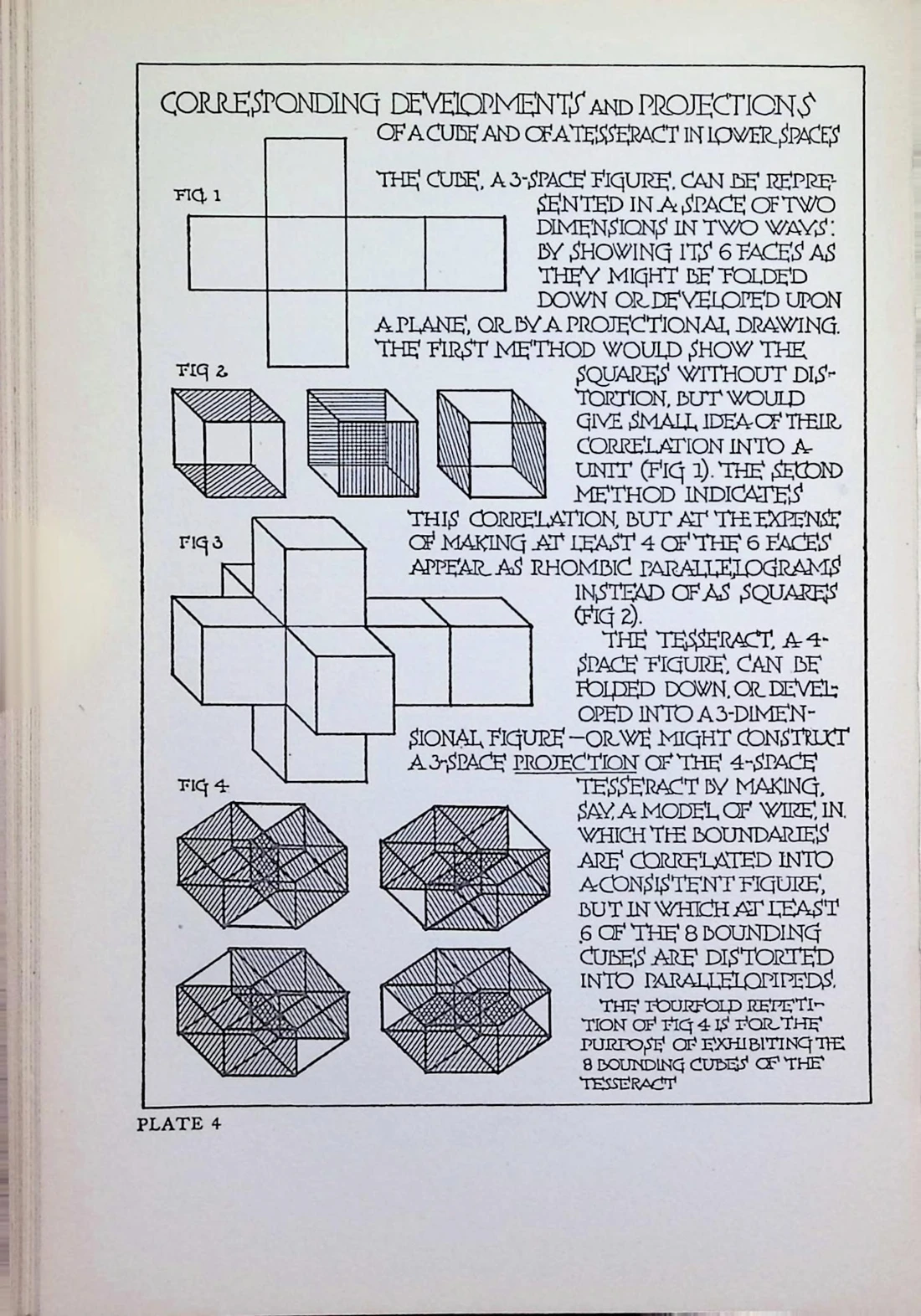
Plate 4 compares the unfolded boundary of a cube with its projection. It repeats the comparison for the eight cubical cells of a tesseract.
Claude Bragdon, A Primer of Higher Space, The Manas Press, 1913. Stickley Museum scan via Internet Archive. · Image source ↗ · Public Domain
What the net keeps visible
The net keeps each face at its original shape and size. Some of its edges connect only when it folds closed. Bragdon places it beside a projection, where more joins appear together and some faces appear slanted. [3][6]
In the library
A Primer of Higher Space
Reading note
The separately titled account draws on exact passages in the consulted Library edition.
Sources
See references (6)
- Plate 4, unfolded boundaries and projections ↗Claude Bragdon, A Primer of Higher Space, The Manas Press, 1913. Stickley Museum scan via Internet Archive.
- A Primer of Higher Space, Plate 3, Reader page 32Claude Bragdon, A Primer of Higher Space (The Fourth Dimension), The Manas Press, Rochester, New York, 1913. Lumitheca Library edition IMJ-0599-E001.Read this page in A Primer of Higher Space ↗
- A Primer of Higher Space, Plate 4, Reader page 33Claude Bragdon, A Primer of Higher Space (The Fourth Dimension), The Manas Press, Rochester, New York, 1913. Lumitheca Library edition IMJ-0599-E001.Read this page in A Primer of Higher Space ↗
- A Primer of Higher Space, printed p. 73, Reader page 76Claude Bragdon, A Primer of Higher Space (The Fourth Dimension), The Manas Press, Rochester, New York, 1913. Lumitheca Library edition IMJ-0599-E001.Read this page in A Primer of Higher Space ↗
- A Primer of Higher Space, printed p. 75, Reader page 78Claude Bragdon, A Primer of Higher Space (The Fourth Dimension), The Manas Press, Rochester, New York, 1913. Lumitheca Library edition IMJ-0599-E001.Read this page in A Primer of Higher Space ↗
- A Primer of Higher Space, Plate 14, Reader page 43Claude Bragdon, A Primer of Higher Space (The Fourth Dimension), The Manas Press, Rochester, New York, 1913. Lumitheca Library edition IMJ-0599-E001.Read this page in A Primer of Higher Space ↗