Western Geomancy
Western geomancy interprets sixteen figures made of dots. See why there are sixteen and how Crowley compares the system with the Yi Jing.
In this article
Why are there sixteen geomantic figures?
Western geomancy is divination with figures made of four rows of dots. Each row can have one dot or two, giving sixteen possible figures. Historical texts name them and assign meanings to them. The English word geomancy also refers to traditions concerned with siting, including feng shui. [1][2][3][4]
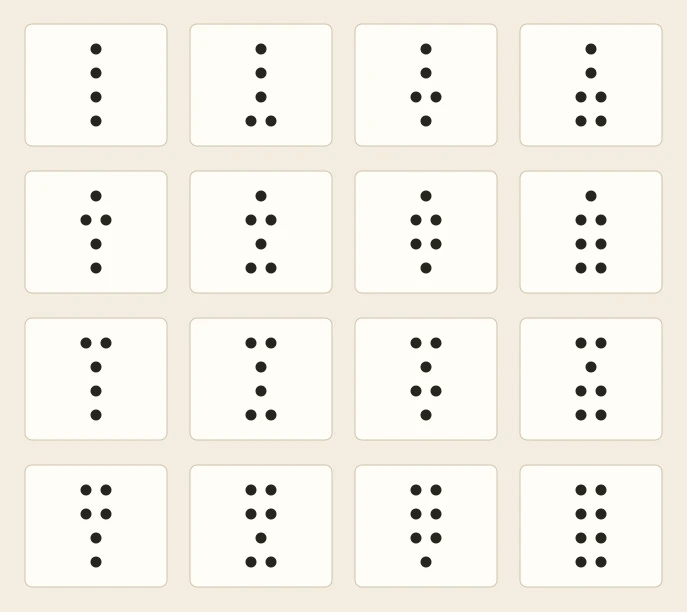
All sixteen figures fit in this chart. Each row has two possible forms, giving sixteen distinct arrangements across four rows.
Lumitheca, diagram of the sixteen possible arrangements, dedicated under CC0. · Image source ↗ · CC0
Of Geomancy, attributed to Heinrich Cornelius Agrippa
Of Geomancy, a 1655 English text attributed to Heinrich Cornelius Agrippa, derives its figures from whether the marks in a row are odd or even. Its table gives the sixteen figures names and celestial associations, which the reader uses in interpretation. [1]
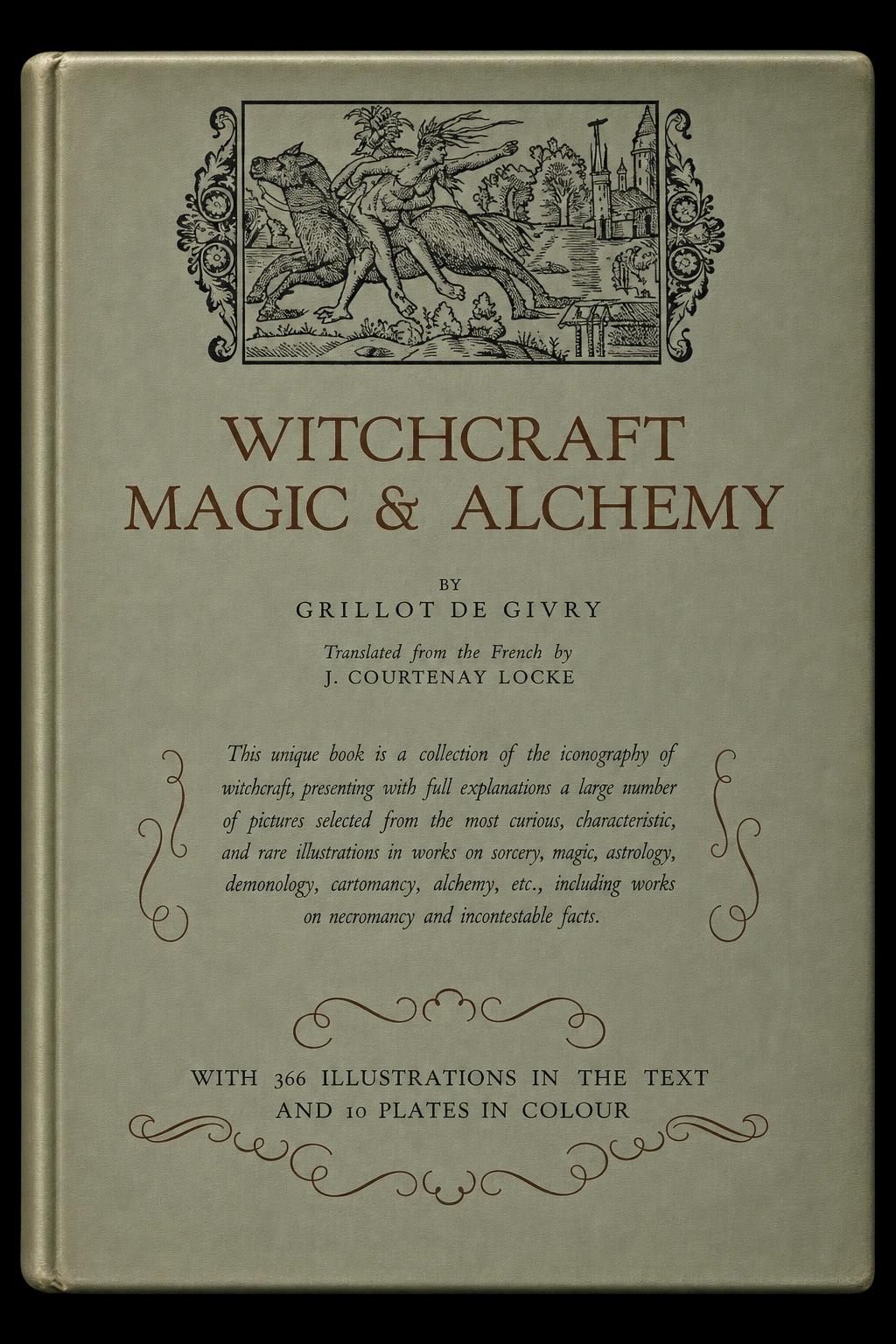
Witchcraft Magic & Alchemy by Grillot de Givry
In Witchcraft Magic & Alchemy, Grillot de Givry describes examining scattered earth as well as making marks on paper. He then gives examples of named figures from Agrippa, whose meanings include good fortune and confinement. [6][7]
De Givry reproduces a wheel by Robert Fludd that identifies the arts with images. A shield bearing dotted figures stands for geomancy. A hand elsewhere on the wheel stands for palmistry. [7][8]
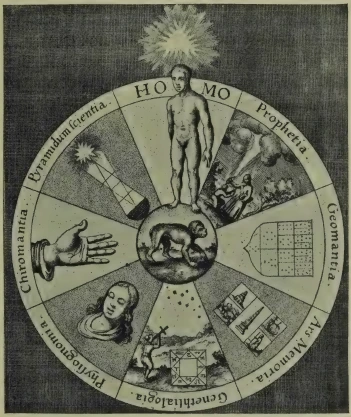
Fludd uses a shield of dotted figures to identify geomancy within a wheel of arts. De Givry reproduces it as figure 288.
Robert Fludd, Utriusque cosmi historia, Oppenheim, 1619. Reproduced by De Givry. · Image source ↗ · Public Domain
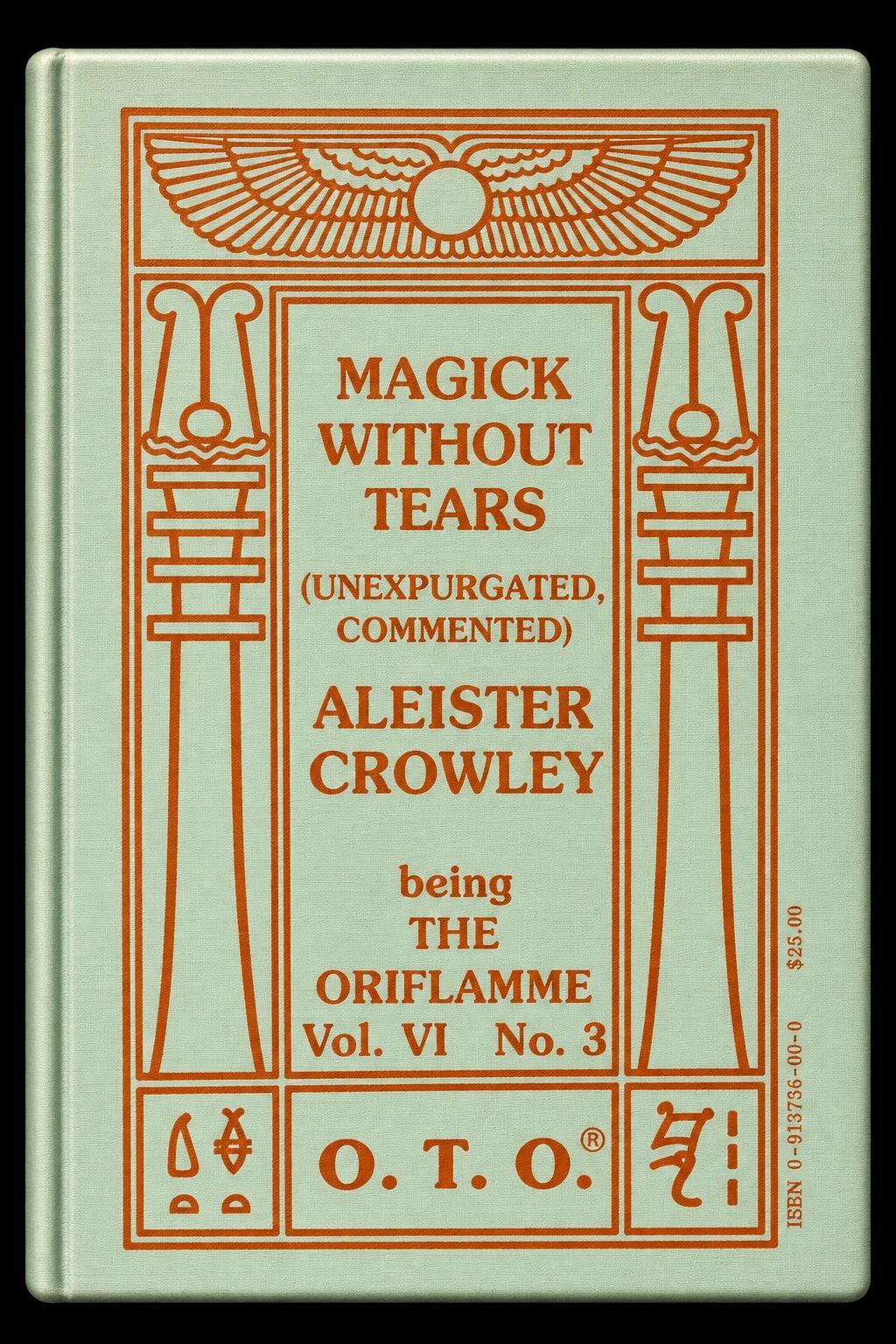
Magick Without Tears by Aleister Crowley
In Magick Without Tears, Aleister Crowley explains the sixteen figures by counting two possibilities in each row. He compares that structure with Yi Jing trigrams and hexagrams. His analogy concerns the number of possible patterns in figures with different numbers of rows. [2][3][5][4]
Crowley describes a student in Johannesburg who tries to narrow a question by stages and considers the discovery of alkali a result. He reports little aptitude for the art himself. The episode shows how his student framed a question and judged what happened. [3][5][4]
What the dots show and what readers infer
The text attributed to Agrippa gives the figures a place in a system of interpretation. Crowley’s letter follows a practitioner trying to phrase a question precisely enough to recognise an answer. [1][2][3][4]
The dotted shield in Fludd’s wheel shows how several recognisable figures could represent the art at a glance. Crowley explains where those sixteen possible patterns come from. Counting the patterns and telling what they mean are two different parts of the practice. [7][8][2][3][4][6]
See references (7)
- Of Geomancy, 1655 English edition, opening and table of the sixteen figures
- Magick Without Tears, Reader page 243
- Magick Without Tears, Reader page 244
- Magick Without Tears, Reader page 246
- Witchcraft Magic & Alchemy, printed p. 301, Reader page 296
- Witchcraft Magic & Alchemy, printed p. 302, Reader page 297
- Witchcraft Magic & Alchemy, printed p. 303, Reader page 298
Read further in the library
Magick Without Tears
Reading note
The separately titled account draws on exact passages in the consulted Library edition.
Witchcraft Magic and Alchemy
Reading note
The separately titled account draws on exact passages in the consulted Library edition.
Sources
See references (8)
- Of Geomancy, 1655 English edition, opening and table of the sixteen figures ↗Of Geomancy, attributed to Heinrich Cornelius Agrippa, translated by Robert Turner, 1655. Transcription hosted at Princeton.Return to text ↑
- Magick Without Tears, Reader page 243Aleister Crowley, Magick Without Tears, undated digital Library edition IMJ-0641-E001. Links use the current Library Reader sequence.Read this page in Magick Without Tears ↗Return to text ↑
- Magick Without Tears, Reader page 244Aleister Crowley, Magick Without Tears, undated digital Library edition IMJ-0641-E001. Links use the current Library Reader sequence.Read this page in Magick Without Tears ↗Return to text ↑
- Magick Without Tears, Reader page 246Aleister Crowley, Magick Without Tears, undated digital Library edition IMJ-0641-E001. Links use the current Library Reader sequence.Read this page in Magick Without Tears ↗Return to text ↑
- Magick Without Tears, Reader page 245Aleister Crowley, Magick Without Tears, undated digital Library edition IMJ-0641-E001. Links use the current Library Reader sequence.Read this page in Magick Without Tears ↗Return to text ↑
- Witchcraft Magic & Alchemy, printed p. 301, Reader page 296Grillot de Givry, Witchcraft Magic & Alchemy, translated by J. Courtenay Locke. Boston and New York, Houghton Mifflin Company, 1931.Read this page in Witchcraft Magic and Alchemy ↗Return to text ↑
- Witchcraft Magic & Alchemy, printed p. 302, Reader page 297Grillot de Givry, Witchcraft Magic & Alchemy, translated by J. Courtenay Locke. Boston and New York, Houghton Mifflin Company, 1931.Read this page in Witchcraft Magic and Alchemy ↗Return to text ↑
- Witchcraft Magic & Alchemy, printed p. 303, Reader page 298Grillot de Givry, Witchcraft Magic & Alchemy, translated by J. Courtenay Locke. Boston and New York, Houghton Mifflin Company, 1931.Read this page in Witchcraft Magic and Alchemy ↗Return to text ↑