Four Stages of Speech
Four stages of speech in Tantric thought trace a word from its unspoken potential to audible language. Learn what each stage means.
In this article
How speech becomes audible
In Tantric accounts of sacred sound, speech begins before there is anything to hear. The four stages are parā, the unmanifest source of speech, paśyantī, its first stirring, madhyamā, the formation of a distinct thought, and vaikharī, the word spoken aloud. They trace how something that can be said becomes something another person can hear. [2][3][4][5]
The Serpent Power in Arthur Avalon’s translation
Arthur Avalon explains the four stages in The Serpent Power. At parā, speech rests in Kuṇḍalinī at the root lotus. At paśyantī it begins to move before taking on a particular form. At madhyamā the mind distinguishes and inwardly names what it apprehends. Vaikharī is the final articulation through the throat and mouth. [2][3][4][5]
Avalon traces paśyantī from the root to the navel, with Svādhiṣṭhāna as an alternative endpoint in some accounts. Madhyamā extends to the heart. The navel and heart belong to a map of how sound unfolds in the subtle body. [2][4][5]
This sequence also explains why mantra has both inward and outward forms in the book. The syllable a listener hears belongs to the last stage. Its audible shape expresses a movement that began earlier. [3][6][7]
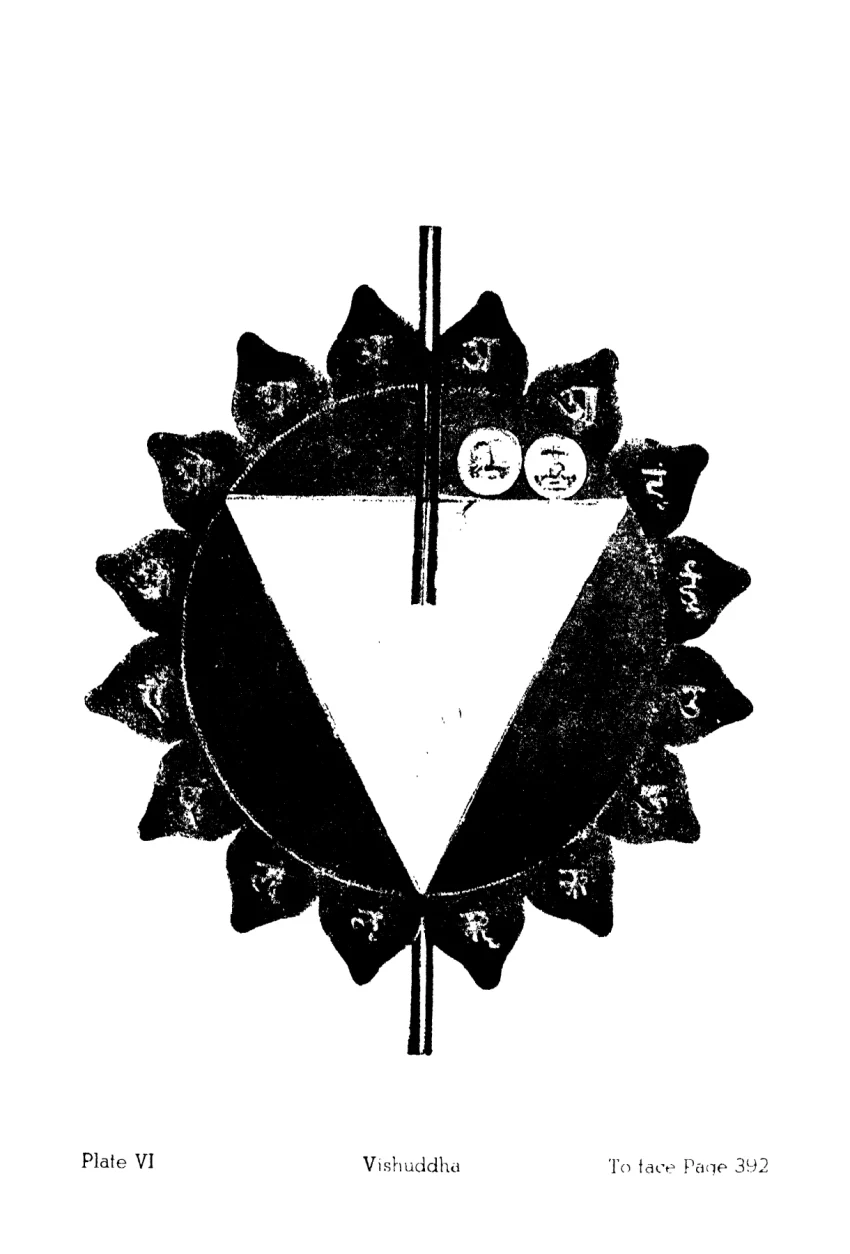
Plate VI shows the throat lotus, Viśuddha. Avalon describes the throat as part of the passage by which speech becomes audible at the mouth.
Illustrator unrecorded. The Serpent Power, Plate VI. Library facsimile, compared with the 1924 second edition. · Image source ↗ · Public Domain
See references (6)
Distinctions and comparisons
Kālīcaraṇa associates Anāhata, the heart lotus, with sound said to arise without a physical strike. In the four-stage scheme the heart also marks the extent of inner speech, while vaikharī requires articulation. These are two distinct uses of sound within the same map. [8][3][5][9]
In the library
The Serpent Power
Reading note
Separately attributed primary Library account, cited on exact verified Reader leaves.
Sources
See references (9)
- The Serpent Power, Plate VI, Reader page 410Illustrator unrecorded. The Serpent Power, Plate VI. Library facsimile, compared with the 1924 second edition.Read this page in The Serpent Power ↗
- The Serpent Power, printed p. 89, Reader page 104Arthur Avalon (Sir John Woodroffe), The Serpent Power, fifth enlarged edition, Ganesh & Co., Madras, 1953. Includes Pūrṇānanda’s Ṣaṭ-cakra-nirūpaṇa, Pādukā-pañcaka and Kālīcaraṇa’s commentary. Exact Library edition IMJ-0608-E001.Read this page in The Serpent Power ↗
- The Serpent Power, printed p. 90, Reader page 105Arthur Avalon (Sir John Woodroffe), The Serpent Power, fifth enlarged edition, Ganesh & Co., Madras, 1953. Includes Pūrṇānanda’s Ṣaṭ-cakra-nirūpaṇa, Pādukā-pañcaka and Kālīcaraṇa’s commentary. Exact Library edition IMJ-0608-E001.Read this page in The Serpent Power ↗
- The Serpent Power, printed p. 170, Reader page 184Arthur Avalon (Sir John Woodroffe), The Serpent Power, fifth enlarged edition, Ganesh & Co., Madras, 1953. Includes Pūrṇānanda’s Ṣaṭ-cakra-nirūpaṇa, Pādukā-pañcaka and Kālīcaraṇa’s commentary. Exact Library edition IMJ-0608-E001.Read this page in The Serpent Power ↗
- The Serpent Power, printed p. 171, Reader page 185Arthur Avalon (Sir John Woodroffe), The Serpent Power, fifth enlarged edition, Ganesh & Co., Madras, 1953. Includes Pūrṇānanda’s Ṣaṭ-cakra-nirūpaṇa, Pādukā-pañcaka and Kālīcaraṇa’s commentary. Exact Library edition IMJ-0608-E001.Read this page in The Serpent Power ↗
- The Serpent Power, printed p. 96, Reader page 111Arthur Avalon (Sir John Woodroffe), The Serpent Power, fifth enlarged edition, Ganesh & Co., Madras, 1953. Includes Pūrṇānanda’s Ṣaṭ-cakra-nirūpaṇa, Pādukā-pañcaka and Kālīcaraṇa’s commentary. Exact Library edition IMJ-0608-E001.Read this page in The Serpent Power ↗
- The Serpent Power, printed p. 97, Reader page 112Arthur Avalon (Sir John Woodroffe), The Serpent Power, fifth enlarged edition, Ganesh & Co., Madras, 1953. Includes Pūrṇānanda’s Ṣaṭ-cakra-nirūpaṇa, Pādukā-pañcaka and Kālīcaraṇa’s commentary. Exact Library edition IMJ-0608-E001.Read this page in The Serpent Power ↗
- The Serpent Power, printed p. 86, Reader page 101Arthur Avalon (Sir John Woodroffe), The Serpent Power, fifth enlarged edition, Ganesh & Co., Madras, 1953. Includes Pūrṇānanda’s Ṣaṭ-cakra-nirūpaṇa, Pādukā-pañcaka and Kālīcaraṇa’s commentary. Exact Library edition IMJ-0608-E001.Read this page in The Serpent Power ↗
- The Serpent Power, printed p. 372, Reader page 388Arthur Avalon (Sir John Woodroffe), The Serpent Power, fifth enlarged edition, Ganesh & Co., Madras, 1953. Includes Pūrṇānanda’s Ṣaṭ-cakra-nirūpaṇa, Pādukā-pañcaka and Kālīcaraṇa’s commentary. Exact Library edition IMJ-0608-E001.Read this page in The Serpent Power ↗