The Four Canopic Jars and the Sons of Horus
Identify Imseti, Hapy, Duamutef and Qebehsenuef in a matched set of canopic jars, and trace how the lids and their uses changed in ancient Egypt.
In this article
Match each head to its protector
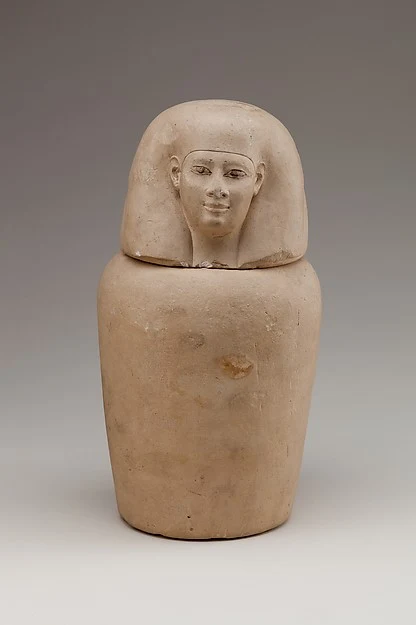
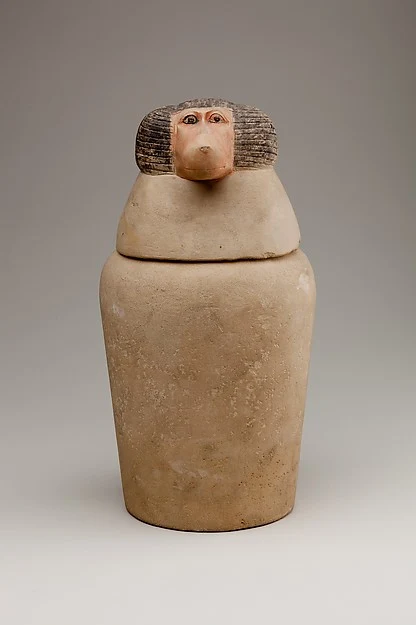
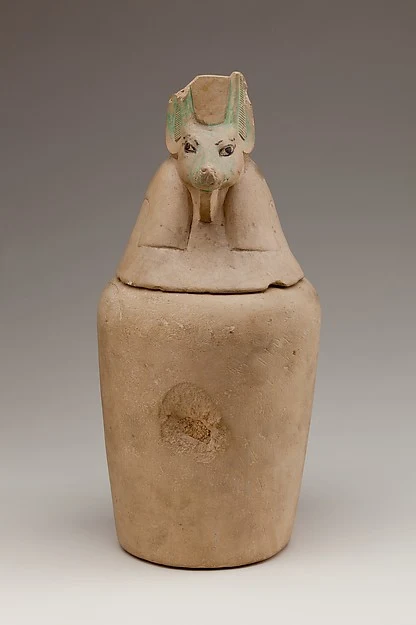
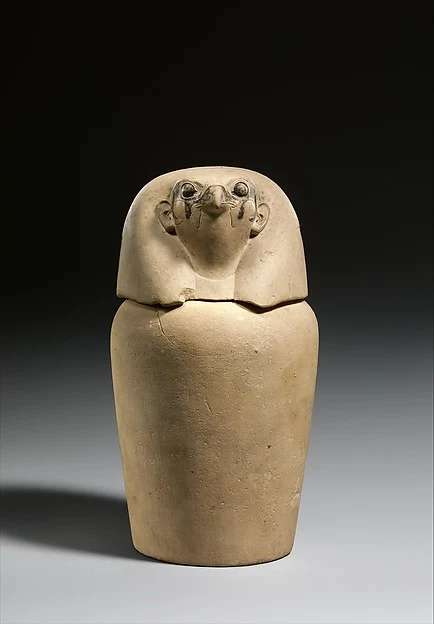
These four limestone jars belong to one Late Period set. Each card opens a closer reading of the lid and the organ traditionally associated with it.
What did the four canopic jars hold?
The familiar associations are Imseti with the liver, Hapy with the lungs, Duamutef with the stomach, and Qebehsenuef with the intestines. A jar could hold a separately wrapped organ removed during mummification. The four Sons of Horus guarded those organs. In the Late Period set pictured here, their lids have human, baboon, jackal and falcon faces. [1][8][9][10][11]
The lid and its inscription identify the intended protection. What a particular jar actually contained requires a different kind of evidence. The Met uses probable identifications for the contents of this set, and the shapes, dates and use of older jars can differ. Egypt’s antiquities ministry treats the heart separately from these four conventionally protected organs. [1][8][2]
Imseti · Human head and liver
Imseti, also written Imsety, is the human-headed protector in the matched Late Period set. Human features are easy to recognise here in contrast with the three animal heads. On earlier vessels several lids in one set could have human faces. On those, an inscription may be more informative than the face. [8][4][2]
Hapy · Baboon head and lungs
The rounded head and projecting muzzle are the clues for Hapy among these four jars. Museum labels may spell the name Hapi. The Met identifies the animal as a baboon and says this vessel probably held lungs. It is one object in the matched group, which helps establish its intended association. [9][1]
Duamutef · Jackal head and stomach
The tall ears and long muzzle identify Duamutef’s jackal head in this Late Period set. Compare it with the Middle Kingdom jar of Sithathoryunet. Its lid is human-headed and its inscription names Duamutef and Neith. The name and the shape can therefore supply different kinds of evidence for the same protector. [10][4]
See references (2)
Qebehsenuef · Falcon head and intestines
The beak and rounded bird head identify Qebehsenuef. His name has several transliterations. The Met gives the intestines as its probable original contents. For this particular set, the four different head forms do more explanatory work together than any one lid can do in isolation. [11][1]
How did the lids change over time?
Early organ containers include a chest with four compartments and jars with plain covers. Middle Kingdom examples often have human heads. Tetinakht’s burial from early Dynasty 18 gives a particularly clear intermediate example. The Met records three surviving jars with one human and two animal heads. The fourth, which the museum thinks may have had a baboon head, is missing. [2][3][15][14]
The Art Institute describes the four distinctive head forms as appearing in some late Dynasty 18 sets and becoming regular from Dynasty 19. Its own Amenhotep set shows why identifying a protector could also depend on the writing. Its lids are human-headed. The inscriptions name protective goddesses and Sons of Horus, and marks under the stoppers helped pair lids with jars. [2]
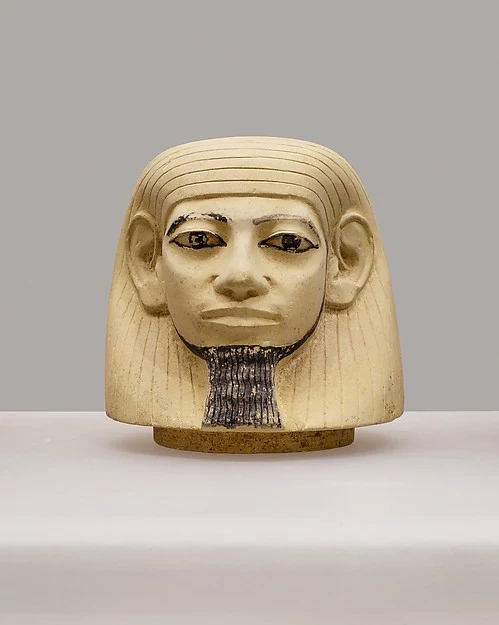
The detached human-headed lid comes from the Middle Kingdom. A lid of this form may have belonged to a set with similar lids for several different protectors.
Middle Kingdom human-headed canopic lid, ca. 1878–1840 B.C.. The Metropolitan Museum of Art, Rogers Fund, 1933, 33.1.8. Open Access. · Image source ↗ · Public Domain
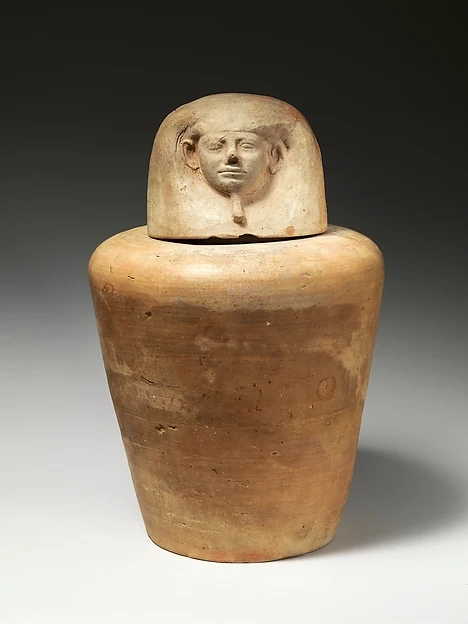
The human-headed Imseti jar belonged with two surviving animal-headed jars from Tetinakht’s burial.
Early New Kingdom jar of Tetinakht, ca. 1550–1525 BCE. The Metropolitan Museum of Art, Rogers Fund, 1912, 12.181.253b.1, .2. Open Access. · Image source ↗ · Public Domain
- Old Kingdom
- Middle Kingdom
- Early New Kingdom
A mix of head forms
Three surviving jars from Tetinakht’s burial include one human form and two animal forms. [14]
- Third Intermediate Period
Solid jars retain the protective form
Some jars have no cavity. The organs could be returned to the wrapped body. [12]
- Late Period
- 4th century BCE or later
The protectors appear on a painted box
The Met proposes that this type of box could hold organs or associated embalming material. [13]
See references (11)
- Art Institute of Chicago · Canopic Jars of Amenhotep, cats. 101–104
- The Met · Canopic jar of Perneb
- The Met · Duamutef jar of Sithathoryunet
- Late Period jar of Imseti
- Late Period jar of Hapy
- Late Period jar of Duamutef
- Late Period jar of Qebehsenuef
- Solid limestone jar of Duamutef
- Later shrine-shaped canopic box
- Early New Kingdom jar of Tetinakht
- Middle Kingdom human-headed canopic lid
Why were some canopic jars solid?
The Met’s Third Intermediate Period jackal-headed object has no interior cavity and no removable lid. The catalogue relates it to the practice of putting preserved organs back inside the mummy. The jar shape and the protective figure remained meaningful as grave goods while the object’s function as a container changed. [12]
Other objects offer different clues. In the Amenhotep group some linen remains on one jar. That material can support use independently of the names on the vessel. In a later painted shrine box, the four guardians are depicted receiving offerings. The Met suggests two possible contents for such boxes, preserved organs or materials connected with embalming. The painting helps interpret the box without settling what was stored in this example. [2][13]
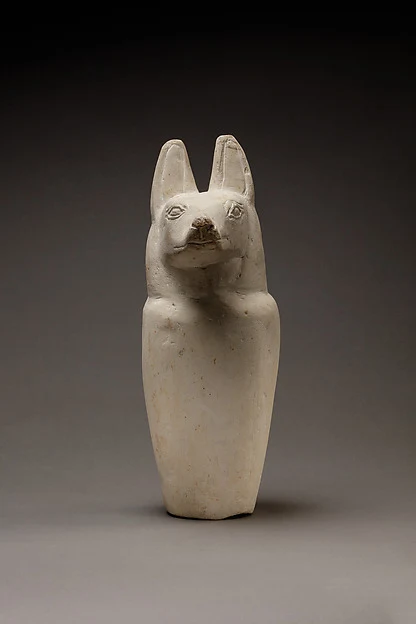
The jackal’s head looks like a lid. It is joined to the solid body, which has no cavity for an organ.
Solid limestone jar of Duamutef, ca. 1080–664 BCE. The Metropolitan Museum of Art, Rogers Fund, 1928, 28.3.60. Open Access. · Image source ↗ · Public Domain
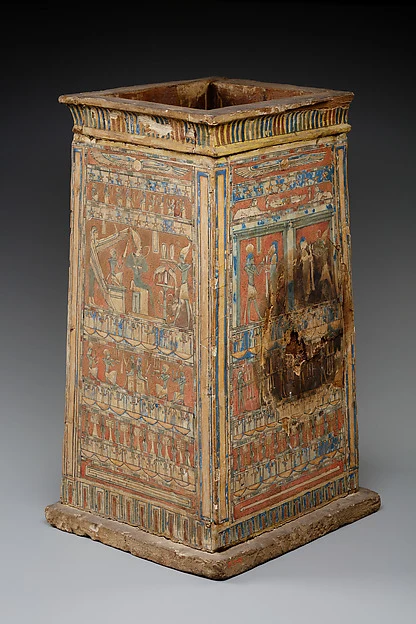
Figures make offerings to the Sons of Horus on the sides. The Met identifies two possible functions for boxes of this type.
Later shrine-shaped canopic box, 4th century BCE–1st century CE. The Metropolitan Museum of Art, Rogers Fund, 1921, 21.2.63. Open Access. · Image source ↗ · Public Domain
Why are they called canopic jars?
The Met traces canopic to an early scholarly association with the Greek figure Canopus, who was depicted in vessel form. The name survived even though the connection confused different objects. The Egyptian inscriptions and burial contexts are the better starting points for reading these vessels. [3][4][2]
Spence’s 1923 reprint in the Library places a photograph of the four forms near his account of mummification. His organ assignments differ from the modern museum labels, even as the heads are recognisable. On the two exact Reader leaves you can see what he wrote and the photograph he used. Compare his text with the current catalogue and keep its claims in their historical setting. [6][7][5][1]
See references (7)
- Egypt’s Ministry of Tourism and Antiquities · Canopic Jars
- Art Institute of Chicago · Canopic Jars of Amenhotep, cats. 101–104
- The Met · Canopic jar of Perneb
- The Met · Duamutef jar of Sithathoryunet
- Lewis Spence · Mummification and the four-jar photograph
- Spence, printed page 28 · The jars and their contents
- Spence · Photograph of four canopic jars
Read further in the library
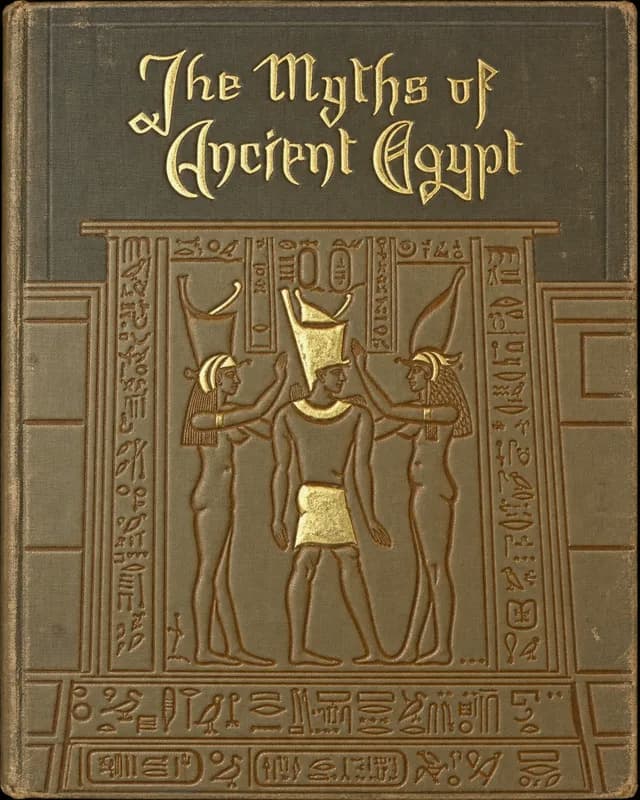
Myths and Legends of Ancient Egypt
Reading note
Compare Spence’s historical organ list with his exact photograph of four jars.
Sources
See references (15)
- Egypt’s Ministry of Tourism and Antiquities · Canopic Jars ↗Egypt’s national collection portal, organ and protector associations.Return to text ↑
- Art Institute of Chicago · Canopic Jars of Amenhotep, cats. 101–104 ↗Art Institute collection catalogue, including the inscriptions, stopper marks, linen and object history.Return to text ↑
- The Met · Canopic jar of Perneb ↗Met collection record, Dynasty 5 object and account of the name canopic.Return to text ↑
- The Met · Duamutef jar of Sithathoryunet ↗Met collection record, human-headed Duamutef jar with inscription.Return to text ↑
- Lewis Spence · Mummification and the four-jar photograph ↗Public-domain electronic transcription, checked alongside the Lumitheca facsimile.Return to text ↑
- Spence, printed page 28 · The jars and their contentsLewis Spence, Myths and Legends of Ancient Egypt, Harrap reprint, 1923. Lumitheca source leaf 50.Read this page in Myths and Legends of Ancient Egypt ↗Return to text ↑
- Spence · Photograph of four canopic jarsLewis Spence, Myths and Legends of Ancient Egypt, Harrap reprint, 1923. Lumitheca source leaf 53.Read this page in Myths and Legends of Ancient Egypt ↗Return to text ↑
- Late Period jar of Imseti ↗Late Period jar of Imseti, 664–525 BCE. The Metropolitan Museum of Art, Gift of J. Pierpont Morgan, 1912, 12.183.1a.1, .2. Open Access.Return to text ↑
- Late Period jar of Hapy ↗Late Period jar of Hapy, 664–525 BCE. The Metropolitan Museum of Art, Gift of J. Pierpont Morgan, 1912, 12.183.1b.1, .2. Open Access.Return to text ↑
- Late Period jar of Duamutef ↗Late Period jar of Duamutef, 664–525 BCE. The Metropolitan Museum of Art, Gift of J. Pierpont Morgan, 1912, 12.183.1d.1, .2. Open Access.Return to text ↑
- Late Period jar of Qebehsenuef ↗Late Period jar of Qebehsenuef, 664–525 BCE. The Metropolitan Museum of Art, Gift of J. Pierpont Morgan, 1912, 12.183.1c.1, .2. Open Access.Return to text ↑
- Solid limestone jar of Duamutef ↗Solid limestone jar of Duamutef, ca. 1080–664 BCE. The Metropolitan Museum of Art, Rogers Fund, 1928, 28.3.60. Open Access.Return to text ↑
- Later shrine-shaped canopic box ↗Later shrine-shaped canopic box, 4th century BCE–1st century CE. The Metropolitan Museum of Art, Rogers Fund, 1921, 21.2.63. Open Access.Return to text ↑
- Early New Kingdom jar of Tetinakht ↗Early New Kingdom jar of Tetinakht, ca. 1550–1525 BCE. The Metropolitan Museum of Art, Rogers Fund, 1912, 12.181.253b.1, .2. Open Access.Return to text ↑
- Middle Kingdom human-headed canopic lid ↗Middle Kingdom human-headed canopic lid, ca. 1878–1840 B.C.. The Metropolitan Museum of Art, Rogers Fund, 1933, 33.1.8. Open Access.Return to text ↑