Fairy evolution
Can fairies become human in esoteric accounts? Compare Rex’s deductions in J. S. M. Ward with C. W. Leadbeater’s separate line of development.
In this article
Understanding fairy evolution
Fairy evolution is an esoteric idea about where fairy beings come from and what they may become. Some writers give them a route towards human life. Others describe their development as separate from humanity. [1][2][3][4]
In J. S. M. Ward’s account, Rex draws an initial conclusion from what he has seen. The stories the beech spirit and the High Fairy king later tell introduce other routes. [1][2][5][4]
See references (5)
A Subaltern in Spirit Land by J. S. M. Ward
In J. S. M. Ward’s A Subaltern in Spirit Land, Rex separates fairy beings from the fairy shapes he attributes to children’s thoughts. He then suggests that some are souls yet to take an earthly form. They might become people, animals or flowers. [1][2]
Rex reasons that gaining a body could narrow a fairy’s freedom and awareness while giving it room to develop particular qualities. On his reading, taking an earthly form can involve losing a freedom and gaining a new capacity. [2][5]
The beech spirit gives one particular case: an ash spirit killed in Fairyland is said to enter a young ash tree on earth, but she cannot explain what follows that tree’s death. The answer supplies a narrated example and preserves another boundary to the contributor’s knowledge. [6]
The High Fairy king offers a different route. Service to humanity supposedly enables some beings to enter the spirit plane without ordinary earthly human life. He nevertheless thinks he may need to experience death on a less material planet. His remaining uncertainty prevents the passage from becoming a complete, uniform evolutionary scheme. [3][7][4]
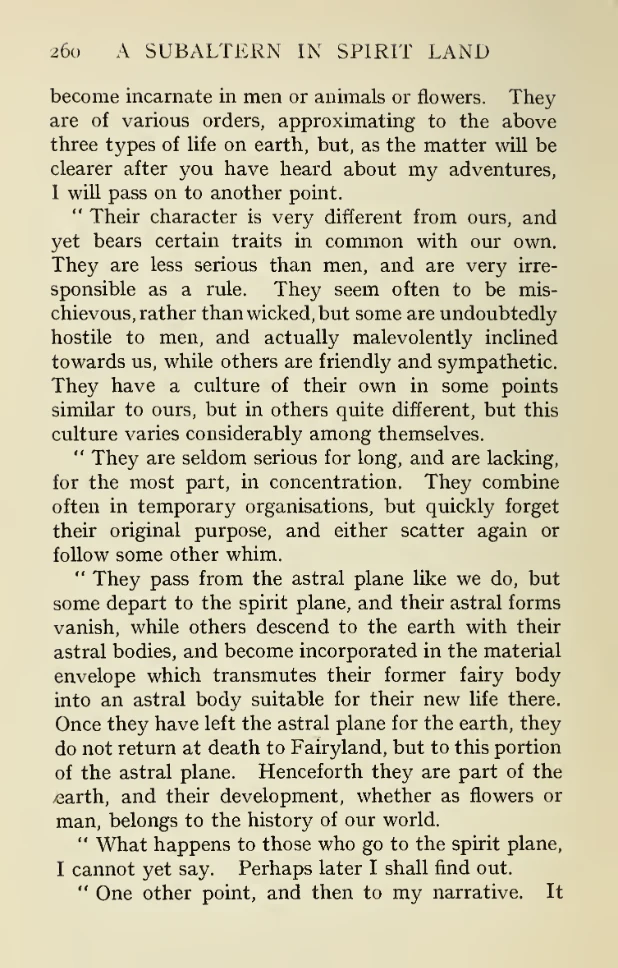
A Subaltern in Spirit Land (1920), printed p. 260, Library Reader page 275. Rex begins with his own deduction about the future of fairies.
J. S. M. Ward, A Subaltern in Spirit Land. William Rider & Son, 1920. Public-domain historical text and page image, extracted from the checksum-verified retained Library scan. · Image source ↗ · Public Domain
See references (7)
- A Subaltern in Spirit Land, printed p. 259, Reader page 274
- A Subaltern in Spirit Land, printed p. 260, Reader page 275
- A Subaltern in Spirit Land, printed p. 288, Reader page 303
- A Subaltern in Spirit Land, printed p. 293, Reader page 308
- A Subaltern in Spirit Land, printed p. 261, Reader page 276
- A Subaltern in Spirit Land, printed p. 281, Reader page 296
- A Subaltern in Spirit Land, printed p. 292, Reader page 307
The Astral Plane by C. W. Leadbeater
C. W. Leadbeater’s The Astral Plane places nature spirits on an evolutionary line separate from humanity. They have not been human and will not become human. His classification includes beings associated with earth, water, air and fire, even where their temporary appearance resembles a small person. [8][9][10]
Three routes and a point of disagreement
The beech spirit describes an ash taking earthly form as a sapling. The king describes service that can lead a being to the spirit plane, and wonders whether he will pass through death on another planet. The cases leave room for more than one path. [2][6][3][4]
Rex’s suggestion concerns fairies taking earthly form for the first time. Reincarnation ordinarily concerns a new embodiment after a life has already ended. The order of events matters to the comparison. [1][2]
Leadbeater gives nature spirits a line of development separate from humanity. Rex considers human embodiment possible for some fairies, while the High Fairy king gives service a route of its own. The disagreement is about what these beings can become. [8][9][10][1][2][3][4]
See references (8)
- A Subaltern in Spirit Land, printed p. 259, Reader page 274
- A Subaltern in Spirit Land, printed p. 260, Reader page 275
- A Subaltern in Spirit Land, printed p. 288, Reader page 303
- A Subaltern in Spirit Land, printed p. 293, Reader page 308
- A Subaltern in Spirit Land, printed p. 281, Reader page 296
- The Astral Plane, Reader page 74
- The Astral Plane, Reader page 76
- The Astral Plane, Reader page 75
Read further in the library
A Subaltern in Spirit Land: A Sequel to Gone West
Reading note
The separately titled account draws on exact passages in the consulted Library edition.
The Astral Plane
Reading note
Separately attributed comparison with exact previously researched Library passages.
Sources
See references (10)
- A Subaltern in Spirit Land, printed p. 259, Reader page 274J. S. M. Ward, A Subaltern in Spirit Land: A Sequel to Gone West. William Rider & Son, London, 1920. Narrated experiences and explanations are attributed to Ward and his reported spirit contributors, especially his brother Rex (R. L. W.) and H. J. L.Read this page in A Subaltern in Spirit Land: A Sequel to Gone West ↗Return to text ↑
- A Subaltern in Spirit Land, printed p. 260, Reader page 275J. S. M. Ward, A Subaltern in Spirit Land: A Sequel to Gone West. William Rider & Son, London, 1920. Narrated experiences and explanations are attributed to Ward and his reported spirit contributors, especially his brother Rex (R. L. W.) and H. J. L.Read this page in A Subaltern in Spirit Land: A Sequel to Gone West ↗Return to text ↑
- A Subaltern in Spirit Land, printed p. 288, Reader page 303J. S. M. Ward, A Subaltern in Spirit Land: A Sequel to Gone West. William Rider & Son, London, 1920. Narrated experiences and explanations are attributed to Ward and his reported spirit contributors, especially his brother Rex (R. L. W.) and H. J. L.Read this page in A Subaltern in Spirit Land: A Sequel to Gone West ↗Return to text ↑
- A Subaltern in Spirit Land, printed p. 293, Reader page 308J. S. M. Ward, A Subaltern in Spirit Land: A Sequel to Gone West. William Rider & Son, London, 1920. Narrated experiences and explanations are attributed to Ward and his reported spirit contributors, especially his brother Rex (R. L. W.) and H. J. L.Read this page in A Subaltern in Spirit Land: A Sequel to Gone West ↗Return to text ↑
- A Subaltern in Spirit Land, printed p. 261, Reader page 276J. S. M. Ward, A Subaltern in Spirit Land: A Sequel to Gone West. William Rider & Son, London, 1920. Narrated experiences and explanations are attributed to Ward and his reported spirit contributors, especially his brother Rex (R. L. W.) and H. J. L.Read this page in A Subaltern in Spirit Land: A Sequel to Gone West ↗Return to text ↑
- A Subaltern in Spirit Land, printed p. 281, Reader page 296J. S. M. Ward, A Subaltern in Spirit Land: A Sequel to Gone West. William Rider & Son, London, 1920. Narrated experiences and explanations are attributed to Ward and his reported spirit contributors, especially his brother Rex (R. L. W.) and H. J. L.Read this page in A Subaltern in Spirit Land: A Sequel to Gone West ↗Return to text ↑
- A Subaltern in Spirit Land, printed p. 292, Reader page 307J. S. M. Ward, A Subaltern in Spirit Land: A Sequel to Gone West. William Rider & Son, London, 1920. Narrated experiences and explanations are attributed to Ward and his reported spirit contributors, especially his brother Rex (R. L. W.) and H. J. L.Read this page in A Subaltern in Spirit Land: A Sequel to Gone West ↗Return to text ↑
- The Astral Plane, Reader page 74C. W. Leadbeater, The Astral Plane, third revised edition scan, circa 1900.Return to text ↑
Examine the original Library page
a humanity such as ours ; their line of evolution is entirely different, and their only connection with us consists in our temporary occupancy of the same
Open the original page in The Astral Plane ↗Scan leaf 81 · C. W. Leadbeater
- The Astral Plane, Reader page 76C. W. Leadbeater, The Astral Plane, third revised edition scan, circa 1900.Return to text ↑
Examine the original Library page
wonderful power which they possess of casting a glamour over those who yield themselves to their influence, so that such victims for the
Open the original page in The Astral Plane ↗Scan leaf 83 · C. W. Leadbeater
- The Astral Plane, Reader page 75C. W. Leadbeater, The Astral Plane, third revised edition scan, circa 1900.Read this page in The Astral Plane ↗Return to text ↑