Eucharistic Adoration
What is Eucharistic adoration? Learn how exposition, the monstrance and Benediction relate to prayer before the Blessed Sacrament.
In this article
What is Eucharistic adoration?
Eucharistic adoration is worship of Christ in the consecrated Eucharist. In Roman Catholic devotion, worshippers may pray before the reserved sacrament. When the consecrated Host is displayed for worship, this is called exposition. A vessel called a monstrance allows the congregation to see the Host. [3][1][2][12]
Benediction is a blessing with the Blessed Sacrament. It may follow a period of prayer, Scripture reading or song during exposition. Communion is the occasion on which the sacrament is received. [1][2]
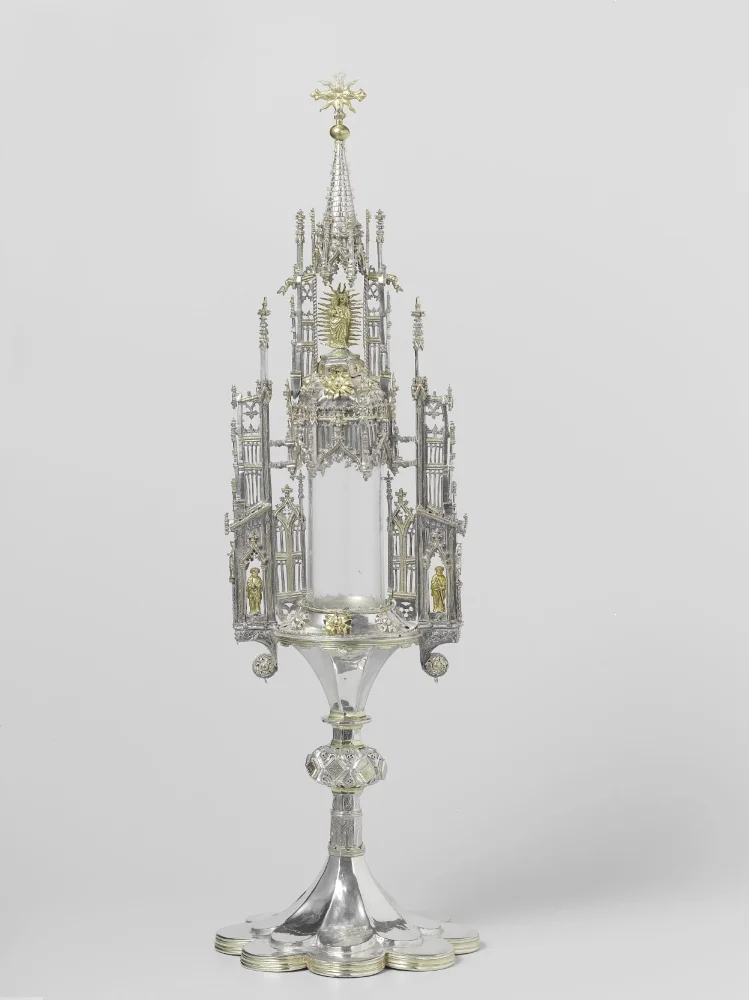
This monstrance from around 1520 held the consecrated Host in its glass cylinder so worshippers could see it.
Attributed to Jan Geldolfs Hoghenzoon, Breda, c. 1520. Rijksmuseum, BK-1981-2. · Image source ↗ · Public Domain
The Science of the Sacraments by Charles W. Leadbeater
Charles W. Leadbeater describes solemn Benediction as a service in its own right, distinct from Vespers. He believes the Host remains a point of contact with Christ and that a congregation’s prayer can draw a stronger response. He attributes the continuing connection to the Angel of the Presence. [4][5][6][7]
Leadbeater pictures the blessing in two directions. He describes expanding spheres around the Host and a horizontal stream going towards the congregation. His comparison with a blessing at the end of an ordinary service turns on where he believes the influence comes from. [8][9][10][11]
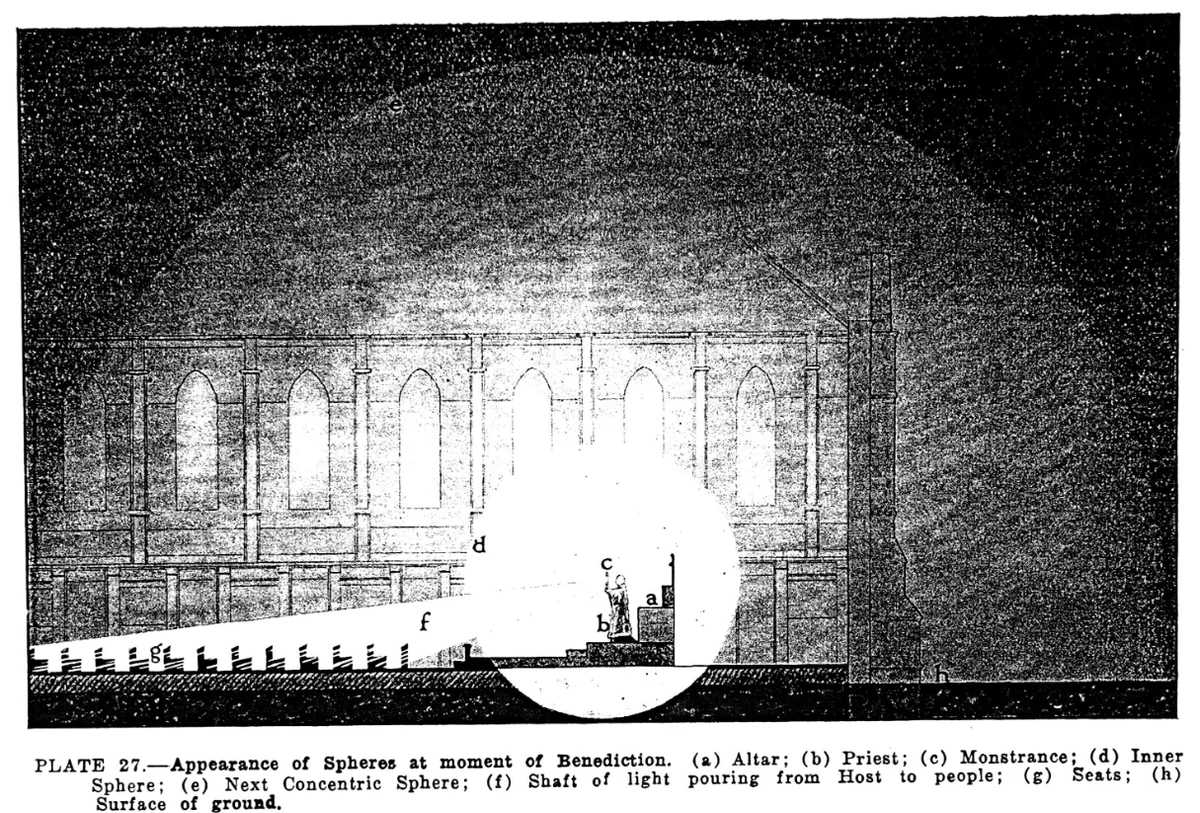
Plate 27, facing printed page 494. Leadbeater’s diagram shows concentric spheres and a shaft of light at Benediction.
The Science of the Sacraments by Charles W. Leadbeater, The St. Alban Press, 1920. Library facsimile. · Image source ↗ · Public Domain
See references (8)
- The Science of the Sacraments, printed p. 489, Reader page 509
- The Science of the Sacraments, printed p. 490, Reader page 510
- The Science of the Sacraments, printed p. 491, Reader page 511
- The Science of the Sacraments, printed p. 494, Reader page 514
- The Science of the Sacraments, Reader page 515
- The Science of the Sacraments, printed p. 497, Reader page 518
- The Science of the Sacraments, printed p. 498, Reader page 519
- The Science of the Sacraments, printed p. 499, Reader page 520
Adoration and Leadbeater’s account of Benediction
Roman Catholic guidance describes exposition through its purpose: adoring Christ present in the Eucharist. Leadbeater also writes about adoration. The spheres and stream belong to his account of what he believes can be perceived during the blessing. [1][3][5][8][9]
In the library
The Science of the Sacraments
Reading note
The separately titled account draws on exact passages in the consulted Library edition.
Sources
See references (12)
- Devotions and Eucharistic Adoration ↗United States Conference of Catholic Bishops.
- Eucharistic Devotion, Exposition and Benediction ↗United States Conference of Catholic Bishops.
- Catechism of the Catholic Church, §§1377–1380 ↗Holy See, English text.
- The Science of the Sacraments, printed p. 489, Reader page 509Charles W. Leadbeater, The Science of the Sacraments, The St. Alban Press, 1920. Exact Library edition IMJ-0615-E001.Read this page in The Science of the Sacraments ↗
- The Science of the Sacraments, printed p. 490, Reader page 510Charles W. Leadbeater, The Science of the Sacraments, The St. Alban Press, 1920. Exact Library edition IMJ-0615-E001.Read this page in The Science of the Sacraments ↗
- The Science of the Sacraments, printed p. 491, Reader page 511Charles W. Leadbeater, The Science of the Sacraments, The St. Alban Press, 1920. Exact Library edition IMJ-0615-E001.Read this page in The Science of the Sacraments ↗
- The Science of the Sacraments, printed p. 494, Reader page 514Charles W. Leadbeater, The Science of the Sacraments, The St. Alban Press, 1920. Exact Library edition IMJ-0615-E001.Read this page in The Science of the Sacraments ↗
- The Science of the Sacraments, Reader page 515Charles W. Leadbeater, The Science of the Sacraments, The St. Alban Press, 1920. Exact Library edition IMJ-0615-E001.Read this page in The Science of the Sacraments ↗
- The Science of the Sacraments, printed p. 497, Reader page 518Charles W. Leadbeater, The Science of the Sacraments, The St. Alban Press, 1920. Exact Library edition IMJ-0615-E001.Read this page in The Science of the Sacraments ↗
- The Science of the Sacraments, printed p. 498, Reader page 519Charles W. Leadbeater, The Science of the Sacraments, The St. Alban Press, 1920. Exact Library edition IMJ-0615-E001.Read this page in The Science of the Sacraments ↗
- The Science of the Sacraments, printed p. 499, Reader page 520Charles W. Leadbeater, The Science of the Sacraments, The St. Alban Press, 1920. Exact Library edition IMJ-0615-E001.Read this page in The Science of the Sacraments ↗
- Monstrance, c. 1520, Rijksmuseum BK-1981-2 ↗Attributed to Jan Geldolfs Hoghenzoon, Breda, c. 1520. Rijksmuseum, BK-1981-2.