Earth-aura and earth-soul
Dion Fortune pictures an earth-aura surrounding the planet and an earth-soul within it. Compare the novel’s closing vision with Plato’s world-soul.
In this article
What are the earth-aura and earth-soul?
In Dion Fortune’s The Goat-Foot God, the earth-aura is a luminous atmosphere around the planet that sustains psychic life. The earth-soul is the living, sentient source within the planet from which it draws vitality. [3][4]
A world-soul can have a different extent in other accounts. Plato’s Timaeus gives a soul to the whole cosmos, extending it through and around the cosmic body. [1][4]
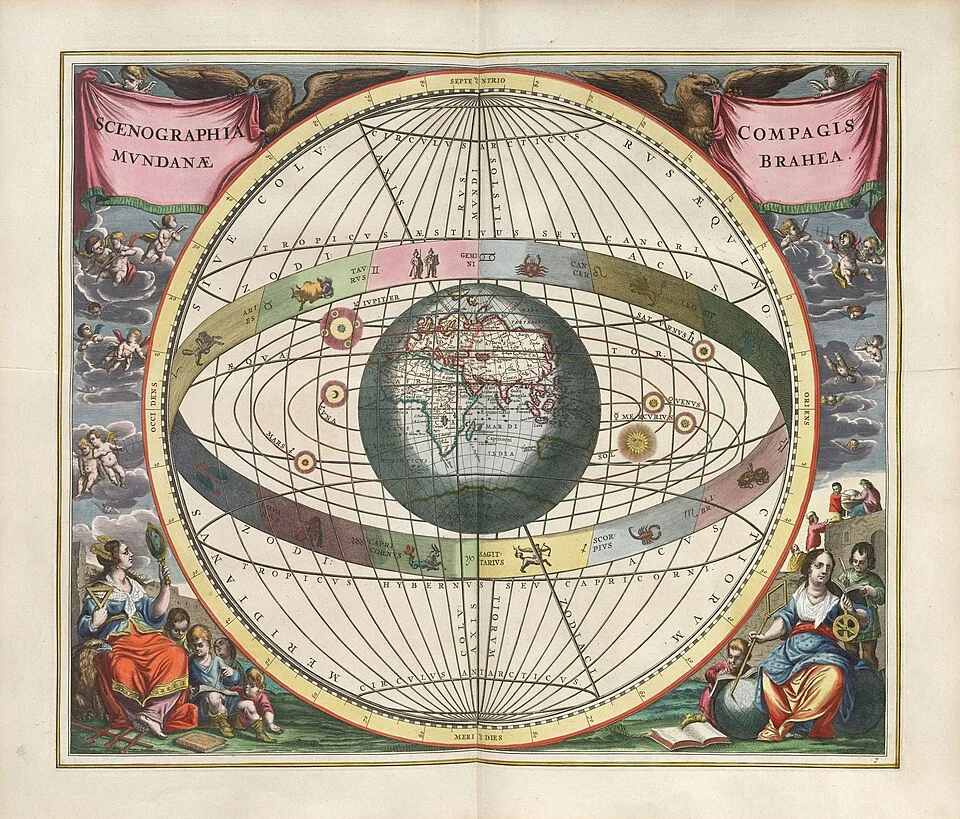
Cellarius gives the Tychonic system a visible arrangement of circles around and near the Earth. Fortune gives bands of light around the planet a psychic meaning in her novel.
Andreas Cellarius, Scenographia Compagis Mundanae Brahea, Harmonia macrocosmica, 1660. Via Wikimedia Commons. · Image source ↗ · Public Domain
The rings of the Earth in The Goat-Foot God
Fortune first uses aura on a smaller scale. As Hugh and Mona leave London, Mona says the city’s influence reaches farther along some roads than others. She follows that impression as they look for a house. [5][6]
In the grove, Hugh sees a globe with luminous rings like Saturn. The narrator calls the rings the earth-aura and locates the earth-soul within. Mona believes they perceive something that was always present. Hugh thinks his invocation has brought it into view. [3][4]
The soul of the cosmos in Timaeus
In Plato’s Timaeus, the maker stretches the world’s soul from the centre through the body and around its outside. The soul belongs to the account of how the whole ordered cosmos lives, knows and moves. [1]
The Principles of Light and Color by Edwin D. Babbitt
In The Principles of Light and Color, Edwin D. Babbitt draws a circle of coloured terrestrial lights. He draws on Karl von Reichenbach’s reports of coloured fringes around a disc in a magnetic experiment and associates the hues with directions and supposed currents. [9][10][11]
Babbitt connects this pattern with polar lights and attributes the colours to Od, a force that Reichenbach’s observers claimed to see. His plate shows where he thought each hue belonged. [9][10][12]
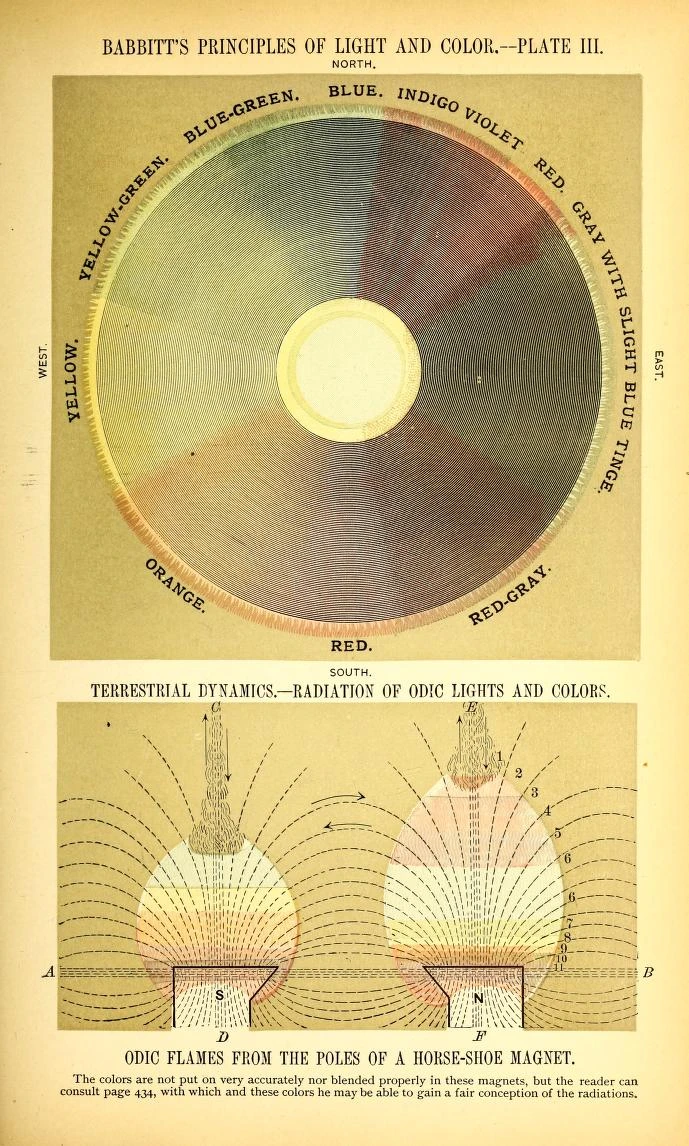
Plate III in the 1878 edition depicts the supposed odic lights of the Earth alongside coloured rays from a horseshoe magnet.
Edwin D. Babbitt, The Principles of Light and Color, first edition (1878), Plate III. Smithsonian Libraries and Archives. · Image source ↗ · CC0
A soul, a psychic atmosphere and a theory of light
Plato places one soul both within and around the cosmos. Fortune distinguishes the earth-soul within from the psychic atmosphere around it. The distinction shapes what Hugh and Mona believe they have seen. [1][3][4]
Babbitt proposes directional currents as a physical explanation. Fortune uses bands of light in a vision and connects them with a sentient Earth. Modern auroral colours come from energetic particles exciting atoms and molecules in the atmosphere. [10][11][3][4][9][12][8]
See references (8)
- Plato, Timaeus 34b–37c
- The Goat-Foot God, Reader page 351
- The Goat-Foot God, Reader page 352
- Auroras, What Causes Auroras?
- The Principles of Light and Color, printed p. 432, Reader page 439
- The Principles of Light and Color, Reader page 442
- The Principles of Light and Color, printed p. 435, Reader page 443
- The Principles of Light and Color, printed p. 445, Reader page 453
Read further in the library
The Goat-Foot God
Reading note
The separately titled account draws on exact passages in the consulted Library edition.
The Principles of Light and Color
Reading note
The separately titled account draws on exact passages in the consulted Library edition.
Sources
See references (12)
- Plato, Timaeus 34b–37c ↗Plato, Timaeus, Stephanus references 34b–37c.Return to text ↑
- The Tychonic system in Harmonia macrocosmica ↗Andreas Cellarius, Scenographia Compagis Mundanae Brahea, Harmonia macrocosmica, 1660. Via Wikimedia Commons.
- The Goat-Foot God, Reader page 351Dion Fortune, The Goat-Foot God. Undated digital Library edition IMJ-0643-E001. Numbered references use the Library Reader sequence.Read this page in The Goat-Foot God ↗Return to text ↑
- The Goat-Foot God, Reader page 352Dion Fortune, The Goat-Foot God. Undated digital Library edition IMJ-0643-E001. Numbered references use the Library Reader sequence.Read this page in The Goat-Foot God ↗Return to text ↑
- The Goat-Foot God, Reader page 89Dion Fortune, The Goat-Foot God. Undated digital Library edition IMJ-0643-E001. Numbered references use the Library Reader sequence.Read this page in The Goat-Foot God ↗Return to text ↑
- The Goat-Foot God, Reader page 90Dion Fortune, The Goat-Foot God. Undated digital Library edition IMJ-0643-E001. Numbered references use the Library Reader sequence.Read this page in The Goat-Foot God ↗Return to text ↑
- The Principles of Light and Color, 1878, Plate III ↗Edwin D. Babbitt, The Principles of Light and Color, first edition (1878), Plate III. Smithsonian Libraries and Archives.
- Auroras, What Causes Auroras? ↗NASA Science.Return to text ↑
- The Principles of Light and Color, printed p. 432, Reader page 439Edwin D. Babbitt, The Principles of Light and Color, second edition, College of Fine Forces, East Orange, New Jersey, 1896. Lumitheca Library edition IMJ-0607-E001.Read this page in The Principles of Light and Color ↗Return to text ↑
- The Principles of Light and Color, Reader page 442Edwin D. Babbitt, The Principles of Light and Color, second edition, College of Fine Forces, East Orange, New Jersey, 1896. Lumitheca Library edition IMJ-0607-E001.Read this page in The Principles of Light and Color ↗Return to text ↑
- The Principles of Light and Color, printed p. 435, Reader page 443Edwin D. Babbitt, The Principles of Light and Color, second edition, College of Fine Forces, East Orange, New Jersey, 1896. Lumitheca Library edition IMJ-0607-E001.Read this page in The Principles of Light and Color ↗Return to text ↑
- The Principles of Light and Color, printed p. 445, Reader page 453Edwin D. Babbitt, The Principles of Light and Color, second edition, College of Fine Forces, East Orange, New Jersey, 1896. Lumitheca Library edition IMJ-0607-E001.Read this page in The Principles of Light and Color ↗Return to text ↑