The draught of forgetfulness
Steiner’s draught of forgetfulness means meeting a new experience on its own terms. Compare it with the removal of wrongdoing from memory in Dante’s Lethe.
In this article
Understanding the concept
The draught of forgetfulness is Rudolf Steiner’s name for meeting a new experience without deciding in advance what it means. Memory remains available. The skill is knowing when past experience will help you see and when it will prevent you from looking closely. [5]
Knowledge of the Higher Worlds by Rudolf Steiner
Rudolf Steiner introduces the draught after the trials of initiation. Someone may judge today entirely by what happened yesterday and miss something that becomes visible only in the new encounter. Steiner asks the student to keep past experiences as clearly in mind as possible and use them to notice more in the present. [6][7][5]
In the next passage, the draught of remembrance concerns what should stay with the student. Knowledge should become part of conduct through practice, free from the need to recall a rule at each step. [5][8]
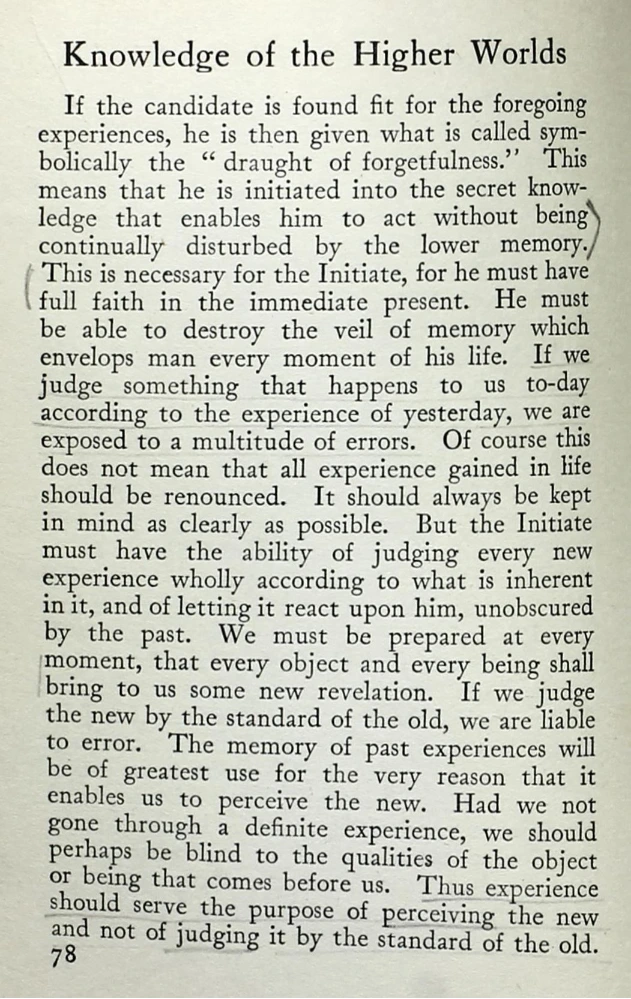
Steiner explains what it means to keep an experience in mind while meeting something new. Knowledge of the Higher Worlds, printed p. 78, Library reader p. 82.
Rudolf Steiner, G. Metaxa translation, edited by Harry Collison. Historical public-domain source facsimile from the exact checksum-verified Library edition. Repository date 1932; the inspected title page is undated. · Image source ↗ · Public Domain
The Divine Comedy by Dante Alighieri
In Dante Alighieri’s Purgatory, Lethe removes the remembrance of wrongdoing. In Canto XXXI, after Beatrice confronts Dante and he acknowledges his error, he is drawn through the river. In Canto XXXIII, Dante cannot recall being estranged from Beatrice. She tells him what has happened to that memory. [1][9][10][2][3]
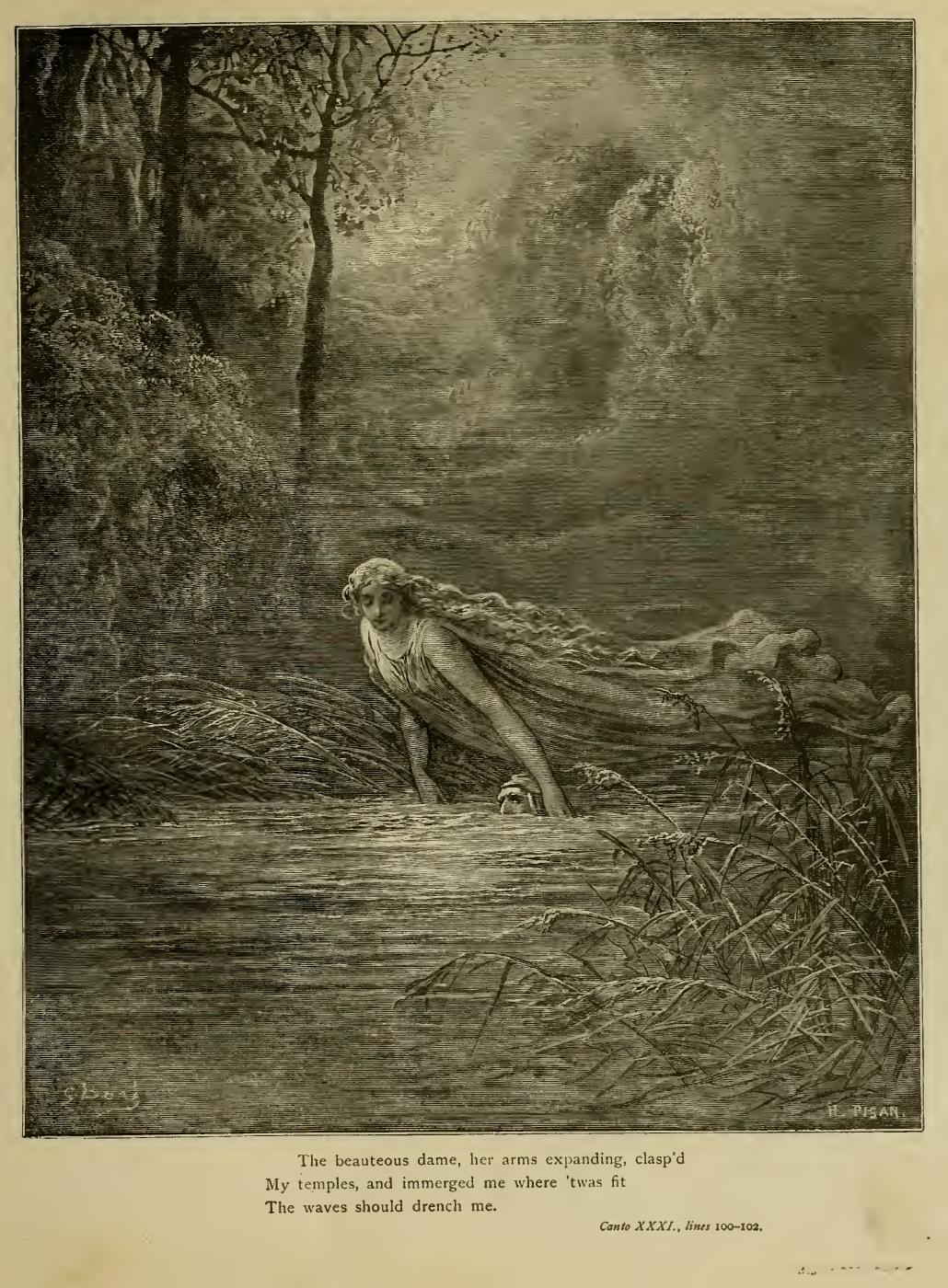
Matilda draws Dante through Lethe. Gustave Doré’s illustration accompanies Purgatory XXXI, lines 100–103 in the Cary edition.
Design by Gustave Doré. Purgatory and Paradise, Henry Francis Cary translation, Thompson & Thomas, Chicago, 1901. Public Domain. · Image source ↗ · Public Domain
See references (5)
- Purgatory and Paradise, Purgatory XXVIII, Reader page 171
- Purgatory and Paradise, Purgatory XXXI, Reader page 189
- Purgatory and Paradise, Purgatory XXXIII, Reader page 200
- Dante, Purgatory XXXI, Cary translation, printed p. 141, Reader page 187
- Dante, Purgatory XXXI, Cary translation, printed p. 142, Reader page 188
What is forgotten at Lethe
Dante gives the water a definite moral purpose: it removes a memory after the pilgrim has faced what he did. Steiner’s draught gives experience another role to play. The past can sharpen perception when it remains available to be corrected by what the person encounters next. [1][2][3][5]
Read further in the library
Purgatory and Paradise: The Vision of Dante
Reading note
Separately attributed primary Library account, cited on exact verified Reader leaves.
Knowledge of the Higher Worlds and Its Attainment
Reading note
The separately titled account draws on exact passages in the consulted Library edition.
Sources
See references (10)
- Purgatory and Paradise, Purgatory XXVIII, Reader page 171Dante Alighieri, The Divine Comedy, translated by Henry Francis Cary. Inferno: undated New Edition, Thompson & Thomas, Chicago. Purgatory and Paradise: New Edition, Thompson & Thomas, Chicago, 1901. Designs by Gustave Doré.Return to text ↑
Examine the original Library page
Existing stable Reader citation retained on the exact current page. Current Reader position reconciled; historical numbering is not reused.
power to take away Remembrance of offence
Open the original page in Purgatory and Paradise: The Vision of Dante ↗Scan leaf 175 · Dante Alighieri; translated by Henry Francis Cary; illustrated by Gustave Doré
- Purgatory and Paradise, Purgatory XXXI, Reader page 189Dante Alighieri, The Divine Comedy, translated by Henry Francis Cary. Inferno: undated New Edition, Thompson & Thomas, Chicago. Purgatory and Paradise: New Edition, Thompson & Thomas, Chicago, 1901. Designs by Gustave Doré.Return to text ↑
Examine the original Library page
Existing stable Reader citation retained on the exact current page. Current Reader position reconciled; historical numbering is not reused.
My temples, and immerged me
Open the original page in Purgatory and Paradise: The Vision of Dante ↗Scan leaf 193 · Dante Alighieri; translated by Henry Francis Cary; illustrated by Gustave Doré
- Purgatory and Paradise, Purgatory XXXIII, Reader page 200Dante Alighieri, The Divine Comedy, translated by Henry Francis Cary. Inferno: undated New Edition, Thompson & Thomas, Chicago. Purgatory and Paradise: New Edition, Thompson & Thomas, Chicago, 1901. Designs by Gustave Doré.Read this page in Purgatory and Paradise: The Vision of Dante ↗Return to text ↑
- Purgatory and Paradise, Purgatory XXXI, Reader page 185Dante Alighieri, The Divine Comedy, translated by Henry Francis Cary. Inferno: undated New Edition, Thompson & Thomas, Chicago. Purgatory and Paradise: New Edition, Thompson & Thomas, Chicago, 1901. Designs by Gustave Doré.Read this page in Purgatory and Paradise: The Vision of Dante ↗
- Knowledge of the Higher Worlds and Its Attainment, Reader page 82Rudolf Steiner, Knowledge of the Higher Worlds and Its Attainment, authorized English translation by G. Metaxa, edited by Harry Collison, Anthroposophic Press, New York City. Exact Library edition IMJ-0513-E001. No publication year is visible on the inspected title page; the repository assigns 1932. Claims of supersensible perception remain attributed to Steiner.Read this page in Knowledge of the Higher Worlds and Its Attainment ↗Return to text ↑
- Knowledge of the Higher Worlds and Its Attainment, Reader page 80Rudolf Steiner, Knowledge of the Higher Worlds and Its Attainment, authorized English translation by G. Metaxa, edited by Harry Collison, Anthroposophic Press, New York City. Exact Library edition IMJ-0513-E001. No publication year is visible on the inspected title page; the repository assigns 1932. Claims of supersensible perception remain attributed to Steiner.Read this page in Knowledge of the Higher Worlds and Its Attainment ↗Return to text ↑
- Knowledge of the Higher Worlds and Its Attainment, Reader page 81Rudolf Steiner, Knowledge of the Higher Worlds and Its Attainment, authorized English translation by G. Metaxa, edited by Harry Collison, Anthroposophic Press, New York City. Exact Library edition IMJ-0513-E001. No publication year is visible on the inspected title page; the repository assigns 1932. Claims of supersensible perception remain attributed to Steiner.Read this page in Knowledge of the Higher Worlds and Its Attainment ↗Return to text ↑
- Knowledge of the Higher Worlds and Its Attainment, Reader page 83Rudolf Steiner, Knowledge of the Higher Worlds and Its Attainment, authorized English translation by G. Metaxa, edited by Harry Collison, Anthroposophic Press, New York City. Exact Library edition IMJ-0513-E001. No publication year is visible on the inspected title page; the repository assigns 1932. Claims of supersensible perception remain attributed to Steiner.Read this page in Knowledge of the Higher Worlds and Its Attainment ↗Return to text ↑
- Dante, Purgatory XXXI, Cary translation, printed p. 141, Reader page 187Dante Alighieri, The Divine Comedy, translated by Henry Francis Cary. Inferno: undated New Edition, Thompson & Thomas, Chicago. Purgatory and Paradise: New Edition, Thompson & Thomas, Chicago, 1901. Designs by Gustave Doré.Read this page in Purgatory and Paradise: The Vision of Dante ↗Return to text ↑
- Dante, Purgatory XXXI, Cary translation, printed p. 142, Reader page 188Dante Alighieri, The Divine Comedy, translated by Henry Francis Cary. Inferno: undated New Edition, Thompson & Thomas, Chicago. Purgatory and Paradise: New Edition, Thompson & Thomas, Chicago, 1901. Designs by Gustave Doré.Read this page in Purgatory and Paradise: The Vision of Dante ↗Return to text ↑