Double-cube altar
A double-cube altar has the proportions of two stacked cubes. See how Crowley and Dion Fortune use the form to represent the universe.
In this article
Why is the altar twice as tall as it is wide?
A double-cube altar has the proportions of two equal cubes stacked one above the other. It is twice as tall as it is wide. In Western ceremonial magic, writers give the shape symbolic meaning as well as a practical place at the centre of a rite. [1][3]
The two cubes can relate what is above to what is below. Their faces and any designs on them give writers another way to set out the relationships the altar is meant to express. [1][3][4]
The altar in Book 4
In Book 4, part II, Aleister Crowley and Soror Virakam use the old geometrical problem of doubling a cube to describe the Great Work. The stacked altar has ten exterior squares. Its top corresponds to Kether and its bottom to Malkuth. [1]
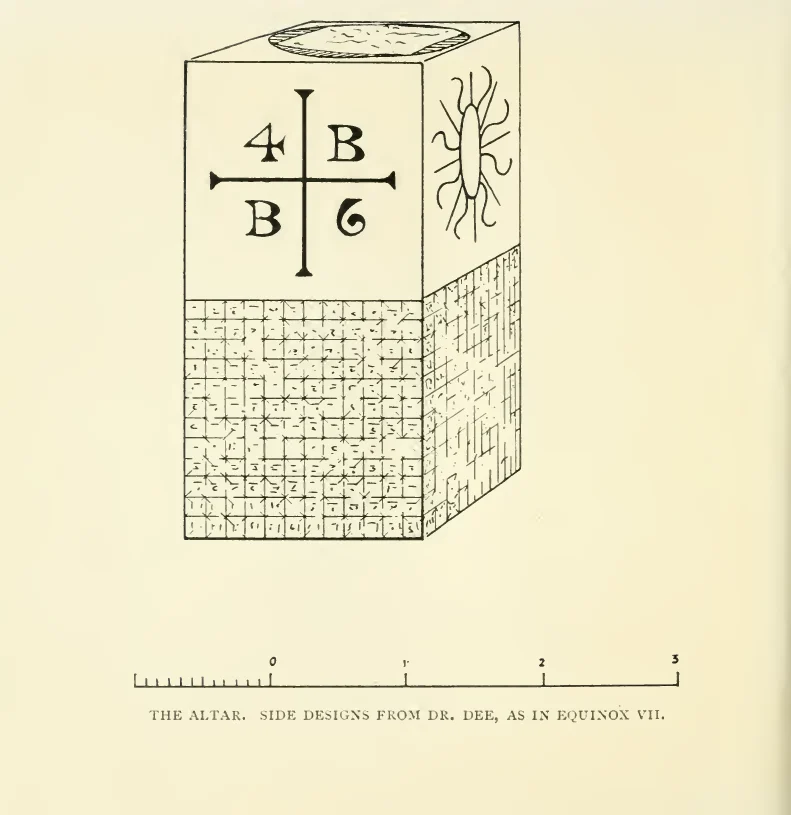
A plate from Book 4, part II, shows the front, side and top of the double-cube altar. Its caption attributes the side designs to John Dee.
Aleister Crowley and Soror Virakam, Book 4, part II (Wieland and Co., ca. 1913), unnumbered plate beside the altar chapter. Digitized copy via Internet Archive. · Image source ↗ · Public Domain
A chapel and a standing stone in The Goat-Foot God
In Dion Fortune’s The Goat-Foot God, Hugh first pictures the cubical altar he associates with the Templars. It prompts him to ask what it would mean to look on the universe as an altar. [5][6]
In the chapel, a double-cube altar supports a figure of Piping Pan. The narrator says the form represents the universe. When Hugh prepares the grove, he has a standing stone raised and uses that as his altar. [3][4][7][8]
A measured form and a stone in a clearing
Book 4 explains the details of the altar through proportion and the meaning of its faces. Fortune shows an altar at work in two places. The chapel has a made object that represents the universe, and the grove has a stone Hugh finds lying where he wants to hold the rite. [1][3][7][8]
Read further in the library
The Goat-Foot God
Reading note
The separately titled account draws on exact passages in the consulted Library edition.
Sources
See references (8)
- Book 4, part II, chapter II, “The Altar” ↗Aleister Crowley and Soror Virakam, Book 4, part II (Wieland and Co., ca. 1913), chapter III, printed pp. 19–23.Return to text ↑
- The Altar. Side Designs ↗Aleister Crowley and Soror Virakam, Book 4, part II (Wieland and Co., ca. 1913), unnumbered plate beside the altar chapter. Digitized copy via Internet Archive.
- The Goat-Foot God, Reader page 306Dion Fortune, The Goat-Foot God. Undated digital Library edition IMJ-0643-E001. Numbered references use the Library Reader sequence.Read this page in The Goat-Foot God ↗Return to text ↑
- The Goat-Foot God, Reader page 307Dion Fortune, The Goat-Foot God. Undated digital Library edition IMJ-0643-E001. Numbered references use the Library Reader sequence.Read this page in The Goat-Foot God ↗Return to text ↑
- The Goat-Foot God, Reader page 239Dion Fortune, The Goat-Foot God. Undated digital Library edition IMJ-0643-E001. Numbered references use the Library Reader sequence.Read this page in The Goat-Foot God ↗Return to text ↑
- The Goat-Foot God, Reader page 240Dion Fortune, The Goat-Foot God. Undated digital Library edition IMJ-0643-E001. Numbered references use the Library Reader sequence.Read this page in The Goat-Foot God ↗Return to text ↑
- The Goat-Foot God, Reader page 335Dion Fortune, The Goat-Foot God. Undated digital Library edition IMJ-0643-E001. Numbered references use the Library Reader sequence.Read this page in The Goat-Foot God ↗Return to text ↑
- The Goat-Foot God, Reader page 336Dion Fortune, The Goat-Foot God. Undated digital Library edition IMJ-0643-E001. Numbered references use the Library Reader sequence.Read this page in The Goat-Foot God ↗Return to text ↑