Divine omniscience
Divine omniscience is the claim that God knows everything. Compare Boethius on eternity, Flammarion on light and Walter Russell on universal Mind.
In this article
Understanding divine omniscience
Divine omniscience is the claim that God knows everything. For a human observer, yesterday is remembered and tomorrow is still unknown. For an omniscient being, the question is how those events can be known at all times, and what that knowledge means for a person’s freedom to act. [3][4][5][1]
Accounts of divine knowledge
The Consolation of Philosophy by Boethius
In The Consolation of Philosophy, Book V, prose 6, Boethius distinguishes eternity from a life that simply goes on forever. In H. R. James’s translation, the divine mind holds all of life in an abiding present. Boethius distinguishes knowing with certainty that an action happens from making it happen by necessity. His account leaves room for actions that are freely chosen. [1]
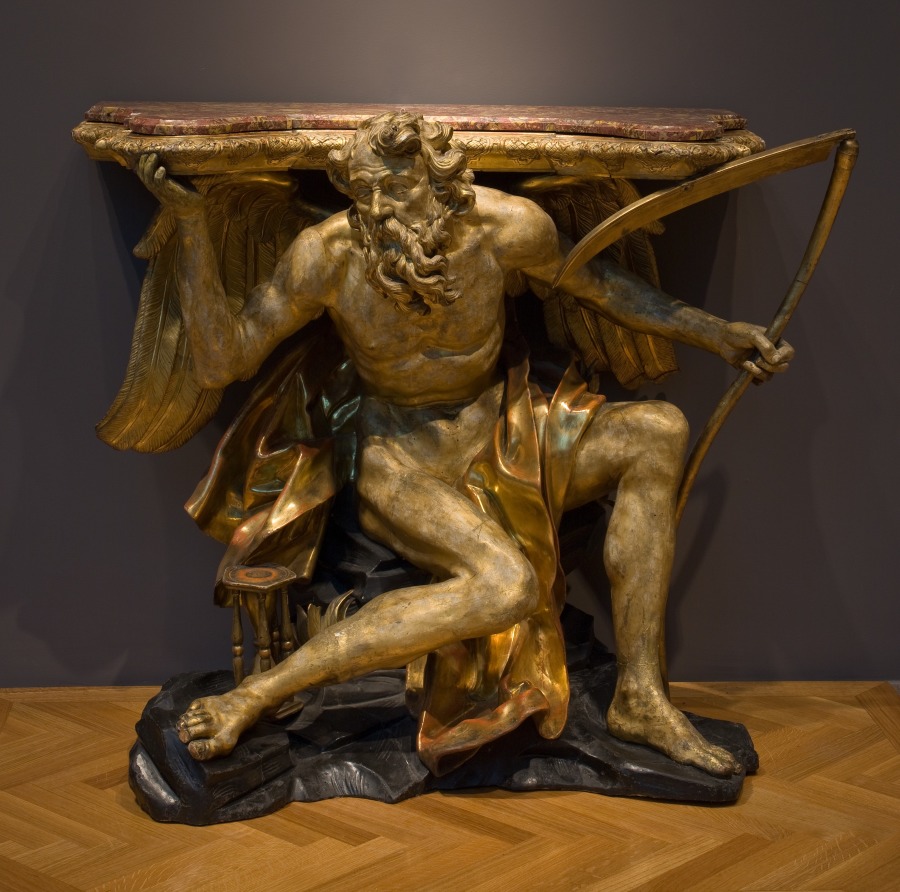
Console Table Depicting Chronos, or Father Time (ca. 1700). An hourglass and scythe make the passage of time visible.
The Cleveland Museum of Art, Elisabeth Severance Prentiss Collection by exchange. 1968.31. CC0. · Image source ↗ · CC0
Lumen by Camille Flammarion
In Lumen, Camille Flammarion pictures the histories of worlds travelling outward in light. An observer in one place sees only what has reached it. God, understood as present everywhere, could take in all those appearances together. [3][4]
The dialogue also argues from causes and effects. As a naturalist infers an extinct animal from a fragment, the Author of Nature could know earlier conditions from their present results. The future is already present in its beginnings, just as the past survives in what it has brought about. [5][4]
The Universal One by Walter Russell
In The Universal One, Walter Russell says that all knowledge belongs to universal Mind. He distinguishes the underlying cause, which he calls simple, from the many effects a person can observe. He describes inspiration as a way to reach knowledge already present in universal Mind. [7][8][9][10][11][12][13]
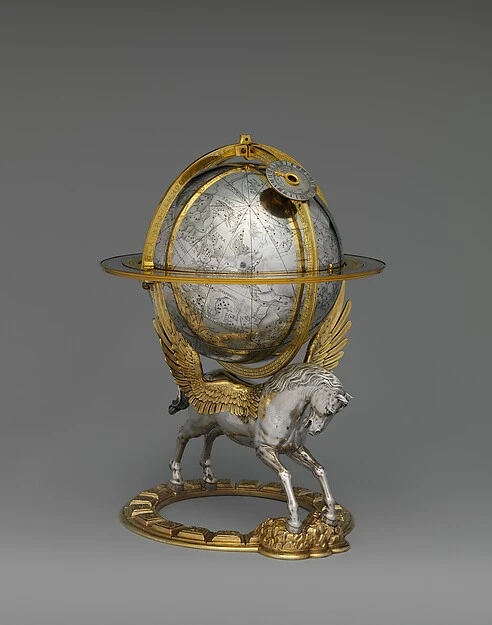
Gerhard Emmoser, Celestial globe with clockwork (1579). A clock mechanism moves the globe to represent the apparent movement of the heavens.
Gerhard Emmoser, Celestial Globe with Clockwork. The Metropolitan Museum of Art. Gift of J. Pierpont Morgan, 1917. · Image source ↗ · CC0
Eternity, presence and knowledge of causes
Boethius gives divine knowledge an eternal present that does not unfold moment by moment. Flammarion imagines a presence that can take in the visible past from all locations and comprehend the causes of what is to come. Russell centres his explanation on universal Mind and its knowledge of the cause beneath many effects. [1][3][4][5][7][8][12][13]
See references (8)
- Boethius, The Consolation of Philosophy, Book V, prose VI, translated by H. R. James,1897
- Lumen, Reader page 132
- Lumen, printed p. 127, Reader page 133
- Lumen, Reader page 134
- The Universal One, Reader page 74
- The Universal One, Reader page 75
- The Universal One, Reader page 86
- The Universal One, Reader page 87
Read further in the library
Lumen
Reading note
The separately titled account draws on exact passages in the consulted Library edition.
The Universal One
Reading note
The separately titled account draws on exact passages in the consulted Library edition.
Sources
See references (13)
- Boethius, The Consolation of Philosophy, Book V, prose VI, translated by H. R. James,1897 ↗Boethius’s primary dialogue in H. R. James’s 1897 translation, consulted in the Wikisource transcription, Book V, prose VI. The same page includes prose V and Song V; the account below uses prose VI. The earlier Project Gutenberg address returned 503 during recheck. No newly verified printed pagination is claimed.Return to text ↑
- Console Table Depicting Chronos, or Father Time, c. 1700 ↗Console Table Depicting Chronos, or Father Time, c. 1700. Italy, probably Rome, late 17th-early 18th Century. Painted and gilded wood, marble top; overall: 95.3 x 107.3 x 62.9 cm (37 1/2 x 42 1/4 x 24 3/4 in.). The Cleveland Museum of Art, Elisabeth Severance Prentiss Collection by exchange, 1968.31. CC0 open-access image.
- Lumen, Reader page 132Camille Flammarion, Lumen, authorised English translation by A. A. M. and R. M., Dodd, Mead and Company, New York, 1897. Exact selected Library edition IMJ-0398-E001. Lumen and Quaerens are speakers in the dialogue; claims made by the narrator are attributed to this text. Original PageIDs and current Reader positions are verified separately from printed pagination.Read this page in Lumen ↗Return to text ↑
- Lumen, printed p. 127, Reader page 133Camille Flammarion, Lumen, authorised English translation by A. A. M. and R. M., Dodd, Mead and Company, New York, 1897. Exact selected Library edition IMJ-0398-E001. Lumen and Quaerens are speakers in the dialogue; claims made by the narrator are attributed to this text. Original PageIDs and current Reader positions are verified separately from printed pagination.Read this page in Lumen ↗Return to text ↑
- Lumen, Reader page 134Camille Flammarion, Lumen, authorised English translation by A. A. M. and R. M., Dodd, Mead and Company, New York, 1897. Exact selected Library edition IMJ-0398-E001. Lumen and Quaerens are speakers in the dialogue; claims made by the narrator are attributed to this text. Original PageIDs and current Reader positions are verified separately from printed pagination.Read this page in Lumen ↗Return to text ↑
- Gerhard Emmoser, Celestial Globe with Clockwork ↗Gerhard Emmoser, Celestial Globe with Clockwork. The Metropolitan Museum of Art. Gift of J. Pierpont Morgan, 1917.
- The Universal One, Reader page 74Walter Russell, The Universal One, edited by Louise Russell, University of Science and Philosophy, Limited Edition De Luxe. Lumitheca Library edition IMJ-0605-E001.Read this page in The Universal One ↗Return to text ↑
- The Universal One, Reader page 75Walter Russell, The Universal One, edited by Louise Russell, University of Science and Philosophy, Limited Edition De Luxe. Lumitheca Library edition IMJ-0605-E001.Read this page in The Universal One ↗Return to text ↑
- The Universal One, Reader page 76Walter Russell, The Universal One, edited by Louise Russell, University of Science and Philosophy, Limited Edition De Luxe. Lumitheca Library edition IMJ-0605-E001.Read this page in The Universal One ↗Return to text ↑
- The Universal One, Reader page 77Walter Russell, The Universal One, edited by Louise Russell, University of Science and Philosophy, Limited Edition De Luxe. Lumitheca Library edition IMJ-0605-E001.Read this page in The Universal One ↗Return to text ↑
- The Universal One, Reader page 85Walter Russell, The Universal One, edited by Louise Russell, University of Science and Philosophy, Limited Edition De Luxe. Lumitheca Library edition IMJ-0605-E001.Read this page in The Universal One ↗Return to text ↑
- The Universal One, Reader page 86Walter Russell, The Universal One, edited by Louise Russell, University of Science and Philosophy, Limited Edition De Luxe. Lumitheca Library edition IMJ-0605-E001.Read this page in The Universal One ↗Return to text ↑
- The Universal One, Reader page 87Walter Russell, The Universal One, edited by Louise Russell, University of Science and Philosophy, Limited Edition De Luxe. Lumitheca Library edition IMJ-0605-E001.Read this page in The Universal One ↗Return to text ↑