Divine appearances and religious belief
In Gone West, J. S. M. Ward reports encounters with forms associated with Osiris and Kartikeya. Read what he claims and what he leaves open.
In this article
Understanding divine appearances and religious belief
In Gone West, divine appearances are encounters in which a figure is recognised through a familiar religious form. J. S. M. Ward places the encounters in communities he describes as continuing their religious lives after death. [1][2]
Ward reports gods, or at least their forms. The qualification leaves open the difference between seeing a familiar image and knowing who or what appeared through it. [1]
Gone West by J. S. M. Ward
Ward summarises the reports in the introduction to Gone West. He attributes them to J. B. P., whose account of a higher realm he says was left out of the main narrative because of the cost of production. The examples reach the reader in that summary. [1]
The examples include Osiris appearing during a service in an Egyptian temple and Kartikeya presiding in a Hindu temple. Ward places them within his account of religious development beyond narrow sectarian communities. These are his contributor’s reported encounters, interpreted within the book’s Spiritualist framework. [1]
The following introduction describes religious unity as the retention of truths from different faiths, rather than the reduction of all religions to one vague creed. That principle explains why distinct religious forms can remain meaningful within a system whose ultimate direction is unity. [2]
Elsewhere an angelic guardian is said to take the forms of flame and cloud voluntarily. That incident shows one way Ward imagines a form being assumed. The introduction leaves the appearances in the temples without a comparable account of how they arose. [2][3]
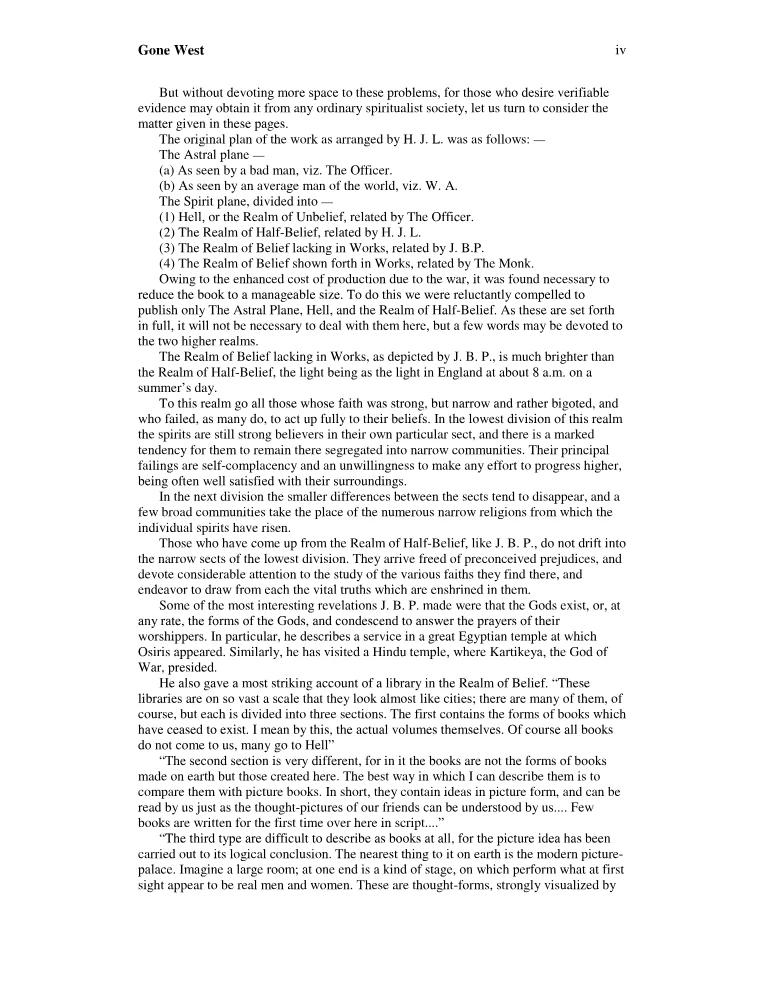
Source page: Gone West, Reader page 8. Ward’s 1920 text is shown in Geoff Cutler’s 2009 digital transcription, rather than an original printed facsimile.
J. S. M. Ward, Gone West, historical text in the public domain. Geoff Cutler’s 2009 transcription expressly permits reuse for any purpose on source leaf2. This image shows the digital transcription, not an original printed facsimile. · Image source ↗ · Public Domain
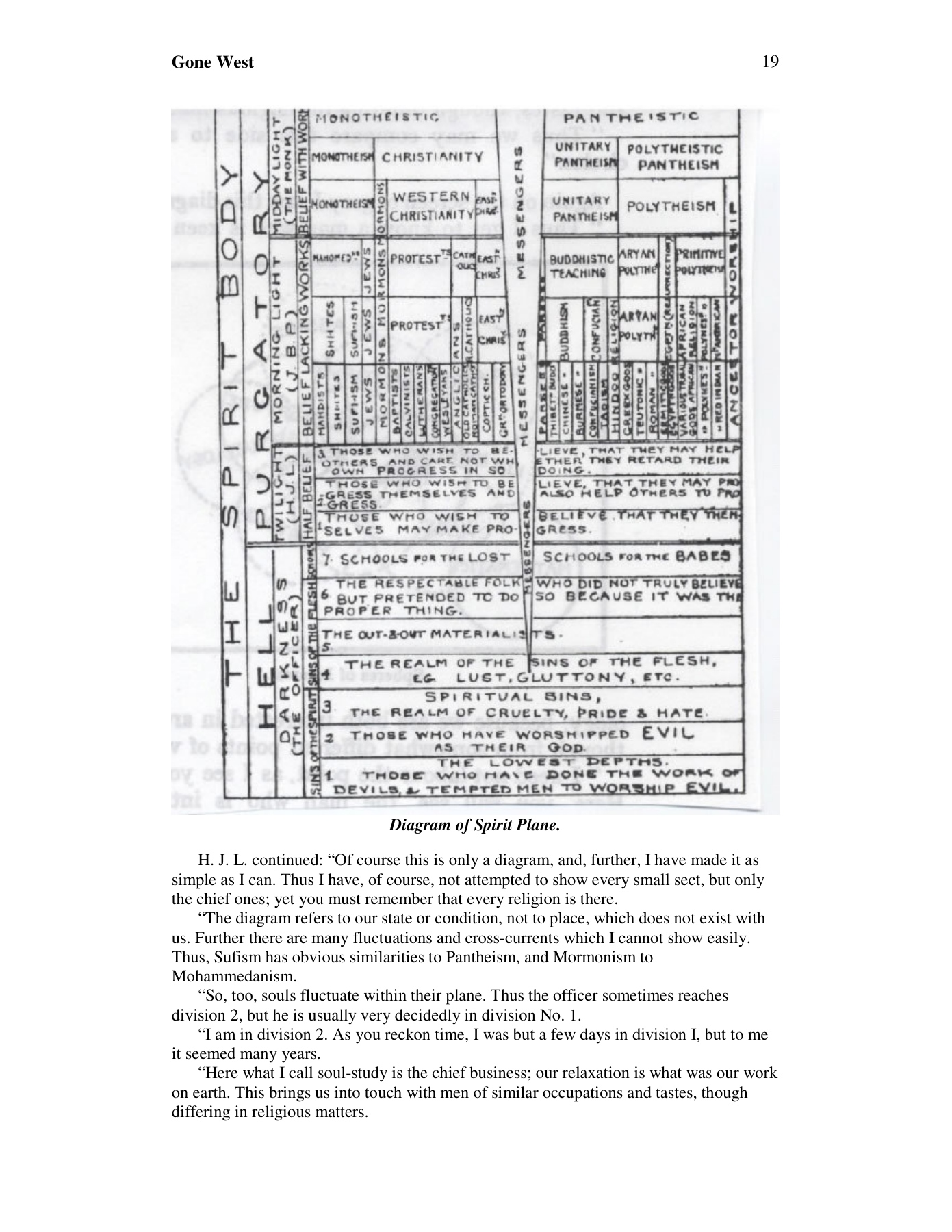
Diagram of the Spirit Plane in Gone West, printed p. 19, Library Reader page 32. Ward’s guide says the diagram represents states or conditions.
J. S. M. Ward, Gone West. Historical diagram in the public domain. Digital transcription by Geoff Cutler, whose notice on source leaf 2 permits reuse for any purpose. · Image source ↗ · Public Domain
Ward’s framework and the traditions it invokes
The diagram of the spirit plane groups religious communities according to Ward’s scheme. His guide calls those groupings states or conditions and treats the chart as a simplification. That frame helps explain where the temple reports appear in the book. [1][2][5]
The Osiris brick gives the deity a historical context outside Ward’s account. The Met connects objects of this type with the Khoiak festival and the image of regeneration through sprouting grain. Ward’s temple episode belongs to his later Spiritualist narrative, which tells the reader how a visitor interpreted what appeared there. [1][4]
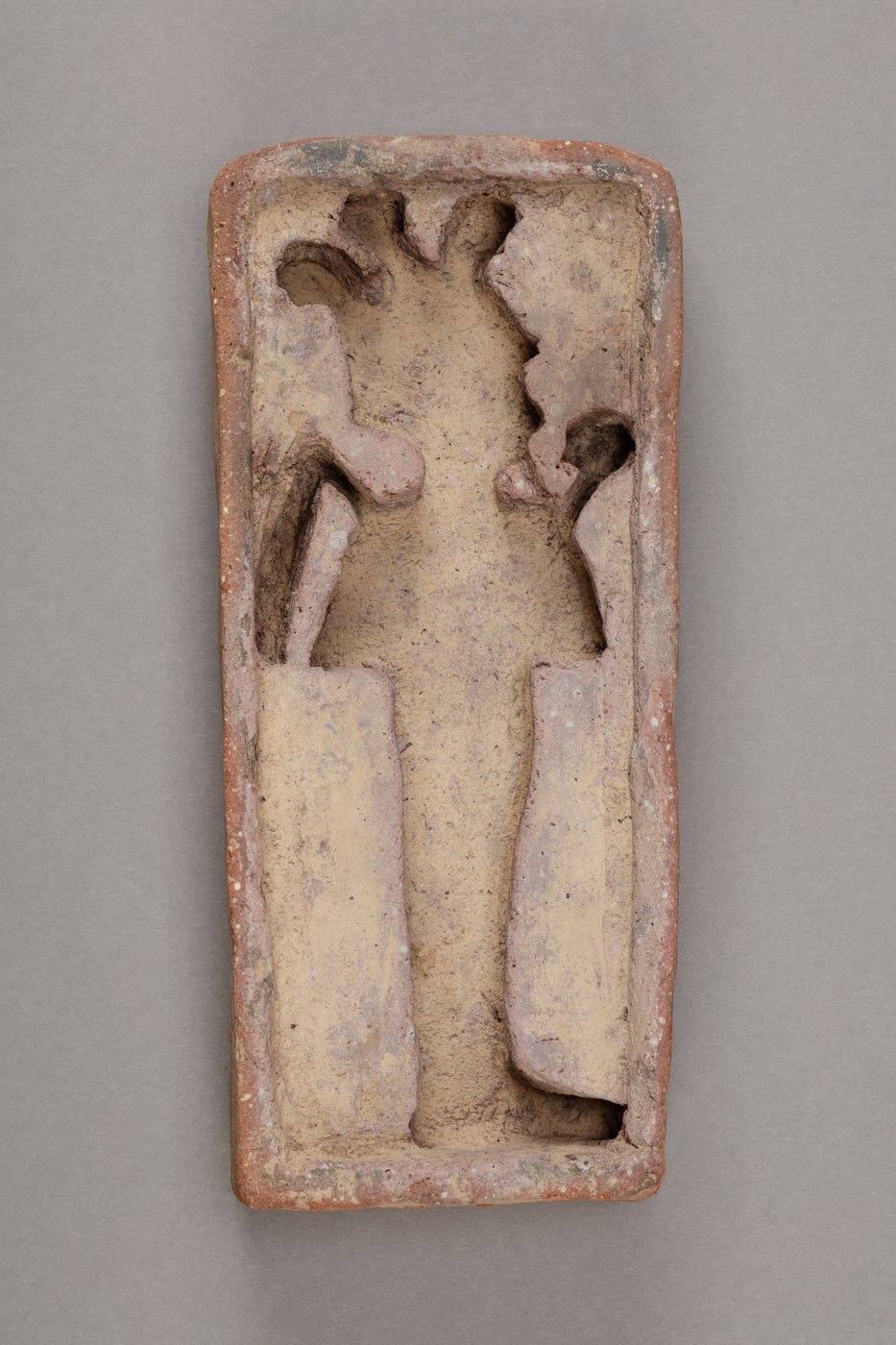
Germinating Osiris Brick, Egypt, about 1100–300 BCE. The Metropolitan Museum of Art connects this kind of object with the Khoiak festival and the regeneration of Osiris.
The Metropolitan Museum of Art. Rogers Fund, 1920. Accession 20.2.30. Public Domain (CC0). · Image source ↗ · CC0
Read further in the library

Gone West
Reading note
The separately titled account draws on exact passages in the consulted Library edition.
Sources
See references (5)
- Gone West, printed p. iv, Reader page 8J. S. M. Ward, Gone West: Three Narratives of After-Death Experiences, third impression, William Rider & Son, London, 1920, as reproduced in Geoff Cutler’s December 2009 digital transcription. Ward’s introduction is distinct from the supplied 1974 foreword.Read this page in Gone West ↗Return to text ↑
- Gone West, printed p. v, Reader page 9J. S. M. Ward, Gone West: Three Narratives of After-Death Experiences, third impression, William Rider & Son, London, 1920, as reproduced in Geoff Cutler’s December 2009 digital transcription. Ward’s introduction is distinct from the supplied 1974 foreword.Read this page in Gone West ↗Return to text ↑
- Gone West, printed p. vi, Reader page 10J. S. M. Ward, Gone West: Three Narratives of After-Death Experiences, third impression, William Rider & Son, London, 1920, as reproduced in Geoff Cutler’s December 2009 digital transcription. Ward’s introduction is distinct from the supplied 1974 foreword.Read this page in Gone West ↗Return to text ↑
- Germinating Osiris Brick ↗The Metropolitan Museum of Art; ca. 1100–300 BCE, accession 20.2.30Return to text ↑
- Gone West, printed p. 19, Reader page 32J. S. M. Ward, Gone West, 1920 third impression as reproduced in the 2009 Geoff Cutler digital transcription.Read this page in Gone West ↗Return to text ↑