Dimension and Boundary in Geometry
Why are a cube’s faces two-dimensional, while a tesseract is bounded by cubes? Follow Bragdon’s examples from a line to four-dimensional space.
In this article
The lower-dimensional pieces that bound a shape
A boundary marks where a region ends. A line segment has two endpoints, a square has four edges, and a cube has six square faces. The next step follows the same pattern: the tesseract is bounded by eight cubes. [3][4][5][6][2]
A Primer of Higher Space by Claude Bragdon
In A Primer of Higher Space, Claude Bragdon asks what solids could bound just as surfaces bound solids. Plate 6 approaches the question through dividers. A point divides a line, a line divides a plane, and a plane divides a solid. Bragdon extends the pattern to a three-dimensional divider in four dimensions. [3][4][7][8][6]
In Man the Square, Bragdon’s cube is represented by its six faces unfolded onto a plane. The faces retain their shapes, and their arrangement shows how they can fold back into a solid. [5][9][10][11]
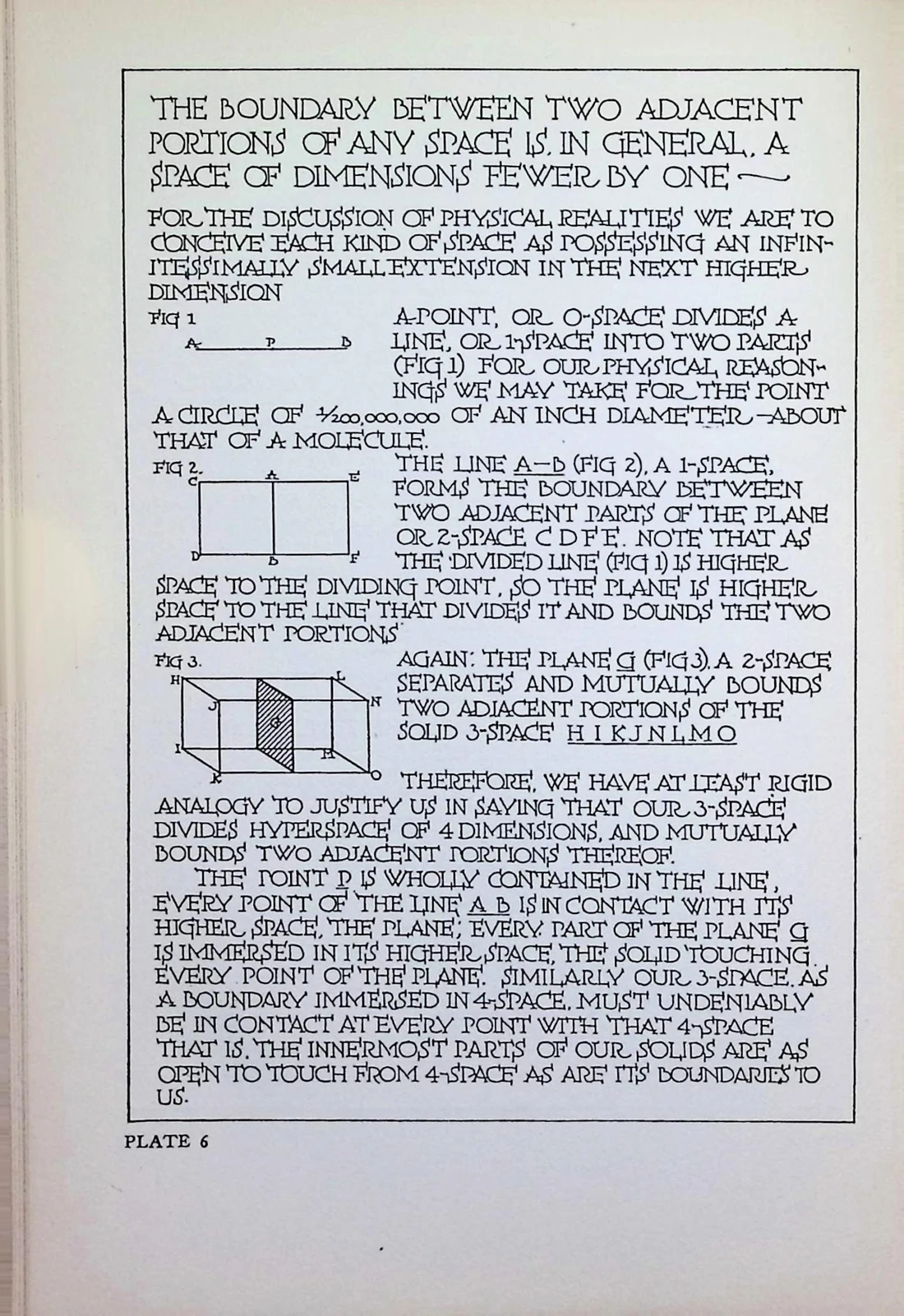
Plate 6 shows a point, line and plane dividing regions of the next dimension, then extends the idea to four dimensions.
Claude Bragdon, A Primer of Higher Space, The Manas Press, 1913. Stickley Museum scan via Internet Archive. · Image source ↗ · Public Domain
See references (9)
- A Primer of Higher Space, printed p. 1, Reader page 8
- A Primer of Higher Space, printed p. 2, Reader page 9
- A Primer of Higher Space, Plate 1, Reader page 30
- A Primer of Higher Space, Plate 6, Reader page 35
- A Primer of Higher Space, printed p. 8, Reader page 15
- A Primer of Higher Space, printed p. 9, Reader page 16
- A Primer of Higher Space, Plate 3, Reader page 32
- A Primer of Higher Space, Plate 4, Reader page 33
- A Primer of Higher Space, printed p. 75, Reader page 78
Elements, Book I, by Euclid
In Elements I, Euclid defines the ends of a line as points and the limits of a surface as lines. A later definition describes a boundary as the extremity of something. [2]
An outside boundary and an internal divider
Euclid’s examples describe where a line or surface ends. Bragdon also shows how a lower-dimensional object can divide a larger region. A plane cutting through a solid can bound either of the pieces it leaves. [3][8][5][6][2]
In the library
A Primer of Higher Space
Reading note
The separately titled account draws on exact passages in the consulted Library edition.
Sources
See references (11)
- Plate 6, boundaries of adjoining parts of space ↗Claude Bragdon, A Primer of Higher Space, The Manas Press, 1913. Stickley Museum scan via Internet Archive.
- Euclid, Elements, Book I, definitions 3, 6 and 13, Heath translation ↗Euclid, Elements, Book I, definitions 3 and 6, translated by Thomas L. Heath. Transcription, Trinity College Dublin.
- A Primer of Higher Space, printed p. 1, Reader page 8Claude Bragdon, A Primer of Higher Space (The Fourth Dimension), The Manas Press, Rochester, New York, 1913. Lumitheca Library edition IMJ-0599-E001.Read this page in A Primer of Higher Space ↗
- A Primer of Higher Space, printed p. 2, Reader page 9Claude Bragdon, A Primer of Higher Space (The Fourth Dimension), The Manas Press, Rochester, New York, 1913. Lumitheca Library edition IMJ-0599-E001.Read this page in A Primer of Higher Space ↗
- A Primer of Higher Space, Plate 1, Reader page 30Claude Bragdon, A Primer of Higher Space (The Fourth Dimension), The Manas Press, Rochester, New York, 1913. Lumitheca Library edition IMJ-0599-E001.Read this page in A Primer of Higher Space ↗
- A Primer of Higher Space, Plate 6, Reader page 35Claude Bragdon, A Primer of Higher Space (The Fourth Dimension), The Manas Press, Rochester, New York, 1913. Lumitheca Library edition IMJ-0599-E001.Read this page in A Primer of Higher Space ↗
- A Primer of Higher Space, printed p. 8, Reader page 15Claude Bragdon, A Primer of Higher Space (The Fourth Dimension), The Manas Press, Rochester, New York, 1913. Lumitheca Library edition IMJ-0599-E001.Read this page in A Primer of Higher Space ↗
- A Primer of Higher Space, printed p. 9, Reader page 16Claude Bragdon, A Primer of Higher Space (The Fourth Dimension), The Manas Press, Rochester, New York, 1913. Lumitheca Library edition IMJ-0599-E001.Read this page in A Primer of Higher Space ↗
- A Primer of Higher Space, Plate 3, Reader page 32Claude Bragdon, A Primer of Higher Space (The Fourth Dimension), The Manas Press, Rochester, New York, 1913. Lumitheca Library edition IMJ-0599-E001.Read this page in A Primer of Higher Space ↗
- A Primer of Higher Space, Plate 4, Reader page 33Claude Bragdon, A Primer of Higher Space (The Fourth Dimension), The Manas Press, Rochester, New York, 1913. Lumitheca Library edition IMJ-0599-E001.Read this page in A Primer of Higher Space ↗
- A Primer of Higher Space, printed p. 75, Reader page 78Claude Bragdon, A Primer of Higher Space (The Fourth Dimension), The Manas Press, Rochester, New York, 1913. Lumitheca Library edition IMJ-0599-E001.Read this page in A Primer of Higher Space ↗