Devi
Explore Devi as divine power and Mother through Shakta teaching, the Devi Mahatmya, Durga’s sacred imagery, darshan and living festival practice.
In this article
Understanding the Goddess
Who is Devi?
Devi is the Goddess in Hindu religious life, understood in many settings as the divine power that animates the world. The Walters Art Museum introduces her as the Great Goddess, whose presence sustains living beings and whose strength supports devotees in adversity. Her forms allow people to encounter that power through a personal divine relationship. [1]
Power and the forms of the Mother
Swami Sivananda presents goddess worship as an approach to supreme divinity through Shakti, divine power. In his explanation, Sarasvati, Lakshmi and Kali express different aspects of one reality. Knowledge, prosperity and transformation become ways of approaching the divine. This is a theological interpretation, rather than a claim that every Hindu community understands these goddesses identically. [2]
The question at the beginning of the Devi Mahatmya
The opening of the Devi Mahatmya begins with a dispossessed king and a merchant deserted by his family. Both know they have been rejected, yet remain attached to what they have lost. Their question to the sage concerns this gap between understanding and feeling. [2]
The sage explains their condition through Mahamaya, the great divine power that binds beings within delusion and can also grant liberation. The cosmic stories that follow answer a question about ordinary experience: why does insight alone fail to loosen attachment? The Goddess enters the narrative as the power through which both bondage and release become intelligible. [2]
Images and the sacred gaze
Meeting the Goddess through sight
A sandstone Devi at the Walters has large eyes and a gently smiling mouth. The museum explains her gaze through darshan, the sacred exchange in which the worshipper sees the deity and is seen in return. Focused looking makes the devotee receptive to blessing. [1]
The encounter connects a sculpted form with a living act of attention. An image can be understood through its material, date and style while also belonging to a religious relationship. For the worshipper, looking is part of approaching divine presence. [1]
Durga’s power in a historical sculpture
A ninth-century schist Durga from Bihar shows the Goddess overcoming Mahisha, the buffalo demon. Her many arms carry weapons associated with the gods, including a discus and trident. One hand grasps the emerging demon’s hair as the struggle unfolds beneath her. [4]
The Met connects the image with the Devi Mahatmya’s account of a power the male gods could not defeat individually. The sculptor makes the Goddess’s decisive action visible through the raised sword, extended stance and tightly arranged weapons. [4]
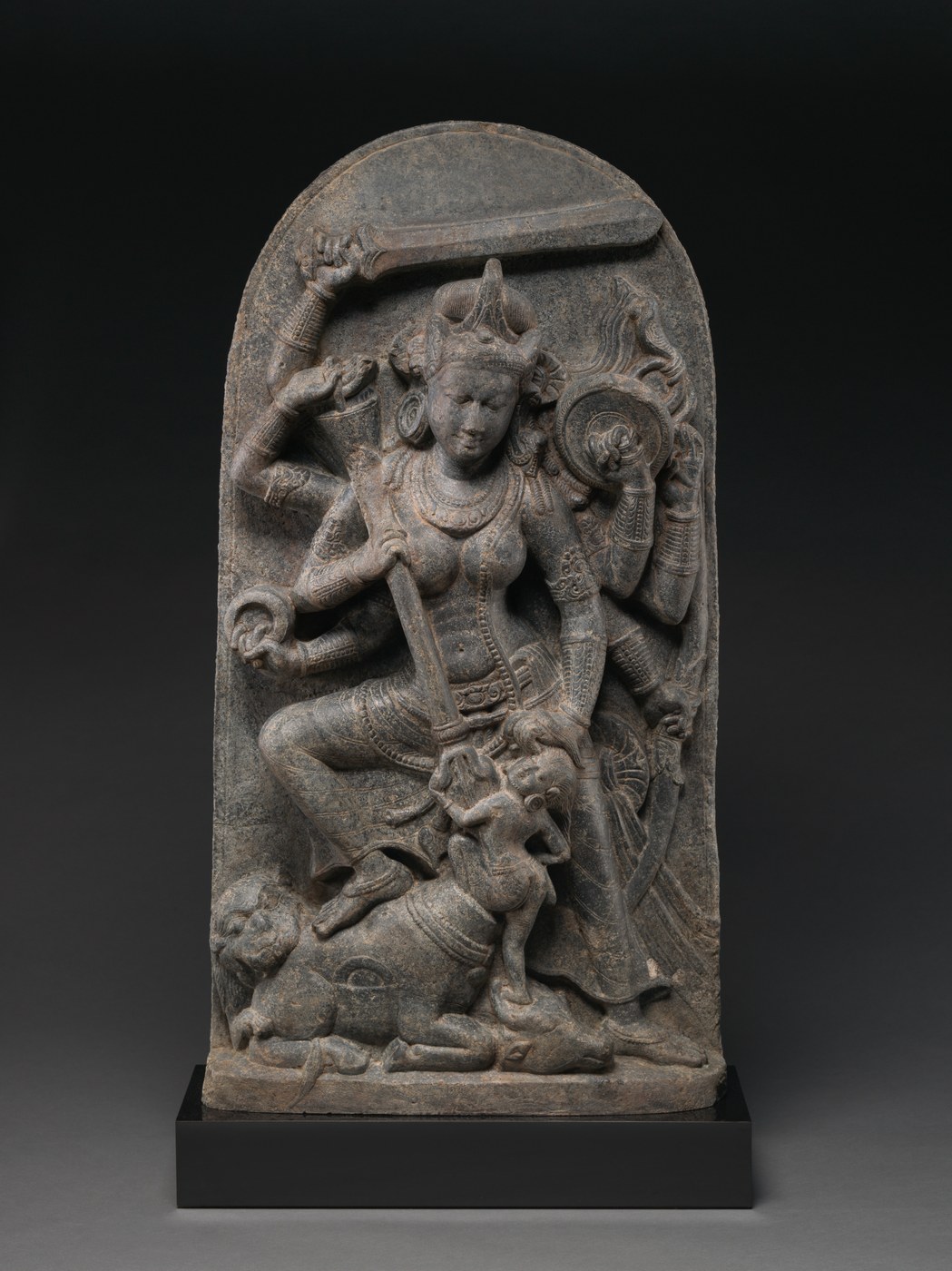
Goddess Durga Slaying the Demon Mahisha, Bihar, second half of the ninth century. Schist.
The Metropolitan Museum of Art. Purchase, Blanca and Sunil Hirani Gift, in honor of Sunita and Gordhan Hirani, 2016. Accession 2016.650. Public Domain (CC0). · Museum record ↗ · CC0
The Divine Mother in living practice
Belur Math’s account reads the Chandi, another name for the Devi Mahatmya, as a celebration of Shakti and the Mother’s protection. Its explanation links care with the strength to confront danger and injustice. The maternal image is therefore active and powerful as well as comforting. [3]
The institution first celebrated Durga Puja in 1901 under Vivekananda’s initiative, with Sarada Devi’s approval and participation. Its account describes a continuing practice shaped by particular choices: animal sacrifice is excluded, with symbolic offerings used instead. Such details show a tradition being lived through a community’s commitments, rather than existing only as an account of ancient battles. [3]
Sources
- Devi, ca. 975–1000 ↗The Walters Art Museum; Great Goddess, divine power and darshanReturn to text ↑
- The Devi Mahatmya ↗Swami Sivananda, Divine Life Society; introduction and translated first chapterReturn to text ↑
- Durga Puja at Belur Math ↗Ramakrishna Math and Ramakrishna Mission; interpretation of Shakti and festival practiceReturn to text ↑
- Goddess Durga Slaying the Demon Mahisha ↗The Metropolitan Museum of Art; Bihar, second half of the ninth century, 2016.650Return to text ↑
About this article & its sources
Selected Hindu goddess traditions, with Divine Life Society and Ramakrishna interpretations, two historical objects and the opening of the Devi Mahatmya. Individual goddesses and schools retain their distinctions.
Passage attributions
Who is Devi?
Passage 1: The Walters Art Museum; Great Goddess, divine power and darshan.
Power and the forms of the Mother
Passage 1: Swami Sivananda, Divine Life Society; introduction and translated first chapter.
The question at the beginning of the Devi Mahatmya
Passage 1: Swami Sivananda, Divine Life Society; introduction and translated first chapter.
Passage 2: Swami Sivananda, Divine Life Society; introduction and translated first chapter.
Meeting the Goddess through sight
Passage 1: The Walters Art Museum; Great Goddess, divine power and darshan.
Passage 2: The Walters Art Museum; Great Goddess, divine power and darshan.