The Immortal Body in Daoist Inner Alchemy
The immortal body is a form of life described in Daoist inner alchemy. Some texts tell of it as an embryo conceived, nourished and brought to birth through cultivation. The Secret of the Golden Flower connects it with the gathering of light.
In this article
What is the immortal body?
In Daoist inner alchemy, the immortal body is a form of life understood to develop within the practitioner. Texts describe its formation through images of conception, gestation and birth. One expression for the result is the body outside the body. [3][4][8]
The immortal body in The Secret of the Golden Flower
In Richard Wilhelm’s translation, rendered into English by Cary F. Baynes, circulating the light allows it to crystallise into a spirit body. The appearance of a seed pearl marks conception. Later, the text uses the image of flesh becoming gold and diamonds to describe the golden flower taking form. [3][4][5]
Wilhelm describes a centre of life independent of the physical body. A note in the edition presents rebirth as a spirit body taking shape within perishable flesh. Wilhelm says that the text gives the early stages of inner rebirth more space than the later ones. [1][2][6]
See references (6)
- The Secret of the Golden Flower, printed p. 8, Reader page 16
- The Secret of the Golden Flower, printed p. 17, Reader page 25
- The Secret of the Golden Flower, printed p. 24, Reader page 31
- The Secret of the Golden Flower, printed p. 34, Reader page 39
- The Secret of the Golden Flower, printed p. 55, Reader page 56
- The Secret of the Golden Flower, printed p. 71, Reader page 70
The diamond body in Jung’s commentary
C. G. Jung reads the diamond body as a symbol of life beyond the conscious ego. The embryo, child and living body are forms through which that experience can appear. His account is a psychological reading of the images in the Daoist text. [7]
The immortal infant in Awakening to Reality
In his introduction to Awakening to Reality, Fabrizio Pregadio relates conception, gestation and birth to stages of refinement in the three cinnabar fields. The Golden Flower also uses birth imagery, with particular attention to the seed pearl that forms as the light circulates. [8][4]
An alchemical image of birth
A small figure appears inside the seated body in this Xingming guizhi woodcut. Its title describes an infant taking form. The image makes visible the idea of another body developing within the practitioner. [9][4]
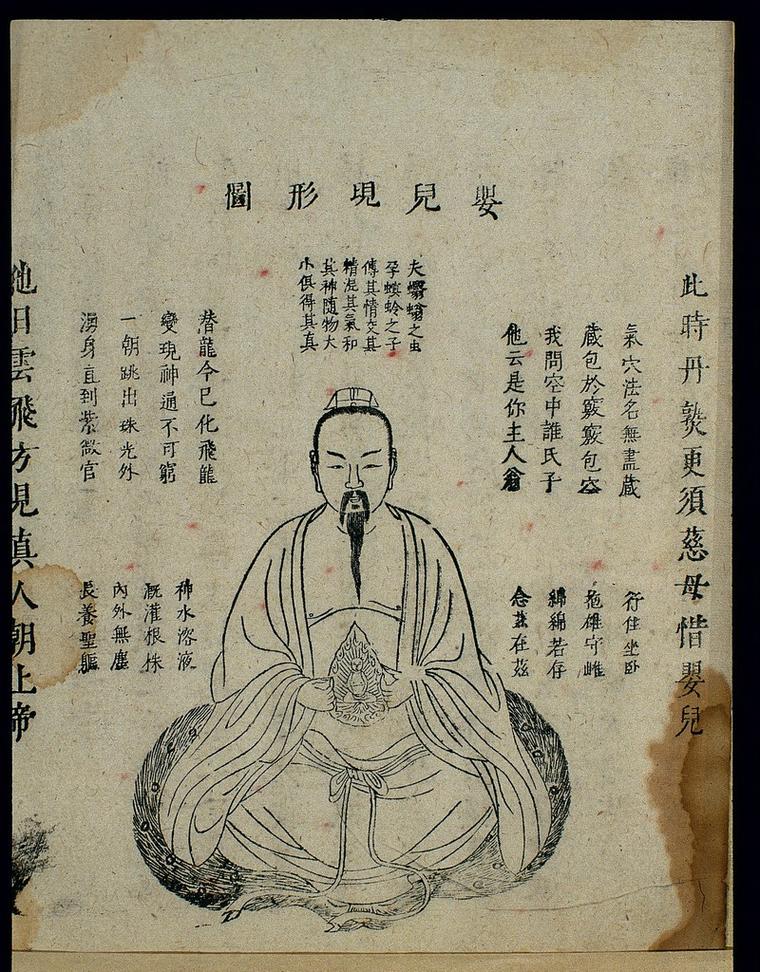
The Infant Takes Form and Appears, from the Xingming guizhi, published in 1615. This separate Daoist work uses the image of birth to depict a stage of inner alchemy.
Wellcome Collection, Chinese woodcut: Daoist internal alchemy (12). Public Domain Mark. · Image source ↗ · Public Domain
In the library
The Secret of the Golden Flower
Reading note
Read the specific account of Daoist Immortal Body in the Wilhelm–Baynes edition.
Sources
See references (9)
- The Secret of the Golden Flower, printed p. 8, Reader page 16The Secret of the Golden Flower: A Chinese Book of Life. Chinese text translated and explained by Richard Wilhelm, English translation by Cary F. Baynes, with separate commentary by C. G. Jung. London, Kegan Paul, Trench, Trubner & Co. Lumitheca Library edition IMJ-0596-E001.Read this page in The Secret of the Golden Flower ↗
- The Secret of the Golden Flower, printed p. 17, Reader page 25The Secret of the Golden Flower: A Chinese Book of Life. Chinese text translated and explained by Richard Wilhelm, English translation by Cary F. Baynes, with separate commentary by C. G. Jung. London, Kegan Paul, Trench, Trubner & Co. Lumitheca Library edition IMJ-0596-E001.Read this page in The Secret of the Golden Flower ↗
- The Secret of the Golden Flower, printed p. 24, Reader page 31The Secret of the Golden Flower: A Chinese Book of Life. Chinese text translated and explained by Richard Wilhelm, English translation by Cary F. Baynes, with separate commentary by C. G. Jung. London, Kegan Paul, Trench, Trubner & Co. Lumitheca Library edition IMJ-0596-E001.Read this page in The Secret of the Golden Flower ↗
- The Secret of the Golden Flower, printed p. 34, Reader page 39The Secret of the Golden Flower: A Chinese Book of Life. Chinese text translated and explained by Richard Wilhelm, English translation by Cary F. Baynes, with separate commentary by C. G. Jung. London, Kegan Paul, Trench, Trubner & Co. Lumitheca Library edition IMJ-0596-E001.Read this page in The Secret of the Golden Flower ↗
- The Secret of the Golden Flower, printed p. 55, Reader page 56The Secret of the Golden Flower: A Chinese Book of Life. Chinese text translated and explained by Richard Wilhelm, English translation by Cary F. Baynes, with separate commentary by C. G. Jung. London, Kegan Paul, Trench, Trubner & Co. Lumitheca Library edition IMJ-0596-E001.Read this page in The Secret of the Golden Flower ↗
- The Secret of the Golden Flower, printed p. 71, Reader page 70The Secret of the Golden Flower: A Chinese Book of Life. Chinese text translated and explained by Richard Wilhelm, English translation by Cary F. Baynes, with separate commentary by C. G. Jung. London, Kegan Paul, Trench, Trubner & Co. Lumitheca Library edition IMJ-0596-E001.Read this page in The Secret of the Golden Flower ↗
- The Secret of the Golden Flower, printed p. 131, Reader page 130The Secret of the Golden Flower: A Chinese Book of Life. Chinese text translated and explained by Richard Wilhelm, English translation by Cary F. Baynes, with separate commentary by C. G. Jung. London, Kegan Paul, Trench, Trubner & Co. Lumitheca Library edition IMJ-0596-E001.Read this page in The Secret of the Golden Flower ↗
- Awakening to Reality (Wuzhen pian), introduction, section 3, “The Elixir” ↗Fabrizio Pregadio, Golden Elixir Press.
- The infant takes form and appears ↗Wellcome Collection, Chinese woodcut: Daoist internal alchemy (12). Public Domain Mark.