Circulation of the Light in The Secret of the Golden Flower
Circulation of the light is the practice of turning awareness inward in The Secret of the Golden Flower. The text describes a change in how the practitioner attends to thoughts, sensations, and daily affairs, using the language of Daoist internal alchemy.
In this article
What is circulation of the light?
Circulation of the light is the turning back of attention in The Secret of the Golden Flower. The text pictures attention as light that ordinarily follows sights, sounds and thoughts outward. Its Daoist language of circulation describes how that light can be gathered and returned to the centre. [1][3][4]
In The Secret of the Golden Flower
In Richard Wilhelm’s translation, rendered into English by Cary F. Baynes, the return of light protects a centre called the Heavenly Heart. The direction of the eyes matters because the book treats seeing as one way attention follows things outward. The circle gives a shape to the process of return. [2][3][4]
The text compares the tip of the nose to a mason’s plumb line. It gives an initial point of alignment. The next part of the work is to notice how thoughts arise and pass while attention remains steady. The book describes this through the paired terms fixation and contemplation. [5][6][7][8]
See references (7)
- The Secret of the Golden Flower, printed p. 24, Reader page 31
- The Secret of the Golden Flower, printed p. 34, Reader page 39
- The Secret of the Golden Flower, printed p. 35, Reader page 40
- The Secret of the Golden Flower, printed p. 37, Reader page 42
- The Secret of the Golden Flower, printed p. 38, Reader page 43
- The Secret of the Golden Flower, printed p. 39, Reader page 44
- The Secret of the Golden Flower, printed p. 48, Reader page 51
Is this the microcosmic orbit?
Fabrizio Pregadio’s note to the Cantong qi describes a later use of the River Chariot as circulating breath through vessels at the front and back of the body. The Golden Flower also uses ascending and descending bodily imagery in its Far Journey chapter. Its central account of light begins with where attention goes and how it returns. [4][7][11][12]
Circulation during ordinary work
A later chapter asks how circulation fits alongside ordinary work. It recommends quiet at the outset and describes a steadiness that can carry over into daily affairs. The text likens this to still water that reflects what comes before it and lets the image go as the object passes. [9][10]
How Daoist artists pictured inner space
In this Daoist woodcut, stars, animals and written labels occupy the space of a body drawn in profile. The print comes from the fifteenth-century Daoist Canon. It shows how a related tradition gave inner processes a visual form. [13]
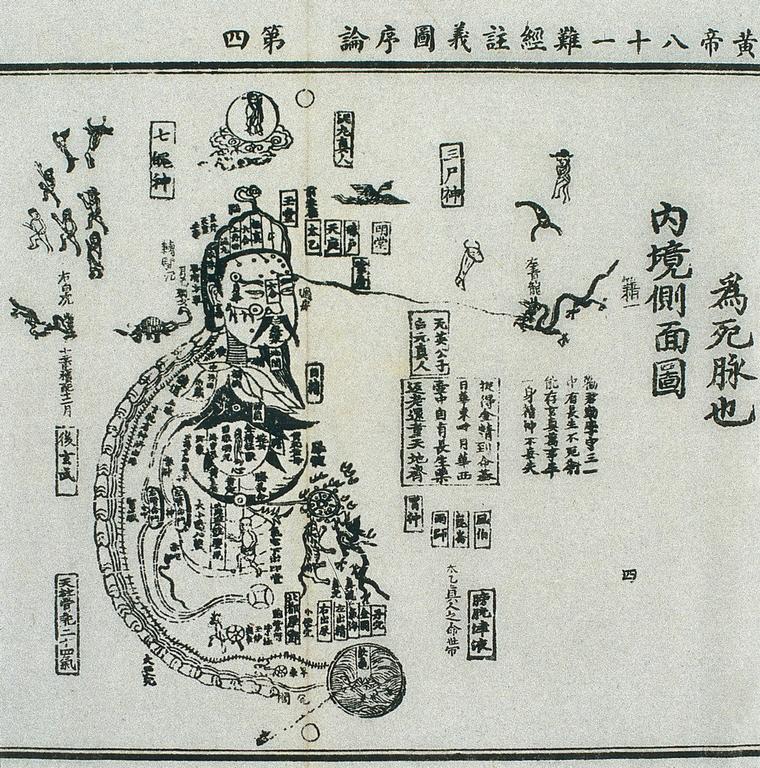
A fifteenth-century illustration of bodily topography from the Daoist Canon. It shows a wider tradition of giving inner processes a visual geography.
Wellcome Collection, L0034715. Public Domain Mark. · Image source ↗ · Public Domain
In the library
The Secret of the Golden Flower
Reading note
Read the specific account of Circulation of the light in the Wilhelm–Baynes edition.
Sources
See references (13)
- The Secret of the Golden Flower, printed p. 23, Reader page 30The Secret of the Golden Flower: A Chinese Book of Life. Chinese text translated and explained by Richard Wilhelm, English translation by Cary F. Baynes, with separate commentary by C. G. Jung. London, Kegan Paul, Trench, Trubner & Co. Lumitheca Library edition IMJ-0596-E001.Read this page in The Secret of the Golden Flower ↗
- The Secret of the Golden Flower, printed p. 24, Reader page 31The Secret of the Golden Flower: A Chinese Book of Life. Chinese text translated and explained by Richard Wilhelm, English translation by Cary F. Baynes, with separate commentary by C. G. Jung. London, Kegan Paul, Trench, Trubner & Co. Lumitheca Library edition IMJ-0596-E001.Read this page in The Secret of the Golden Flower ↗
- The Secret of the Golden Flower, printed p. 34, Reader page 39The Secret of the Golden Flower: A Chinese Book of Life. Chinese text translated and explained by Richard Wilhelm, English translation by Cary F. Baynes, with separate commentary by C. G. Jung. London, Kegan Paul, Trench, Trubner & Co. Lumitheca Library edition IMJ-0596-E001.Read this page in The Secret of the Golden Flower ↗
- The Secret of the Golden Flower, printed p. 35, Reader page 40The Secret of the Golden Flower: A Chinese Book of Life. Chinese text translated and explained by Richard Wilhelm, English translation by Cary F. Baynes, with separate commentary by C. G. Jung. London, Kegan Paul, Trench, Trubner & Co. Lumitheca Library edition IMJ-0596-E001.Read this page in The Secret of the Golden Flower ↗
- The Secret of the Golden Flower, printed p. 37, Reader page 42The Secret of the Golden Flower: A Chinese Book of Life. Chinese text translated and explained by Richard Wilhelm, English translation by Cary F. Baynes, with separate commentary by C. G. Jung. London, Kegan Paul, Trench, Trubner & Co. Lumitheca Library edition IMJ-0596-E001.Read this page in The Secret of the Golden Flower ↗
- The Secret of the Golden Flower, printed p. 38, Reader page 43The Secret of the Golden Flower: A Chinese Book of Life. Chinese text translated and explained by Richard Wilhelm, English translation by Cary F. Baynes, with separate commentary by C. G. Jung. London, Kegan Paul, Trench, Trubner & Co. Lumitheca Library edition IMJ-0596-E001.Read this page in The Secret of the Golden Flower ↗
- The Secret of the Golden Flower, printed p. 39, Reader page 44The Secret of the Golden Flower: A Chinese Book of Life. Chinese text translated and explained by Richard Wilhelm, English translation by Cary F. Baynes, with separate commentary by C. G. Jung. London, Kegan Paul, Trench, Trubner & Co. Lumitheca Library edition IMJ-0596-E001.Read this page in The Secret of the Golden Flower ↗
- The Secret of the Golden Flower, printed p. 48, Reader page 51The Secret of the Golden Flower: A Chinese Book of Life. Chinese text translated and explained by Richard Wilhelm, English translation by Cary F. Baynes, with separate commentary by C. G. Jung. London, Kegan Paul, Trench, Trubner & Co. Lumitheca Library edition IMJ-0596-E001.Read this page in The Secret of the Golden Flower ↗
- The Secret of the Golden Flower, printed p. 57, Reader page 58The Secret of the Golden Flower: A Chinese Book of Life. Chinese text translated and explained by Richard Wilhelm, English translation by Cary F. Baynes, with separate commentary by C. G. Jung. London, Kegan Paul, Trench, Trubner & Co. Lumitheca Library edition IMJ-0596-E001.Read this page in The Secret of the Golden Flower ↗
- The Secret of the Golden Flower, printed p. 58, Reader page 59The Secret of the Golden Flower: A Chinese Book of Life. Chinese text translated and explained by Richard Wilhelm, English translation by Cary F. Baynes, with separate commentary by C. G. Jung. London, Kegan Paul, Trench, Trubner & Co. Lumitheca Library edition IMJ-0596-E001.Read this page in The Secret of the Golden Flower ↗
- The Secret of the Golden Flower, printed p. 68, Reader page 67The Secret of the Golden Flower: A Chinese Book of Life. Chinese text translated and explained by Richard Wilhelm, English translation by Cary F. Baynes, with separate commentary by C. G. Jung. London, Kegan Paul, Trench, Trubner & Co. Lumitheca Library edition IMJ-0596-E001.Read this page in The Secret of the Golden Flower ↗
- The Seal of the Unity of the Three (Cantong qi), poem 22 and note 10 ↗Fabrizio Pregadio’s translation and commentary, Golden Elixir Press
- Chinese 15th century Daoist image of internal topography ↗Wellcome Collection, L0034715. Public Domain Mark.