Daoism
Explore Daoism through the Daodejing, Zhuangzi, wuwei, religious lineages, ritual, meditation, alchemy and the changing relationship between people and the Way.
In this article
What is Daoism?
Daoism, also spelled Taoism, is a family of Chinese traditions concerned with the Dao, the Way, and with how people might live in relation to it. Its inheritance includes philosophical argument, sacred texts, ritual, temples, religious lineages and practices of self-cultivation. Daoism and Taoism are different romanisations of the same name, not two religions. [1]
The early texts associated with Laozi and Zhuangzi took shape in the intellectual world of ancient China, where thinkers debated how life and government should be ordered. The classification of these thinkers as a shared school came later. Daoist inquiry repeatedly asks whether established human distinctions and ambitions give reliable guidance. Attention to changing circumstances and the possibilities of the natural world offers another point of departure. [1]
Dao is also an ordinary word for a path or way. Early debates concerned which ways of speaking, acting and organising society people should follow. Daoist writers widen that question by attending to the world beyond inherited human conventions. The language moves between ordinary paths and the more encompassing Way. [1]
The Way and the classical texts
Laozi and the Daodejing
The Daodejing, also called the Laozi, is a short text whose influence extends far beyond its length. Its traditional author, Laozi, is remembered as an ancient sage, but the surviving accounts of his life and the formation of the text leave substantial historical uncertainty. Neither a precise biography nor a single uncontested date of composition can be supplied. [2]
The text joins reflections on the Dao and de, its power or virtue, to questions of conduct and government. Wuwei, often translated as nonaction, concerns action freed from coercive or self-serving striving. Ziran, naturalness or being so of itself, describes a related freedom from imposed artifice. These ideas do not simply demand inactivity. They ask what changes when action no longer begins from the urge to dominate, accumulate or force a result. [2]
The political implications are substantial. The text criticises warfare, harsh punishment and heavy taxation as expressions of excessive desire. A ruler’s appetite for control can become part of the disorder it claims to remedy. Different commentators consequently read the text as both a work of inner cultivation and a challenge to familiar methods of government. [2]
Water, restraint and knowing when to stop
Chapter 8 of the Daodejing uses water to think about excellence. Water benefits living things and occupies low places; its usefulness does not depend on competing for prominence. The following chapter turns to the risks of overfilling a vessel, over-sharpening an edge and clinging to wealth and distinction. Together these images make restraint concrete. [7]
This is one reason the text remains open to ethical, spiritual and political readings. A household, a ruler and a person cultivating their own character can each recognise the temptation to push beyond what a situation can bear. The images do not supply a formula for every decision. They train attention towards sufficiency, timing and the costs of excess. James Legge’s nineteenth-century translation, cited here, is one historically influential English rendering of these passages. [7]
Chapter 10 extends the questions to breath, pliancy and the care of a community. These neighbouring passages join bodily cultivation with the problem of governing well. Images of an infant, water and a vessel ask the reader to consider receptivity and proportion alongside the more obvious appeal of strength and achievement. [7]
Zhuangzi: perspective, skill and transformation
The Zhuangzi uses stories, humour and imagined conversations to unsettle familiar judgments. Its speakers move between human and nonhuman viewpoints, asking what becomes visible when a preferred perspective loses its claim to be the only one. Reading it requires attention to the play between its voices, rather than treating every speaker as a spokesperson for one settled doctrine. [3]
Stories of skilled activity, including Cook Ding’s cutting of an ox, explore ways of responding to the structures of a task. Practised responsiveness can achieve what blunt effort cannot. Yet skill in one activity does not produce mastery of every situation. The text also returns to the limits of knowledge and the transformations of life and death. Its freedom includes the ability to release an attachment to how things must appear from one’s present position. [3]
The range of its stories matters as much as a single famous parable. Craftspeople, animals and unconventional teachers can expose the limitations of prestigious forms of expertise. What first appears useless or marginal may become valuable when the situation, and the standpoint from which it is judged, changes. [3]
Religious history and cultivation
Revelation, communities and sacred texts
Organised Daoist movements became visible in the later Han period. The Way of the Celestial Masters traces its origin to a revelation of the deified Laozi to Zhang Daoling in 142 CE. That is the tradition’s account of its sacred authority. Its communities developed parishes, religious leadership and shared obligations, making Daoism a form of collective life as well as personal cultivation. [6]
Later revelations and textual collections enlarged this inheritance. Shangqing, or Highest Clarity, teachings and Lingbao, or Numinous Treasure, scriptures brought distinctive visions and ritual resources. The Daoist canon became a vast collection rather than a single book equivalent to the Daodejing. Priestly knowledge of texts and rites supported services for communities, the living and the dead. This institutional history belongs alongside the early philosophical writings when asking what Daoism is. [6]
Priests used revealed texts and registers as signs of authority to petition the divine world. Services could concern healing, protection, repentance and the fate of the dead. A local community’s religious needs therefore helped shape Daoism’s history alongside the concerns of individual seekers, scholars and rulers. [6]
Lineages, meditation and alchemy
Daoist traditions connect teaching to lineages of transmission. Quanzhen, associated with Wang Zhe in the twelfth century and his disciples, developed a major monastic form. Its celibate institutions differ from the household-based priesthood of the Celestial Masters tradition, although actual affiliations and forms of practice are more varied than a simple two-column division suggests. [4]
Meditation and cultivation may address the body as a field of religious transformation. Neidan, internal alchemy, uses the language of refinement to describe this work; waidan, external alchemy, historically involved compounded substances. These are historical religious practices, not evidence of biomedical effectiveness. Daoist traditions also contain different accounts of transcendence and immortality. Their shared concern with returning to the Dao allows many approaches without making every technique universal to every Daoist. [4]
The Daoist body can be imagined as a microcosm, with inner locations and powers corresponding to the larger cosmos. Methods of visualisation and inner refinement make use of these relationships. Transmission and interpretation determine what a particular practice means; a single modern exercise cannot stand for the whole tradition. [4]
How commentaries changed the conversation
The history of Daoist thought continued through interpretation. During the centuries after the Han dynasty, the intellectual movement known as xuanxue, learning of the profound, returned to texts including the Laozi, Zhuangzi and Yijing. Wang Bi and Guo Xiang became influential interpreters whose questions helped shape how later readers approached those works. [5]
The convenient modern label Neo-Daoism can conceal the breadth of this inquiry. Xuanxue was not simply an exclusive religious denomination: it brought together debates over the Way, naturalness, political order and human capacity. A commentary could become an important work of philosophy in its own right. Encountering the same short classical passage through different commentators therefore reveals a continuing intellectual tradition rather than a meaning fixed once and for all in antiquity. [5]
Sacred images and landscapes
Gods, ritual and the arts
Daoist art ranges from images of deities and immortals to ritual robes, cosmic diagrams and paintings of mountains. The pantheon can be pictured through ranks and heavenly offices, while a ritual garment may bring stars, sacred landscapes and auspicious beings into the space of a ceremony. Art can give visible form to a cosmology that is otherwise difficult to picture. [8]
The same image may carry different associations in a temple, a household or a painting collection. Daoist concepts circulated through wider Chinese culture and interacted with Buddhism and Confucian traditions. Shared artists, buildings or symbols do not make these traditions identical. The particular object, patron and ritual setting help explain what an image was doing and why it mattered. [8]
Some paintings were made by Daoist religious leaders themselves. Zhang Yucai’s dragons in Beneficent Rain, for example, connect pictorial skill to a Celestial Master’s ritual authority. The relationship between image-making and religious practice could be much closer than a division between fine art and worship would suggest. [8]
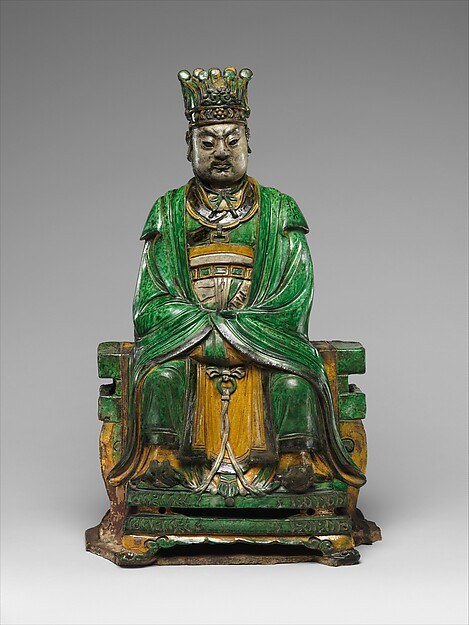
Qiao Bin’s Daoist divine official, dated 1482, in glazed stoneware. Courtly robes, formal posture and a tablet make heavenly office visible through the imagery of administration.
The Metropolitan Museum of Art. Bequest of Harrison Cady, 1970. Accession 1971.163. Public Domain (CC0). · Museum record ↗ · CC0
Mountains and sacred landscapes
Mountains have long been understood in Chinese culture as places of concentrated power, retreat and encounter. Daoist cave-heavens join actual landscapes to imagined sacred realms. Temples, pilgrimage and stories of immortals make geography part of religious life. [9]
Ideas about qi, vital energy, and the interacting phases of yin and yang belong to a wider Chinese cosmological inheritance. They are significant for Daoism without being exclusively Daoist inventions. Landscape painting and gardens also gave these relationships artistic form. To describe Daoism as simply loving nature would miss its institutions and ritual, but to leave out mountains, changing rhythms and the human place within the cosmos would miss something equally central. [9]
Mountains attracted religious practitioners alongside poets, officials and travellers. Their sacred associations became part of wider landscape culture without requiring every visitor or painter to be a Daoist initiate. The same physical place could sustain several relationships, each informed by a different purpose and form of knowledge. [9]
Read further in the library
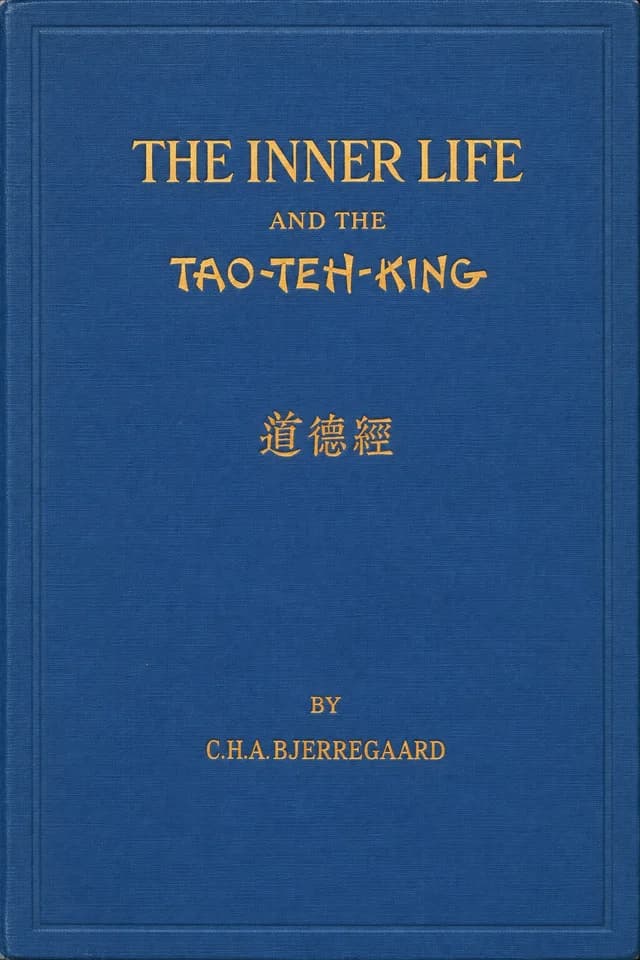
The Inner Life and the Tao-Teh-King
Reading note
C. H. A. Bjerregaard’s comparative treatment places the Tao-Teh-King beside Western mystical concerns. Read it as a later interpretation rather than a neutral account of all Daoist traditions.
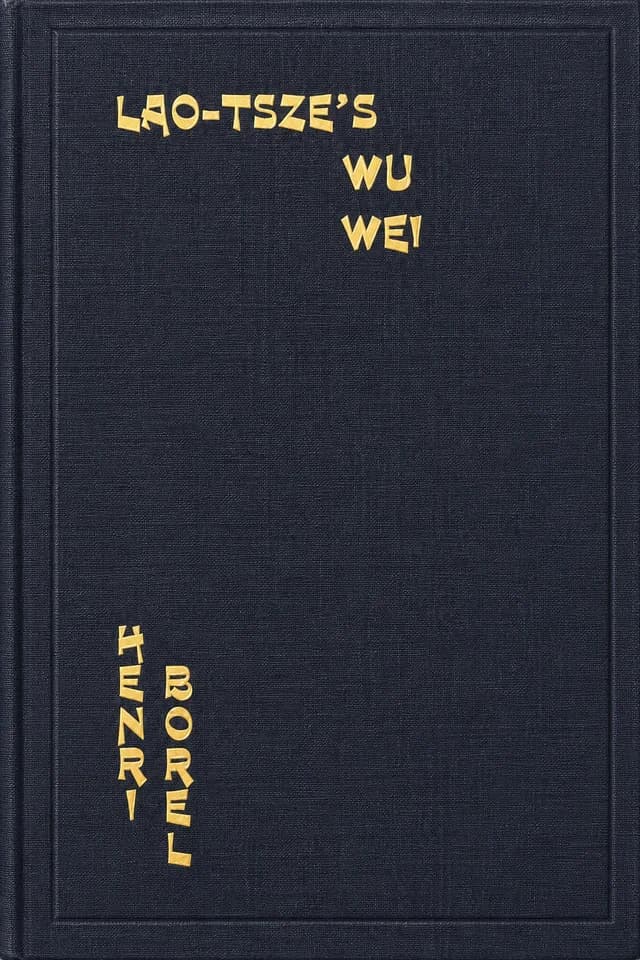
Wu Wei: A Phantasy Based on the Philosophy of Lao-Tse
Reading note
Henri Borel’s imagined conversations explore Dao, art and love. This literary reception of Laozi offers a different kind of reading from a direct translation of the classical text.
Sources
- Daoism ↗Stanford Encyclopedia of PhilosophyReturn to text ↑
- Laozi ↗Stanford Encyclopedia of PhilosophyReturn to text ↑
- Zhuangzi ↗Stanford Encyclopedia of PhilosophyReturn to text ↑
- Religious Daoism ↗Stanford Encyclopedia of PhilosophyReturn to text ↑
- Neo-Daoism ↗Stanford Encyclopedia of PhilosophyReturn to text ↑
- Daoism ↗Columbia University, Asia for EducatorsReturn to text ↑
- The Tao Teh King, chapters 8–10 ↗Laozi; translated by James Legge; Project GutenbergReturn to text ↑
- Daoism and Daoist Art ↗The Metropolitan Museum of ArtReturn to text ↑
- Nature in Chinese Culture ↗The Metropolitan Museum of ArtReturn to text ↑
- Daoist divine official ↗The Metropolitan Museum of Art, Open Access collection
About this article & its sources
An introduction to Daoist thought and religious life. The modern division between philosophy and religion is treated as a useful question, not a fixed boundary within the tradition.
Passage attributions
What is Daoism?
Passage 1: Stanford Encyclopedia of Philosophy.
Passage 2: Stanford Encyclopedia of Philosophy.
Passage 3: Stanford Encyclopedia of Philosophy.
Laozi and the Daodejing
Passage 1: Stanford Encyclopedia of Philosophy.
Passage 2: Stanford Encyclopedia of Philosophy.
Passage 3: Stanford Encyclopedia of Philosophy.
Water, restraint and knowing when to stop
Passage 1: Laozi; translated by James Legge; Project Gutenberg.
Passage 2: Laozi; translated by James Legge; Project Gutenberg.
Passage 3: Laozi; translated by James Legge; Project Gutenberg.
Zhuangzi: perspective, skill and transformation
Passage 1: Stanford Encyclopedia of Philosophy.
Passage 2: Stanford Encyclopedia of Philosophy.
Passage 3: Stanford Encyclopedia of Philosophy.
Revelation, communities and sacred texts
Passage 1: Columbia University, Asia for Educators.
Passage 2: Columbia University, Asia for Educators.
Passage 3: Columbia University, Asia for Educators.
Lineages, meditation and alchemy
Passage 1: Stanford Encyclopedia of Philosophy.
Passage 2: Stanford Encyclopedia of Philosophy.
Passage 3: Stanford Encyclopedia of Philosophy.
How commentaries changed the conversation
Passage 1: Stanford Encyclopedia of Philosophy.
Passage 2: Stanford Encyclopedia of Philosophy.