The Celestial Eagle of Justice
Dante’s Celestial Eagle is formed by the souls of Jupiter. Read what its single voice says about justice, the limits of judgment, Trajan and Ripheus.
In this article
Understanding the celestial eagle of justice
The Celestial Eagle of Justice is formed by blessed souls in the heaven of Jupiter in Dante’s Paradise. Many people make one figure, and the beak speaks in the singular. The speaker is a community whose members remain distinct. [1][2]
The eagle questions how much anyone can know about divine judgment. The fact that the souls speak together makes their humility striking: agreement among them gives them a common voice, without giving them all the knowledge they might wish for. [2][3][4]
The Divine Comedy by Dante Alighieri
In Paradise XVIII, Dante Alighieri shows the lights spelling a call to those who judge the Earth to love justice. They arrange themselves into an eagle. In the next canto the eagle speaks as one, even though Dante recognises many intentions in what he hears. [5][1][2]
Dante asks how a just person born far from knowledge of Christ could be condemned. The eagle answers by comparing human sight with the depth of divine judgment. It then rebukes rulers whose conduct gives the lie to their Christian profession. [3][4][6]
Paradise XX names the figures visible in the eagle’s eye, among them David, Trajan and Ripheus. The last two surprise Dante. The poem gives them particular histories of faith and grace, testing the assumptions he brought to his question. [7][8][9][10]
Even the blessed speaker ends by warning against presumption: the community does not claim complete knowledge of the number of the chosen. Its unity of will with God is compatible with limits in what it knows. [10]
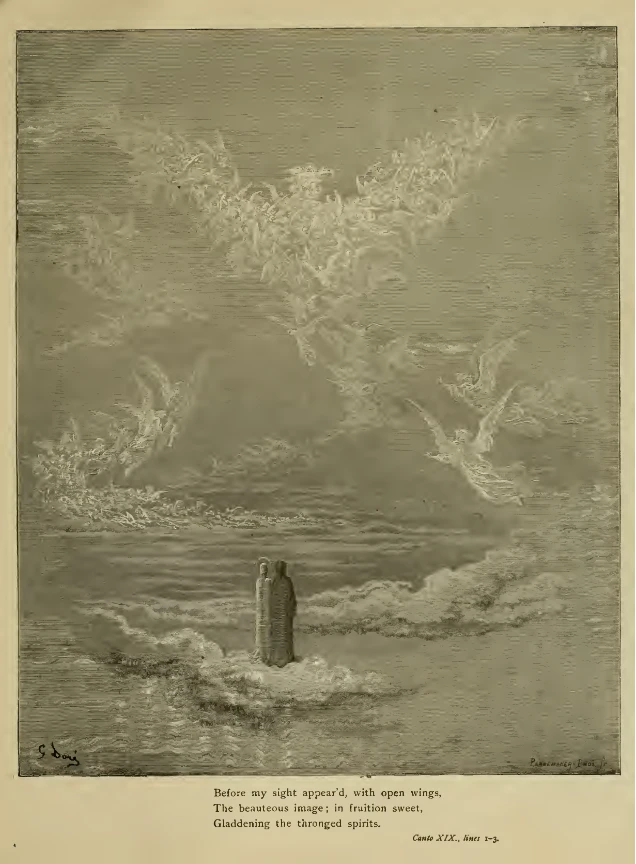
Gustave Doré, Paradise XIX. The many lights of Jupiter form the eagle that speaks about justice.
Purgatory and Paradise, 1901. Dante Alighieri, translated by Henry Francis Cary, designs by Gustave Doré. Thompson & Thomas, Chicago. Historical text and original designs Public Domain. · Image source ↗ · Public Domain
See references (10)
- Purgatory and Paradise, Reader page 295
- Purgatory and Paradise, Reader page 296
- Purgatory and Paradise, Reader page 297
- Purgatory and Paradise, Reader page 298
- Purgatory and Paradise, Reader page 292
- Purgatory and Paradise, Reader page 299
- Purgatory and Paradise, Reader page 301
- Purgatory and Paradise, Reader page 302
- Purgatory and Paradise, Reader page 303
- Purgatory and Paradise, Reader page 304
Many people, one visible form
The eagle gathers many speakers into one voice. The Celestial Rose gathers many people into a form that lets Dante see seats, faces and relationships. Both make a community visible, with different effects on what the pilgrim can hear or recognise. [2][10][11][12]
The figure should not be confused with the golden eagle in Dante’s earlier dream during Purgatory. That earlier bird carries the sleeping pilgrim; this eagle is an assembly in Jupiter teaching about justice. [13][14][2]
Read further in the library
Purgatory and Paradise: The Vision of Dante
Reading note
Exact consulted edition and PageRefs in a separately titled book account.
Sources
See references (15)
- Purgatory and Paradise, Reader page 295Dante Alighieri, The Divine Comedy, translated by Henry Francis Cary, designs by Gustave Doré. Inferno: undated New Edition, Thompson & Thomas, Chicago. Purgatory and Paradise: New Edition, Thompson & Thomas, Chicago, 1901. Canto arguments are editorial matter and are distinguished from the poem.Read this page in Purgatory and Paradise: The Vision of Dante ↗Return to text ↑
- Purgatory and Paradise, Reader page 296Dante Alighieri, The Divine Comedy, translated by Henry Francis Cary, designs by Gustave Doré. Inferno: undated New Edition, Thompson & Thomas, Chicago. Purgatory and Paradise: New Edition, Thompson & Thomas, Chicago, 1901. Canto arguments are editorial matter and are distinguished from the poem.Read this page in Purgatory and Paradise: The Vision of Dante ↗Return to text ↑
- Purgatory and Paradise, Reader page 297Dante Alighieri, The Divine Comedy, translated by Henry Francis Cary, designs by Gustave Doré. Inferno: undated New Edition, Thompson & Thomas, Chicago. Purgatory and Paradise: New Edition, Thompson & Thomas, Chicago, 1901. Canto arguments are editorial matter and are distinguished from the poem.Read this page in Purgatory and Paradise: The Vision of Dante ↗Return to text ↑
- Purgatory and Paradise, Reader page 298Dante Alighieri, The Divine Comedy, translated by Henry Francis Cary, designs by Gustave Doré. Inferno: undated New Edition, Thompson & Thomas, Chicago. Purgatory and Paradise: New Edition, Thompson & Thomas, Chicago, 1901. Canto arguments are editorial matter and are distinguished from the poem.Read this page in Purgatory and Paradise: The Vision of Dante ↗Return to text ↑
- Purgatory and Paradise, Reader page 292Dante Alighieri, The Divine Comedy, translated by Henry Francis Cary, designs by Gustave Doré. Inferno: undated New Edition, Thompson & Thomas, Chicago. Purgatory and Paradise: New Edition, Thompson & Thomas, Chicago, 1901. Canto arguments are editorial matter and are distinguished from the poem.Read this page in Purgatory and Paradise: The Vision of Dante ↗Return to text ↑
- Purgatory and Paradise, Reader page 299Dante Alighieri, The Divine Comedy, translated by Henry Francis Cary, designs by Gustave Doré. Inferno: undated New Edition, Thompson & Thomas, Chicago. Purgatory and Paradise: New Edition, Thompson & Thomas, Chicago, 1901. Canto arguments are editorial matter and are distinguished from the poem.Read this page in Purgatory and Paradise: The Vision of Dante ↗Return to text ↑
- Purgatory and Paradise, Reader page 301Dante Alighieri, The Divine Comedy, translated by Henry Francis Cary, designs by Gustave Doré. Inferno: undated New Edition, Thompson & Thomas, Chicago. Purgatory and Paradise: New Edition, Thompson & Thomas, Chicago, 1901. Canto arguments are editorial matter and are distinguished from the poem.Read this page in Purgatory and Paradise: The Vision of Dante ↗Return to text ↑
- Purgatory and Paradise, Reader page 302Dante Alighieri, The Divine Comedy, translated by Henry Francis Cary, designs by Gustave Doré. Inferno: undated New Edition, Thompson & Thomas, Chicago. Purgatory and Paradise: New Edition, Thompson & Thomas, Chicago, 1901. Canto arguments are editorial matter and are distinguished from the poem.Read this page in Purgatory and Paradise: The Vision of Dante ↗Return to text ↑
- Purgatory and Paradise, Reader page 303Dante Alighieri, The Divine Comedy, translated by Henry Francis Cary, designs by Gustave Doré. Inferno: undated New Edition, Thompson & Thomas, Chicago. Purgatory and Paradise: New Edition, Thompson & Thomas, Chicago, 1901. Canto arguments are editorial matter and are distinguished from the poem.Read this page in Purgatory and Paradise: The Vision of Dante ↗Return to text ↑
- Purgatory and Paradise, Reader page 304Dante Alighieri, The Divine Comedy, translated by Henry Francis Cary, designs by Gustave Doré. Inferno: undated New Edition, Thompson & Thomas, Chicago. Purgatory and Paradise: New Edition, Thompson & Thomas, Chicago, 1901. Canto arguments are editorial matter and are distinguished from the poem.Read this page in Purgatory and Paradise: The Vision of Dante ↗Return to text ↑
- Purgatory and Paradise, Reader page 355Dante Alighieri, The Divine Comedy, translated by Henry Francis Cary, designs by Gustave Doré. Inferno: undated New Edition, Thompson & Thomas, Chicago. Purgatory and Paradise: New Edition, Thompson & Thomas, Chicago, 1901. Canto arguments are editorial matter and are distinguished from the poem.Read this page in Purgatory and Paradise: The Vision of Dante ↗Return to text ↑
- Purgatory and Paradise, Reader page 356Dante Alighieri, The Divine Comedy, translated by Henry Francis Cary, designs by Gustave Doré. Inferno: undated New Edition, Thompson & Thomas, Chicago. Purgatory and Paradise: New Edition, Thompson & Thomas, Chicago, 1901. Canto arguments are editorial matter and are distinguished from the poem.Read this page in Purgatory and Paradise: The Vision of Dante ↗Return to text ↑
- Purgatory and Paradise, Reader page 54Dante Alighieri, The Divine Comedy, translated by Henry Francis Cary, designs by Gustave Doré. Inferno: undated New Edition, Thompson & Thomas, Chicago. Purgatory and Paradise: New Edition, Thompson & Thomas, Chicago, 1901. Canto arguments are editorial matter and are distinguished from the poem.Read this page in Purgatory and Paradise: The Vision of Dante ↗Return to text ↑
- Purgatory and Paradise, Reader page 56Dante Alighieri, The Divine Comedy, translated by Henry Francis Cary, designs by Gustave Doré. Inferno: undated New Edition, Thompson & Thomas, Chicago. Purgatory and Paradise: New Edition, Thompson & Thomas, Chicago, 1901. Canto arguments are editorial matter and are distinguished from the poem.Read this page in Purgatory and Paradise: The Vision of Dante ↗Return to text ↑
- Purgatory and Paradise, Reader page 293Dante Alighieri, The Divine Comedy, translated by Henry Francis Cary, designs by Gustave Doré. Inferno: undated New Edition, Thompson & Thomas, Chicago. Purgatory and Paradise: New Edition, Thompson & Thomas, Chicago, 1901. Canto arguments are editorial matter and are distinguished from the poem.Read this page in Purgatory and Paradise: The Vision of Dante ↗