Crystallization in Walter Russell
Walter Russell called a crystal a record of motion. Read the original chart and learn how his explanation compares with modern crystallography.
In this article
Crystal form as a record
Walter Russell treats crystal form as a record of the motion and pressure he believes produced it. In his cosmology, geometry and hardness give clues about where matter stands within a cycle. [3][4][5][6]
The Universal One by Walter Russell
In The Universal One, Walter Russell describes crystals as records in form. He imagines one movement accumulating matter and a reaction fixing its appearance. The pair carries his account of formation into the shapes of solids. [4][5]
His chart moves from softer, more complex forms toward harder, simpler ones, then returns toward softness. He maps those properties onto the formula of locked potentials, the pattern he applies throughout the book. [3][4][5][6]
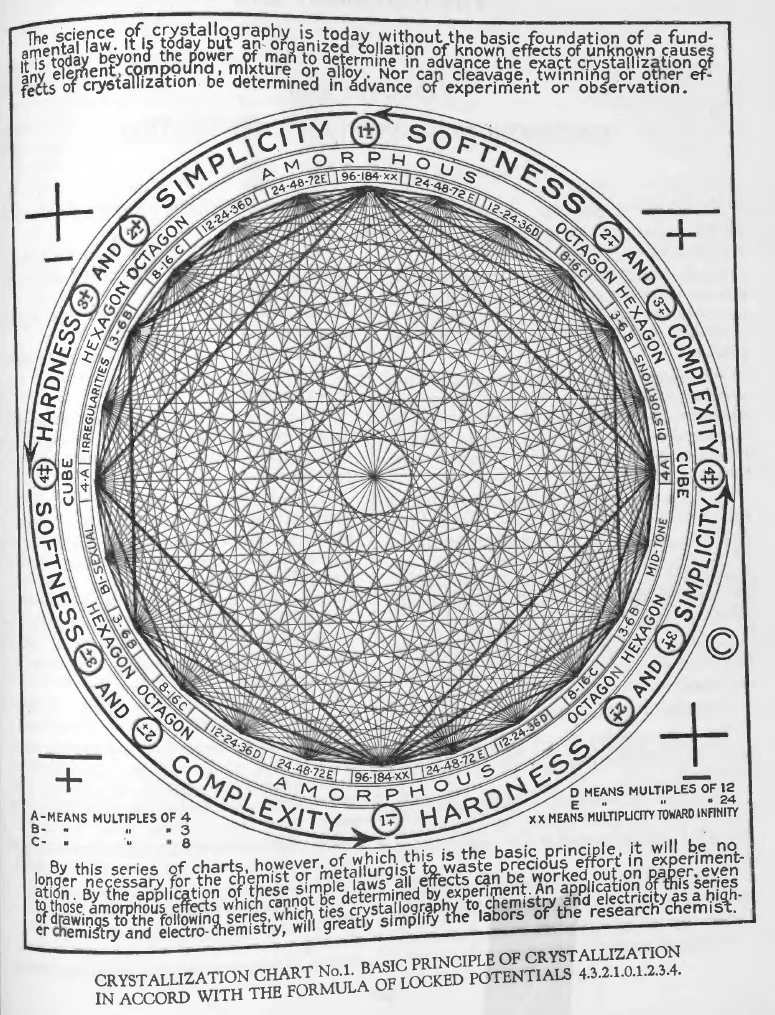
Russell’s crystallization chart arranges changes in form and hardness around a circle. The positions correspond to his formula of locked potentials.
Walter Russell, Crystallization Chart No. 1. Brieger Press, New York, copyright 1926, Library of Congress LCCN 27004508. Library of Congress, public domain. · Image source ↗ · Public Domain
What defines a crystal in crystallography
The International Union of Crystallography defines a crystal by long-range spatial order or a corresponding sharp diffraction pattern. These criteria describe the arrangement of the material. Russell uses crystal form to infer a proposed history of pressure and motion. [4][5][6][2]
In the library
The Universal One
Reading note
The separately titled account draws on exact passages in the consulted Library edition.
Sources
See references (6)
- Crystallization Chart No. 1 ↗Walter Russell, Crystallization Chart No. 1. Brieger Press, New York, copyright 1926, Library of Congress LCCN 27004508. Library of Congress, public domain.
- IUCr Online Dictionary of Crystallography, Crystal ↗International Union of Crystallography, Crystal, direct-space and reciprocal-space definitions.
- The Universal One, printed p. 152, Reader page 151Walter Russell, The Universal One, edited by Louise Russell, University of Science and Philosophy, Limited Edition De Luxe. Lumitheca Library edition IMJ-0605-E001.Read this page in The Universal One ↗
- The Universal One, printed p. 285, Reader page 284Walter Russell, The Universal One, edited by Louise Russell, University of Science and Philosophy, Limited Edition De Luxe. Lumitheca Library edition IMJ-0605-E001.Read this page in The Universal One ↗
- The Universal One, printed p. 286, Reader page 285Walter Russell, The Universal One, edited by Louise Russell, University of Science and Philosophy, Limited Edition De Luxe. Lumitheca Library edition IMJ-0605-E001.Read this page in The Universal One ↗
- The Universal One, printed p. 287, Reader page 286Walter Russell, The Universal One, edited by Louise Russell, University of Science and Philosophy, Limited Edition De Luxe. Lumitheca Library edition IMJ-0605-E001.Read this page in The Universal One ↗