Revolution as Creative Motion
Revolution is the circular motion that holds matter together in Evolution of Immortality. Follow Dowd’s theory from the formation of cells to planets.
In this article
Understanding the concept
Revolution is circular motion. In Evolution of Immortality, it keeps inward and outward forces working around a centre so they can produce an organised form. [1][2][3]
The book follows the same pattern from a developing cell to a planet. It also makes the sphere an image of spiritual freedom, giving circular form a place in its account of what a person can become. [3][4][5][6][7]
See references (7)
- Evolution of Immortality, printed p. 26, Reader page 23
- Evolution of Immortality, printed p. 29, Reader page 26
- Evolution of Immortality, printed p. 30, Reader page 27
- Evolution of Immortality, printed p. 34, Reader page 31
- Evolution of Immortality, printed p. 35, Reader page 32
- Evolution of Immortality, printed p. 45, Reader page 42
- Evolution of Immortality, printed p. 46, Reader page 43
Evolution of Immortality by Rosicruciæ, catalogued as F. B. Dowd
Freeman Benjamin Dowd, writing as Rosicruciæ, asks the reader to picture water staying in a bucket swung overhead. He uses the example to imagine loose material gathering into a rotating world. He calls revolution his third law of motion because it keeps the material in place. [1]
The author distinguishes the earth’s rotation from its movement around the sun and reads their effects as a planetary breathing. The inward and outward currents are described through magnetic and electrical language. These explanations belong to his historical cosmology, rather than a demonstrated physical account. [8][9]
When the argument returns to the developing egg, attraction gathers and repulsion distributes. Neither motion, he says, can exist without revolution. The cell’s supposed spiritual atmosphere provides a place for the motions before their material expression becomes visible. [2][3]
Once the book turns to a perfected body, the sphere has a further meaning. Dowd imagines a form that can move freely without limbs. He calls bodies angular when their shape still answers the pressures of earthly life. [4][5][6][7]
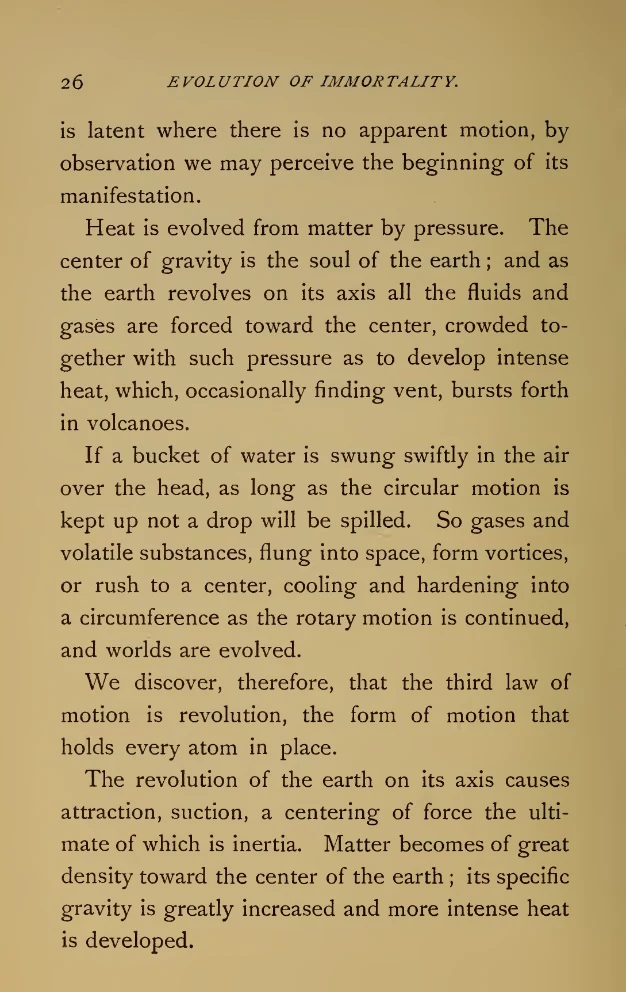
Evolution of Immortality (1900), printed p. 26, Library Reader page 23. Dowd uses the swung bucket to explain why he treats rotation as a creative motion.
Rosicruciæ (catalogued as Freeman Benjamin Dowd), Evolution of Immortality, copyright 1900. Public-domain historical page from the checksum-verified Library PDF. · Image source ↗ · Public Domain
See references (9)
- Evolution of Immortality, printed p. 26, Reader page 23
- Evolution of Immortality, printed p. 29, Reader page 26
- Evolution of Immortality, printed p. 30, Reader page 27
- Evolution of Immortality, printed p. 34, Reader page 31
- Evolution of Immortality, printed p. 35, Reader page 32
- Evolution of Immortality, printed p. 45, Reader page 42
- Evolution of Immortality, printed p. 46, Reader page 43
- Evolution of Immortality, printed p. 27, Reader page 24
- Evolution of Immortality, printed p. 28, Reader page 25
A Wanderer in the Spirit Lands: Franchezzo, transcribed by A. Farnese
In the narrative transcribed by A. Farnese, Hassein explains a planet as a mass cast off from a parent sun and gathering matter from space. Its spiritual spheres develop with its inhabitants; eventually the material planet disperses and its community joins a wider solar association. [10][11][12][13]
Heaven and Its Wonders and Hell by Emanuel Swedenborg
Emanuel Swedenborg describes the societies of heaven as reflecting a single human form. Understanding and will are what make that form human in his account. Dowd takes up the idea directly, arguing that the human outline still belongs to one stage of development and that the sphere comes later. [15][16][7]
Circular motion at different scales
Circular motion does two jobs in Dowd’s account. It holds matter together during formation, and the sphere becomes the shape of an imagined freedom from earthly demands. The argument moves from how things form to what a fully developed body might be. [1][3][4][5][6][7]
Hassein in A Wanderer in the Spirit Lands also follows the formation of a planet. He asks how its spiritual spheres change with the lives of its inhabitants. Dowd asks what movements can make a planet or a cell hold together in the first place. [10][11][12][13][1][8][9][3]
The title page of Robert Fludd’s Utriusque cosmi historia sets the human figure inside cosmic circles. It gives a visual example of the older analogy between person and world. Dowd gives the connection a mechanical part to play, applying the same motions to a cell and a planet. [14][3]
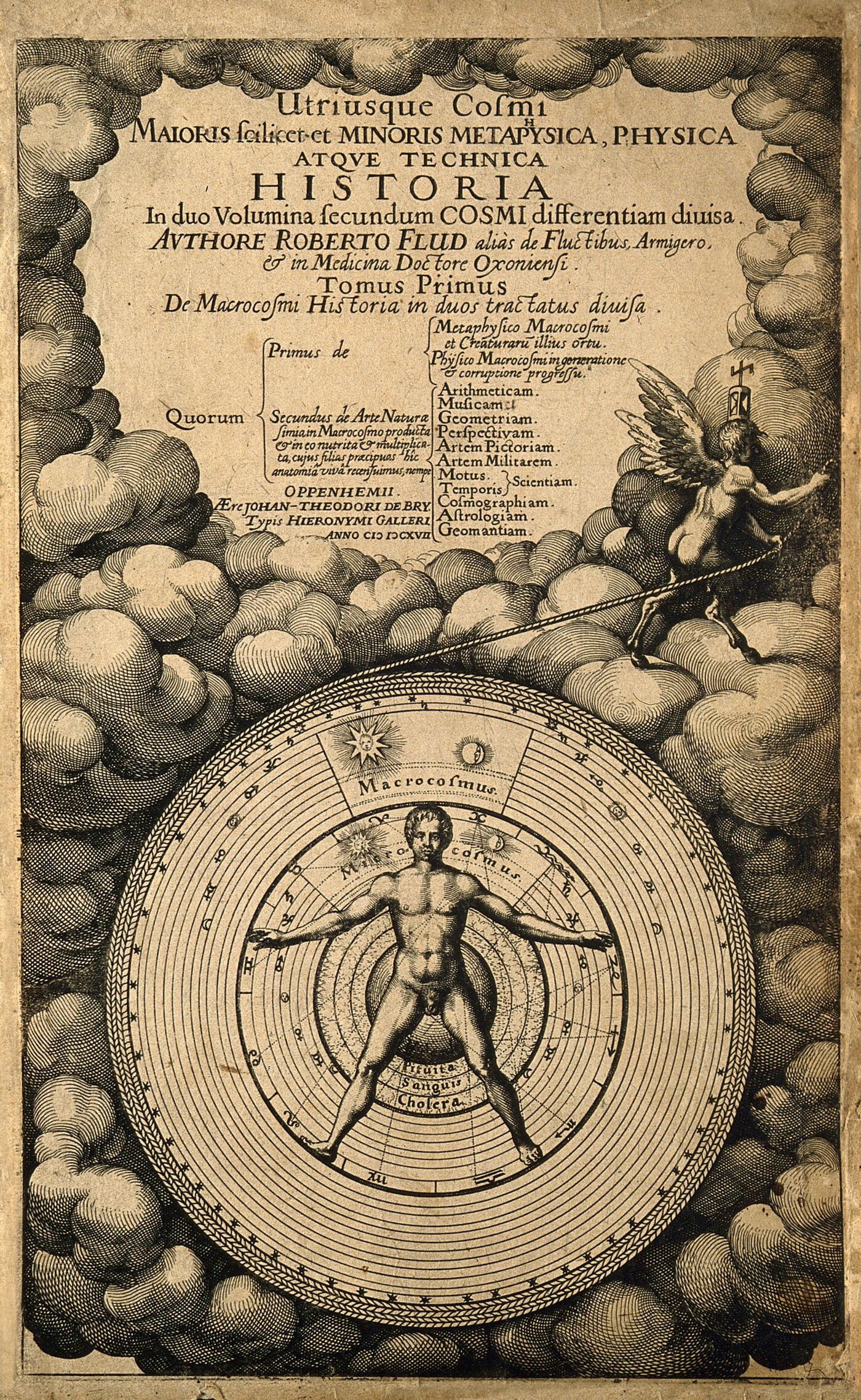
T. de Bry’s engraving for Robert Fludd, 1617. The labels Microcosmus and Macrocosmus connect the figure with the rings around it.
Wellcome Collection, 2989i. Public Domain Mark. · Image source ↗ · Public Domain
See references (13)
- Evolution of Immortality, printed p. 26, Reader page 23
- Evolution of Immortality, printed p. 30, Reader page 27
- Evolution of Immortality, printed p. 34, Reader page 31
- Evolution of Immortality, printed p. 35, Reader page 32
- Evolution of Immortality, printed p. 45, Reader page 42
- Evolution of Immortality, printed p. 46, Reader page 43
- Evolution of Immortality, printed p. 27, Reader page 24
- Evolution of Immortality, printed p. 28, Reader page 25
- A Wanderer in the Spirit Lands, printed p. 253, Reader page 262
- A Wanderer in the Spirit Lands, printed p. 254, Reader page 263
- A Wanderer in the Spirit Lands, printed p. 256, Reader page 265
- A Wanderer in the Spirit Lands, printed p. 257, Reader page 266
- The microcosm (man) and the macrocosm (the world), 1617: Wellcome Collection 2989i
Read further in the library
Evolution of Immortality
Reading note
The separately titled account draws on exact passages in the consulted Library edition.

A Wanderer in the Spirit Lands
Reading note
Separately attributed comparison with exact previously researched Library passages.

Heaven and Its Wonders and Hell
Reading note
Heaven’s societies are described as a coordinated human form, united through shared uses.
Sources
See references (16)
- Evolution of Immortality, printed p. 26, Reader page 23Rosicruciæ, catalogued as Freeman Benjamin Dowd, Evolution of Immortality. Eulian Publishing Company, Salem, Mass., copyright 1900; title page undated. The book’s metaphysical and scientific assertions remain attributed. The separately reproduced Higher Thought of Sex address has no speaker named in this edition.Read this page in Evolution of Immortality ↗Return to text ↑
- Evolution of Immortality, printed p. 29, Reader page 26Rosicruciæ, catalogued as Freeman Benjamin Dowd, Evolution of Immortality. Eulian Publishing Company, Salem, Mass., copyright 1900; title page undated. The book’s metaphysical and scientific assertions remain attributed. The separately reproduced Higher Thought of Sex address has no speaker named in this edition.Read this page in Evolution of Immortality ↗Return to text ↑
- Evolution of Immortality, printed p. 30, Reader page 27Rosicruciæ, catalogued as Freeman Benjamin Dowd, Evolution of Immortality. Eulian Publishing Company, Salem, Mass., copyright 1900; title page undated. The book’s metaphysical and scientific assertions remain attributed. The separately reproduced Higher Thought of Sex address has no speaker named in this edition.Read this page in Evolution of Immortality ↗Return to text ↑
- Evolution of Immortality, printed p. 34, Reader page 31Rosicruciæ, catalogued as Freeman Benjamin Dowd, Evolution of Immortality. Eulian Publishing Company, Salem, Mass., copyright 1900; title page undated. The book’s metaphysical and scientific assertions remain attributed. The separately reproduced Higher Thought of Sex address has no speaker named in this edition.Read this page in Evolution of Immortality ↗Return to text ↑
- Evolution of Immortality, printed p. 35, Reader page 32Rosicruciæ, catalogued as Freeman Benjamin Dowd, Evolution of Immortality. Eulian Publishing Company, Salem, Mass., copyright 1900; title page undated. The book’s metaphysical and scientific assertions remain attributed. The separately reproduced Higher Thought of Sex address has no speaker named in this edition.Read this page in Evolution of Immortality ↗Return to text ↑
- Evolution of Immortality, printed p. 45, Reader page 42Rosicruciæ, catalogued as Freeman Benjamin Dowd, Evolution of Immortality. Eulian Publishing Company, Salem, Mass., copyright 1900; title page undated. The book’s metaphysical and scientific assertions remain attributed. The separately reproduced Higher Thought of Sex address has no speaker named in this edition.Read this page in Evolution of Immortality ↗Return to text ↑
- Evolution of Immortality, printed p. 46, Reader page 43Rosicruciæ, catalogued as Freeman Benjamin Dowd, Evolution of Immortality. Eulian Publishing Company, Salem, Mass., copyright 1900; title page undated. The book’s metaphysical and scientific assertions remain attributed. The separately reproduced Higher Thought of Sex address has no speaker named in this edition.Read this page in Evolution of Immortality ↗Return to text ↑
- Evolution of Immortality, printed p. 27, Reader page 24Rosicruciæ, catalogued as Freeman Benjamin Dowd, Evolution of Immortality. Eulian Publishing Company, Salem, Mass., copyright 1900; title page undated. The book’s metaphysical and scientific assertions remain attributed. The separately reproduced Higher Thought of Sex address has no speaker named in this edition.Read this page in Evolution of Immortality ↗Return to text ↑
- Evolution of Immortality, printed p. 28, Reader page 25Rosicruciæ, catalogued as Freeman Benjamin Dowd, Evolution of Immortality. Eulian Publishing Company, Salem, Mass., copyright 1900; title page undated. The book’s metaphysical and scientific assertions remain attributed. The separately reproduced Higher Thought of Sex address has no speaker named in this edition.Read this page in Evolution of Immortality ↗Return to text ↑
- A Wanderer in the Spirit Lands, printed p. 253, Reader page 262A Wanderer in the Spirit Lands, attributed to the spirit Franchezzo and transcribed by A. Farnese. W. J. Sinkins, London. Title page undated; preface dated 1896. The narrator’s experiences and the guides’ explanations are reported claims, not independently established observations.Read this page in A Wanderer in the Spirit Lands ↗Return to text ↑
- A Wanderer in the Spirit Lands, printed p. 254, Reader page 263A Wanderer in the Spirit Lands, attributed to the spirit Franchezzo and transcribed by A. Farnese. W. J. Sinkins, London. Title page undated; preface dated 1896. The narrator’s experiences and the guides’ explanations are reported claims, not independently established observations.Read this page in A Wanderer in the Spirit Lands ↗Return to text ↑
- A Wanderer in the Spirit Lands, printed p. 256, Reader page 265A Wanderer in the Spirit Lands, attributed to the spirit Franchezzo and transcribed by A. Farnese. W. J. Sinkins, London. Title page undated; preface dated 1896. The narrator’s experiences and the guides’ explanations are reported claims, not independently established observations.Read this page in A Wanderer in the Spirit Lands ↗Return to text ↑
- A Wanderer in the Spirit Lands, printed p. 257, Reader page 266A Wanderer in the Spirit Lands, attributed to the spirit Franchezzo and transcribed by A. Farnese. W. J. Sinkins, London. Title page undated; preface dated 1896. The narrator’s experiences and the guides’ explanations are reported claims, not independently established observations.Read this page in A Wanderer in the Spirit Lands ↗Return to text ↑
- The microcosm (man) and the macrocosm (the world), 1617: Wellcome Collection 2989i ↗Wellcome Collection, 2989i. Engraving credited to T. de Bry, 1617; associated with Robert Fludd. Public Domain Mark.Return to text ↑
- Heaven and Its Wonders and Hell, printed p. 43, Reader page 50Emanuel Swedenborg, Heaven and Its Wonders and Hell, translated by J. C. Ager. The American Swedenborg Printing and Publishing Society, New York, 1916. Original Latin work first published in 1758.Read this page in Heaven and Its Wonders and Hell ↗Return to text ↑
- Heaven and Its Wonders and Hell, printed p. 44, Reader page 51Emanuel Swedenborg, Heaven and Its Wonders and Hell, translated by J. C. Ager. The American Swedenborg Printing and Publishing Society, New York, 1916. Original Latin work first published in 1758.Read this page in Heaven and Its Wonders and Hell ↗Return to text ↑