Who Guards the Gates of Heaven in the Coptic Apocalypse of Paul?
Trace Paul’s ascent through the ten heavens of the Coptic Apocalypse of Paul, from the fourth-heaven judgement to the sign at the seventh gate.
In this article
Follow five encounters on Paul’s ascent
See who speaks, who opens the way and what happens at each encounter.
- The road and third heaven
A guide on the road
The child recognises Paul
Follow the questions about Paul’s name and destination before the ascent. - Fourth heaven
Three witnesses
A soul answers an accusation
Separate what Paul sees from what the soul itself asks for. - Fifth and sixth heavens
The Spirit opens the way
Two kinds of encounter
Compare the angels driving souls with Paul’s request to pass. - Seventh heaven
The sign in Paul’s hand
The longest challenge
Watch for the Spirit’s two interventions during the exchange. - Eighth to tenth heavens
The greetings
The final three stops
Notice the shift from challenges to greetings.
Which Apocalypse of Paul is this?
The Coptic Apocalypse of Paul is a short work preserved in the Sahidic Coptic manuscript known as Nag Hammadi Codex V. The passage begins on page 17, line 19, and ends on page 24, line 9. It follows a figure named Paul through successive heavens. There is a different work with a similar title, often called the Visio Pauli. The codex and page range identify the text discussed here. [1][2][4]
In 2 Corinthians, Paul recalls a person caught up to the third heaven and to paradise. He twice leaves open whether the experience occurred in the body. The Coptic work turns the ascent into a narrated route with a guide, gates, conversations and encounters after the third heaven. The two works give readers different kinds of detail about a vision. [3][6][11]
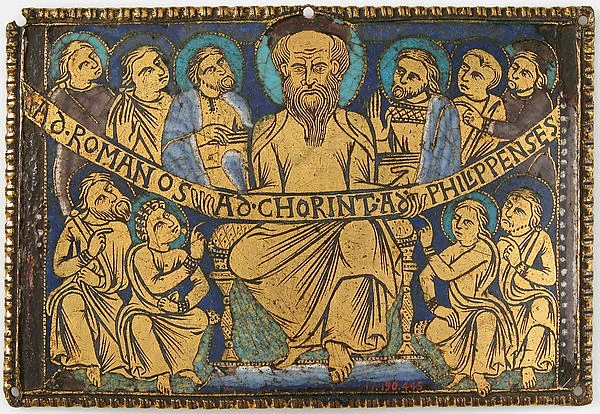
The medieval plaque places Paul among disciples and names three communities addressed in his letters. The Corinthians inscription points to the earlier text that mentions the third heaven.
Plaque with Saint Paul and His Disciples, ca. 1160–80, champlevé enamel on copper, Gift of J. Pierpont Morgan, 1917, The Metropolitan Museum of Art. Open Access, public domain. · Image source ↗ · Public Domain
From the road to the third heaven
The surviving story is damaged near its opening. A child asks Paul his name and recognises him already. The child identifies himself as the Spirit accompanying him. The journey initially has an earthly destination, Jerusalem. It changes direction when the Spirit draws Paul’s attention to what remains hidden in the scene and carries him upwards. [2][5][6]
The exchange about identity is worth remembering when the old man questions Paul later. At the beginning the guide knows his name and tells him how to proceed. At the seventh heaven questions of origin and destination determine whether he can go on. The story prepares for that dialogue before a gate appears. [5][10]
At the fourth heaven, a soul asks for witnesses
Paul watches angels bring a soul to the gate. When the collector accuses it of wrongful acts, the soul asks for testimony about the body in which the acts were committed. Three witnesses answer. The scene puts an accusation, a demand for evidence and a decision into the same episode, giving the reader more detail than a bare declaration of guilt. [7]
After the testimony the soul is cast down into a body prepared for it. Paul is a witness to this judgement, and the Spirit calls him onward. That difference matters when reading the word toll-collector. The fourth-heaven official handles the soul’s case, while the description of how Paul proceeds belongs to a separate thread of the story. [7][8]
The fifth and sixth heavens set different conditions
At the fifth heaven, Paul sees angels carrying whips and driving souls towards judgement. His own gate opens along the route he takes with the Spirit and the apostles. At the sixth he sees light from above and directly addresses the collector. The Spirit opens the way. Reading these two stops together shows how the accompaniment matters each time without making the encounters identical. [8][9]
The old man and the sign at the seventh heaven
The seventh heaven brings a long exchange. An old man sits on a throne more radiant than the sun. He asks where Paul is going and challenges his ability to escape. Paul looks to the Spirit for permission to answer. When the Spirit directs him to give the sign in his hand, the old man turns his attention down towards his own creation and the gate opens. [10]
Some readings identify the figure with a lower creator or demiurge. Start with what the scene makes explicit, his authority, his creation, his questions and his response to the sign. The narrative gives little help in picturing the sign itself. It is more useful to ask who tells Paul to show it and what changes once it is shown. [10][4]
Beyond the seventh, questions give way to greetings
The text calls the next stop the ogdoad, meaning the eighth. The apostles greet Paul there. He goes on to greet people in the ninth heaven and fellow spirits in the tenth. The closing pages give greetings where the middle of the narrative supplied testimony and challenges. The brevity of the final stops is part of how the account ends. [11]
For a first reading, put the fourth and the seventh heavens next to one another. One scene asks for testimony about a life, while the other asks a traveller to account for where he is going. Then read the last three stops, where recognition takes the form of a greeting. The story changes the very action by which a place becomes known. [7][10][11]
Sources
See references (12)
- Codex V,2 and the scholarly page and line range ↗Coptic Gnostic Library Online, Brill, NHC V,2, 17.19–24.9.Return to text ↑
- Coptic Museum manuscript inventory 10548 ↗4CARE, Nag Hammadi Codex V catalogue record, with the work’s Sahidic Coptic setting and page range.Return to text ↑
- The third heaven in 2 Corinthians 12:1–4 ↗2 Corinthians 12:1–4, King James Version.Return to text ↑
- The Coptic work and the other Apocalypse of Paul ↗NASSCAL e-Clavis, Apocalypse of Paul (Coptic), distinct from the Visio Pauli.Return to text ↑
- The child who identifies himself as the Spirit ↗The Coptic Apocalypse of Paul, Nag Hammadi Codex V,2, pp. 18–19. English reading and Coptic text at Good Works Library.Return to text ↑
- The Spirit takes Paul to the third heaven ↗The Coptic Apocalypse of Paul, Nag Hammadi Codex V,2, pp. 19–20. English reading and Coptic text at Good Works Library.Return to text ↑
- The soul asks for witnesses at the fourth heaven ↗The Coptic Apocalypse of Paul, Nag Hammadi Codex V,2, pp. 20–21. English reading and Coptic text at Good Works Library.Return to text ↑
- The angels driving souls towards judgement ↗The Coptic Apocalypse of Paul, Nag Hammadi Codex V,2, p. 22. English reading and Coptic text at Good Works Library.Return to text ↑
- Paul speaks to the collector in the sixth heaven ↗The Coptic Apocalypse of Paul, Nag Hammadi Codex V,2, p. 22. English reading and Coptic text at Good Works Library.Return to text ↑
- The old man, the throne and the sign ↗The Coptic Apocalypse of Paul, Nag Hammadi Codex V,2, pp. 22–23. English reading and Coptic text at Good Works Library.Return to text ↑
- Greetings in the eighth, ninth and tenth heavens ↗The Coptic Apocalypse of Paul, Nag Hammadi Codex V,2, p. 24. English reading and Coptic text at Good Works Library.Return to text ↑
- The enamel plaque naming the recipients of Paul’s letters ↗Plaque with Saint Paul and His Disciples, ca. 1160–80, champlevé enamel on copper, Gift of J. Pierpont Morgan, 1917, The Metropolitan Museum of Art. Open Access, public domain.