Contrapasso
Contrapasso is the fit between an offence and its punishment in Dante’s Inferno. Compare Bertran de Born’s divided body with the diviners’ backward gaze.
In this article
Understanding contrapasso
Contrapasso is the fitting relation between an offence and its punishment in Dante’s Inferno. The punishment can reverse what someone tried to do or make the harm they caused visible in their own body. [1][2][3][4]
Bertran de Born says he divided a father and son. Now he carries his head apart from his body. His explanation gives the reader a direct example of an offence made visible as a punishment. [3][4]
The Divine Comedy by Dante Alighieri
In Inferno XXVIII, Dante Alighieri meets Bertran among those who caused division. Bertran holds his severed head like a lamp and speaks through it. He explains the division of his body through what he did to a father and son. Cary renders his final phrase as a law of retribution, where the Italian names contrapasso. [3][4][9]
The account is dramatic rather than a general rule announced by a detached narrator. The punished speaker tells the pilgrim how to read his body, and asks that news of him return to earth. Recognition, explanation and reputation remain part of the scene. [3][4]
In Inferno XX, the diviners have their heads turned backwards. Virgil connects their desire to see too far ahead with the impossibility of looking forward now. The punishment reverses their aim. Bertran’s instead repeats the division he caused. [1][2]
Dante also records the pilgrim’s tears at the distorted figures and Virgil’s rebuke. The journey therefore includes a difficulty in learning how to respond to what is presented as divine judgment. An explanation of the pattern does not remove the poem’s emotional pressure. [1][2]
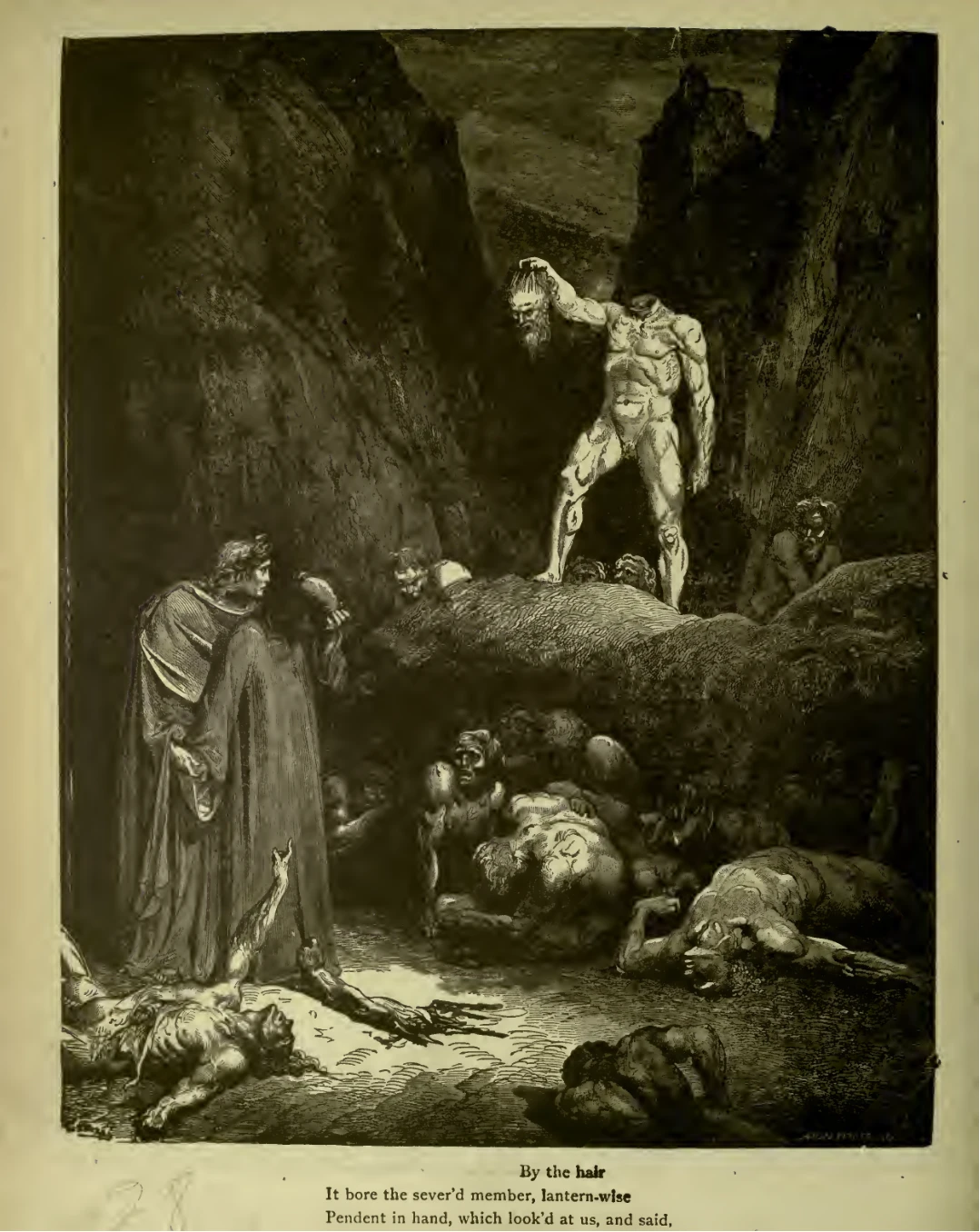
Gustave Doré, Inferno XXVIII. Bertran de Born carries the head through which he explains his punishment.
Inferno, undated New Edition. Dante Alighieri, translated by Henry Francis Cary, designs by Gustave Doré. Thompson & Thomas, Chicago. Historical text and original designs Public Domain. · Image source ↗ · Public Domain
Reversal, resemblance and correction
The proud carry burdens in Purgatory that bow them low and teach humility. Dante grows lighter as his own correction proceeds. The physical condition helps change the person, while Bertran’s condition exposes the injury he caused. [5][6][7][8][4]
A backward gaze and a separated head fit their offences in different ways. The first reverses a desire. The second brings a damaged relationship into view. Dante also makes room for the pilgrim’s tears at what he sees. [2][3][4]
Read further in the library
Dante's Inferno
Reading note
Exact consulted edition and PageRefs in a separately titled book account.
Purgatory and Paradise: The Vision of Dante
Reading note
Exact consulted edition and PageRefs in a separately titled book account.
Sources
See references (10)
- Dante’s Inferno, Reader page 137Dante Alighieri, The Divine Comedy, translated by Henry Francis Cary, designs by Gustave Doré. Inferno: undated New Edition, Thompson & Thomas, Chicago. Purgatory and Paradise: New Edition, Thompson & Thomas, Chicago, 1901. Canto arguments are editorial matter and are distinguished from the poem.Read this page in Dante's Inferno ↗Return to text ↑
- Dante’s Inferno, Reader page 138Dante Alighieri, The Divine Comedy, translated by Henry Francis Cary, designs by Gustave Doré. Inferno: undated New Edition, Thompson & Thomas, Chicago. Purgatory and Paradise: New Edition, Thompson & Thomas, Chicago, 1901. Canto arguments are editorial matter and are distinguished from the poem.Read this page in Dante's Inferno ↗Return to text ↑
- Dante’s Inferno, Reader page 189Dante Alighieri, The Divine Comedy, translated by Henry Francis Cary, designs by Gustave Doré. Inferno: undated New Edition, Thompson & Thomas, Chicago. Purgatory and Paradise: New Edition, Thompson & Thomas, Chicago, 1901. Canto arguments are editorial matter and are distinguished from the poem.Read this page in Dante's Inferno ↗Return to text ↑
- Dante’s Inferno, Reader page 192Dante Alighieri, The Divine Comedy, translated by Henry Francis Cary, designs by Gustave Doré. Inferno: undated New Edition, Thompson & Thomas, Chicago. Purgatory and Paradise: New Edition, Thompson & Thomas, Chicago, 1901. Canto arguments are editorial matter and are distinguished from the poem.Read this page in Dante's Inferno ↗Return to text ↑
- Purgatory and Paradise, Reader page 60Dante Alighieri, The Divine Comedy, translated by Henry Francis Cary, designs by Gustave Doré. Inferno: undated New Edition, Thompson & Thomas, Chicago. Purgatory and Paradise: New Edition, Thompson & Thomas, Chicago, 1901. Canto arguments are editorial matter and are distinguished from the poem.Read this page in Purgatory and Paradise: The Vision of Dante ↗Return to text ↑
- Purgatory and Paradise, Reader page 73Dante Alighieri, The Divine Comedy, translated by Henry Francis Cary, designs by Gustave Doré. Inferno: undated New Edition, Thompson & Thomas, Chicago. Purgatory and Paradise: New Edition, Thompson & Thomas, Chicago, 1901. Canto arguments are editorial matter and are distinguished from the poem.Read this page in Purgatory and Paradise: The Vision of Dante ↗Return to text ↑
- Purgatory and Paradise, Reader page 75Dante Alighieri, The Divine Comedy, translated by Henry Francis Cary, designs by Gustave Doré. Inferno: undated New Edition, Thompson & Thomas, Chicago. Purgatory and Paradise: New Edition, Thompson & Thomas, Chicago, 1901. Canto arguments are editorial matter and are distinguished from the poem.Read this page in Purgatory and Paradise: The Vision of Dante ↗Return to text ↑
- Purgatory and Paradise, Reader page 76Dante Alighieri, The Divine Comedy, translated by Henry Francis Cary, designs by Gustave Doré. Inferno: undated New Edition, Thompson & Thomas, Chicago. Purgatory and Paradise: New Edition, Thompson & Thomas, Chicago, 1901. Canto arguments are editorial matter and are distinguished from the poem.Read this page in Purgatory and Paradise: The Vision of Dante ↗Return to text ↑
- Dante, Inferno XXVIII, lines 139–142, Italian text ↗Dante Alighieri, Inferno XXVIII.142, Italian text in the Princeton Dante Project. The Italian contrapasso is distinguished from Cary’s phrase law of retribution.Return to text ↑
- Dante’s Inferno, Reader page 187Dante Alighieri, The Divine Comedy, translated by Henry Francis Cary, designs by Gustave Doré. Inferno: undated New Edition, Thompson & Thomas, Chicago. Purgatory and Paradise: New Edition, Thompson & Thomas, Chicago, 1901. Canto arguments are editorial matter and are distinguished from the poem.Read this page in Dante's Inferno ↗