Concentration
Concentration is sustained, directed attention. Compare its roles in Steiner’s spiritual training and the exchange of drawings described in Thought-Forms.
In this article
Understanding the concept
Concentration is the deliberate gathering and sustaining of attention. In the esoteric books here it can mean holding a line of thought steady or directing a wish towards someone. Each book explains the result through its own account of what attention can change. [1][2][3][4]
Initiation and Its Results by Rudolf Steiner
In Initiation and Its Results, Rudolf Steiner puts concentration within an education of thought and conduct. He distinguishes being able to hold a thought from having the habits needed to make good use of that steadiness. [1][2][3][4]
In the account of the heart lotus, concentration includes a coherent sequence of thought. One idea should follow another for a reason, rather than attention being carried through disconnected associations. Steiner asks the student to work first on personal thinking, without withdrawing uncharitably from others or continually correcting their conversation. [1]
The etheric-body chapter gives concentrated thought a further role. Reasonable thought is to be deepened until it is independent of immediate sense impressions and gathered into a point under the individual’s direction. Steiner calls this the formation of a preliminary etheric centre near the head. He insists that the person remain connected with ordinary rational life. [2][3]
Steiner says focused exercises contribute to the formation of a centre. The four spiritual qualifications give that formation a place in ordinary life. A person learns to distinguish what endures, value things properly and cultivate qualities such as tolerance. [5][4][6]
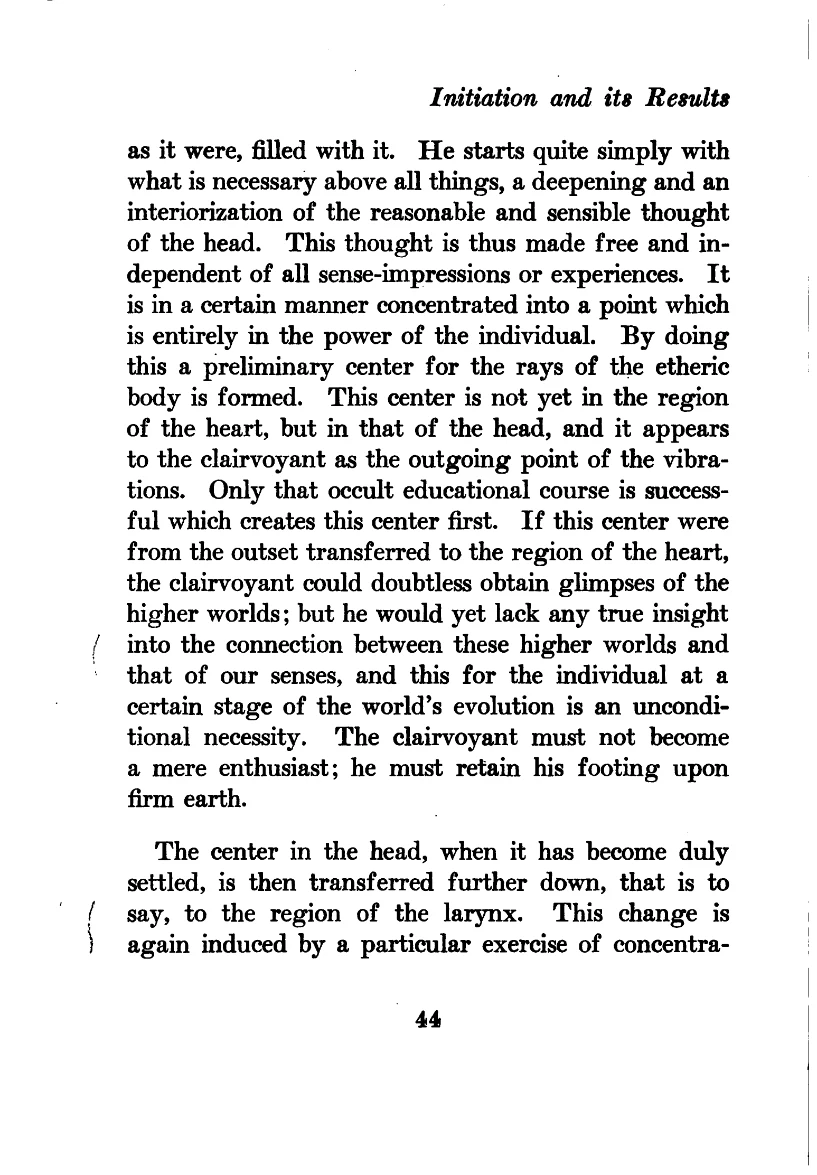
Source facsimile: Initiation and Its Results (1909), printed p. 44, Reader page 43.
Rudolf Steiner, Initiation and Its Results, Clifford Bax translation, First American Edition, 1909. Public-domain historical page from the checksum-verified Library PDF. · Image source ↗ · Public Domain
See references (6)
- Initiation and Its Results, printed p. 27, Reader page 27
- Initiation and Its Results, printed p. 43, Reader page 42
- Initiation and Its Results, printed p. 44, Reader page 43
- Initiation and Its Results, printed p. 48, Reader page 47
- Initiation and Its Results, printed p. 47, Reader page 46
- Initiation and Its Results, printed p. 49, Reader page 48
Thought-Forms by Annie Besant and C. W. Leadbeater
In Thought-Forms, Annie Besant and C. W. Leadbeater describe correspondents who exchanged drawings of forms associated with deliberately directed helpful thoughts. The account connects differences between the drawings with how steadily the sender could concentrate. [7][8]
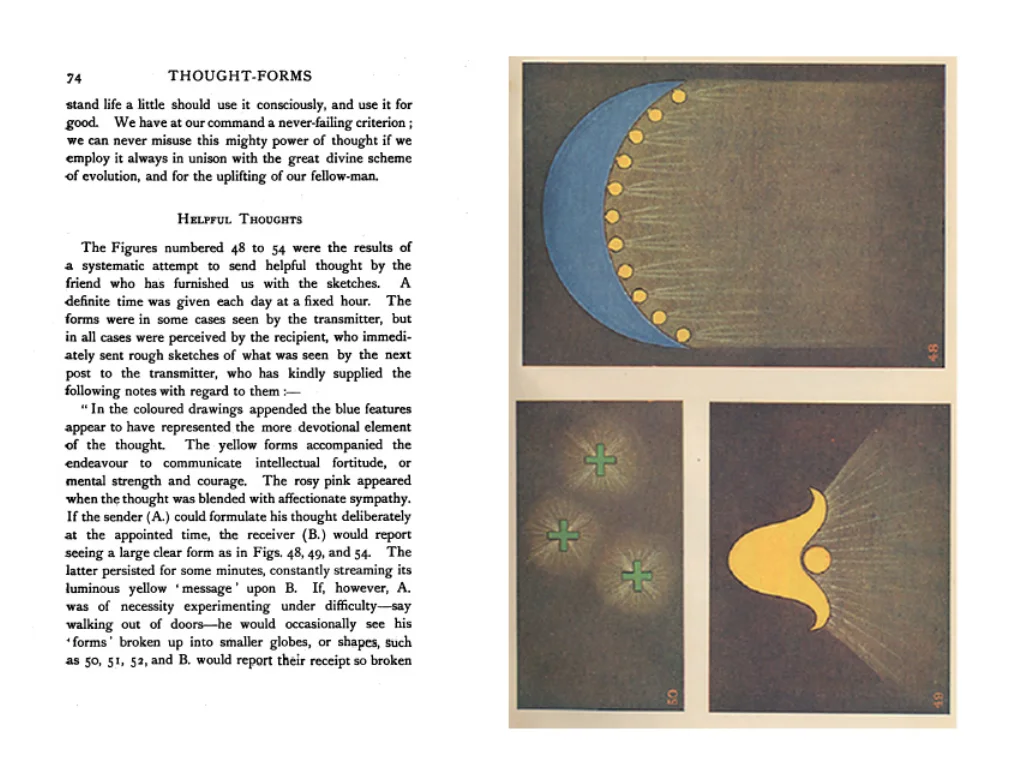
Helpful Thoughts, figures 48 to 50 in Thought-Forms. The book links differences in the forms with how steadily the sender could concentrate. This plate illustrates that account, not Steiner’s etheric physiology.
Annie Besant and C. W. Leadbeater, Thought-Forms (1901). Historical public-domain plate retained from the Library edition. The artists’ interpretation is part of the book’s account. · Image source ↗ · Public Domain
What sustained attention is said to form
In Thought-Forms, the correspondents relate the shape of a reported impression to how steadily the sender could concentrate. Steiner gives concentrated thought a different task, the formation of an organising point within the learner. Both accounts make attention formative and propose different things for it to form. [2][3][4][7][8]
See references (5)
Read further in the library

Initiation and Its Results
Reading note
The separately titled account draws on exact passages in the consulted Library edition.

Thought-Forms
Reading note
Separately attributed comparison with exact previously researched Library passages.
Sources
See references (8)
- Initiation and Its Results, printed p. 27, Reader page 27Rudolf Steiner, Initiation and Its Results: A Sequel to The Way of Initiation, translated by Clifford Bax. First American Edition, 1909. Macoy Publishing and Masonic Supply Co., New York; Max Gysi, London. Claims of clairvoyant perception and subtle organs remain attributed. References identify the exact consulted Library edition.Read this page in Initiation and Its Results ↗Return to text ↑
- Initiation and Its Results, printed p. 43, Reader page 42Rudolf Steiner, Initiation and Its Results: A Sequel to The Way of Initiation, translated by Clifford Bax. First American Edition, 1909. Macoy Publishing and Masonic Supply Co., New York; Max Gysi, London. Claims of clairvoyant perception and subtle organs remain attributed. References identify the exact consulted Library edition.Read this page in Initiation and Its Results ↗Return to text ↑
- Initiation and Its Results, printed p. 44, Reader page 43Rudolf Steiner, Initiation and Its Results: A Sequel to The Way of Initiation, translated by Clifford Bax. First American Edition, 1909. Macoy Publishing and Masonic Supply Co., New York; Max Gysi, London. Claims of clairvoyant perception and subtle organs remain attributed. References identify the exact consulted Library edition.Read this page in Initiation and Its Results ↗Return to text ↑
- Initiation and Its Results, printed p. 48, Reader page 47Rudolf Steiner, Initiation and Its Results: A Sequel to The Way of Initiation, translated by Clifford Bax. First American Edition, 1909. Macoy Publishing and Masonic Supply Co., New York; Max Gysi, London. Claims of clairvoyant perception and subtle organs remain attributed. References identify the exact consulted Library edition.Read this page in Initiation and Its Results ↗Return to text ↑
- Initiation and Its Results, printed p. 47, Reader page 46Rudolf Steiner, Initiation and Its Results: A Sequel to The Way of Initiation, translated by Clifford Bax. First American Edition, 1909. Macoy Publishing and Masonic Supply Co., New York; Max Gysi, London. Claims of clairvoyant perception and subtle organs remain attributed. References identify the exact consulted Library edition.Read this page in Initiation and Its Results ↗Return to text ↑
- Initiation and Its Results, printed p. 49, Reader page 48Rudolf Steiner, Initiation and Its Results: A Sequel to The Way of Initiation, translated by Clifford Bax. First American Edition, 1909. Macoy Publishing and Masonic Supply Co., New York; Max Gysi, London. Claims of clairvoyant perception and subtle organs remain attributed. References identify the exact consulted Library edition.Read this page in Initiation and Its Results ↗Return to text ↑
- Helpful Thoughts, printed page 74 and figures 48 to 50 (Reader page 57)Exact source retained from the earlier attributed Thought-forms account.Read this page in Thought-Forms ↗Return to text ↑
- Helpful Thoughts, complete sequence of figures 48 to 54 ↗Previously researched historical book transcription or plate; retained from the earlier Thought-forms account.Return to text ↑