The chrono-telescope
Camille Flammarion’s chrono-telescope turns a flash into an extended view. Explore the thought experiment and its analogy with motion photography.
In this article
Understanding chrono-telescope
The chrono-telescope is Camille Flammarion’s idea for making a brief event appear to last longer. In Lumen, a flash of lightning might unfold slowly enough for a viewer to examine each phase in order. The event itself still takes the same time. [3][4][5][6]
Lumen by Camille Flammarion
In Lumen, Camille Flammarion imagines an observer moving alongside the light of a flash. Matching its speed would hold one moment in view. Moving a little slower would let light from the later phases catch up gradually, stretching the appearance of the flash. He imagines watching falling rocks and other brief catastrophes the same way. [3][4][5]
To make the idea concrete, the dialogue compares it with a series of photographs. Displaying rapid changes slowly reveals details. Playing long intervals in quick succession can compress the growth of a child or flower. Flammarion names his proposed method a chronoscope or chrono-telescope. [5][6][7]
The book’s retrograde vision uses a different relation to the travelling light. There the observer overtakes it and meets older scenes in reverse order. Here the observer watches an event unfold forward at a slower pace. [8][9][10][11][3][4][5][6][13]
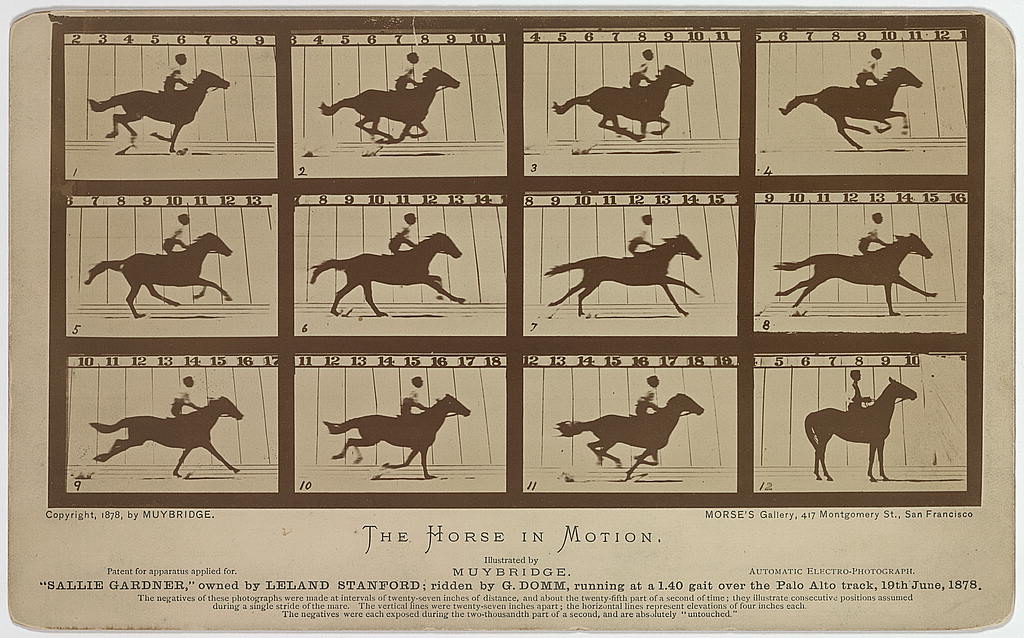
Eadweard Muybridge, The Horse in Motion (1878). A series of photographs makes successive positions of the horse and rider visible.
Eadweard Muybridge. Library of Congress, Prints and Photographs Division. · Image source ↗ · Public Domain
See references (10)
- Lumen, Reader page 224
- Lumen, Reader page 225
- Lumen, Reader page 226
- Lumen, printed p. 221, Reader page 227
- Lumen, Reader page 228
- Lumen, Reader page 99
- Lumen, Reader page 100
- Lumen, Reader page 101
- Lumen, Reader page 102
- Eadweard Muybridge, The Horse in Motion: Sallie Gardner, 1878, Library of Congress, 97502309
Thought-Forms by Annie Besant and C. W. Leadbeater
In Thought-Forms, Annie Besant and Charles Webster Leadbeater show how sand collects in patterns on a bowed plate and how a pen can trace the movements of coupled pendulums. The physical patterns give them an analogy for the forms they ascribe to thought. [2][12]
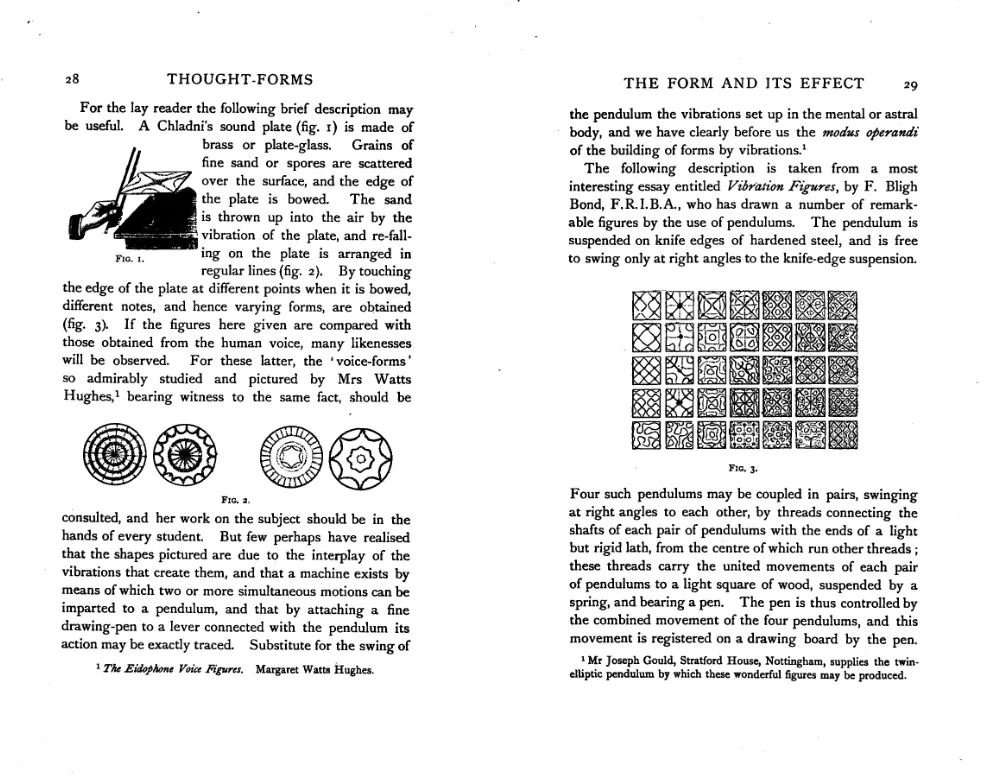
Thought-Forms (1905), pp. 28–29. Sand on a bowed plate forms patterns, and the text explains how a pen can record coupled pendulums.
Annie Besant and Charles Webster Leadbeater, Thought-Forms (1901). Historical public-domain illustrated spread from the exact Library edition. · Image source ↗ · Public Domain
What each record preserves
A pendulum trace shows the path of a movement, while a photographic series shows successive positions. Flammarion’s proposed observer would change the intervals between the arriving images themselves. NASA’s account of relativity gives light a limiting speed. [1][3][4][5][6][2][12]
See references (7)
- NASA Space Place, Is Time Travel Possible?, sections on telescopes and relativity
- Thought-Forms (1905), printed pp. 28–29, Reader page 16
- Lumen, Reader page 224
- Lumen, Reader page 225
- Lumen, Reader page 226
- Lumen, printed p. 221, Reader page 227
- Thought-Forms (1905), printed p. 30 and figs. 4–7, Reader page 17
Read further in the library
Thought-Forms
Reading note
Separately attributed primary Library account, cited on exact verified Reader leaves.

Lumen
Reading note
The separately titled account draws on exact passages in the consulted Library edition.
Sources
See references (13)
- NASA Space Place, Is Time Travel Possible?, sections on telescopes and relativity ↗NASA/JPL-Caltech educational explanation. Consulted for the distinction between receiving old light and the relativistic speed limit; not evidence for Flammarion’s spiritual faculties.Return to text ↑
- Thought-Forms (1905), printed pp. 28–29, Reader page 16Annie Besant and Charles Webster Leadbeater, Thought-Forms, The Theosophical Publishing Society, 1905.Read this page in Thought-Forms ↗Return to text ↑
- Lumen, Reader page 224Camille Flammarion, Lumen, authorised English translation by A. A. M. and R. M., Dodd, Mead and Company, New York, 1897. Exact selected Library edition IMJ-0398-E001. Lumen and Quaerens are speakers in the dialogue; claims made by the narrator are attributed to this text. Original PageIDs and current Reader positions are verified separately from printed pagination.Read this page in Lumen ↗Return to text ↑
- Lumen, Reader page 225Camille Flammarion, Lumen, authorised English translation by A. A. M. and R. M., Dodd, Mead and Company, New York, 1897. Exact selected Library edition IMJ-0398-E001. Lumen and Quaerens are speakers in the dialogue; claims made by the narrator are attributed to this text. Original PageIDs and current Reader positions are verified separately from printed pagination.Read this page in Lumen ↗Return to text ↑
- Lumen, Reader page 226Camille Flammarion, Lumen, authorised English translation by A. A. M. and R. M., Dodd, Mead and Company, New York, 1897. Exact selected Library edition IMJ-0398-E001. Lumen and Quaerens are speakers in the dialogue; claims made by the narrator are attributed to this text. Original PageIDs and current Reader positions are verified separately from printed pagination.Read this page in Lumen ↗Return to text ↑
- Lumen, printed p. 221, Reader page 227Camille Flammarion, Lumen, authorised English translation by A. A. M. and R. M., Dodd, Mead and Company, New York, 1897. Exact selected Library edition IMJ-0398-E001. Lumen and Quaerens are speakers in the dialogue; claims made by the narrator are attributed to this text. Original PageIDs and current Reader positions are verified separately from printed pagination.Read this page in Lumen ↗Return to text ↑
- Lumen, Reader page 228Camille Flammarion, Lumen, authorised English translation by A. A. M. and R. M., Dodd, Mead and Company, New York, 1897. Exact selected Library edition IMJ-0398-E001. Lumen and Quaerens are speakers in the dialogue; claims made by the narrator are attributed to this text. Original PageIDs and current Reader positions are verified separately from printed pagination.Read this page in Lumen ↗Return to text ↑
- Lumen, Reader page 99Camille Flammarion, Lumen, authorised English translation by A. A. M. and R. M., Dodd, Mead and Company, New York, 1897. Exact selected Library edition IMJ-0398-E001. Lumen and Quaerens are speakers in the dialogue; claims made by the narrator are attributed to this text. Original PageIDs and current Reader positions are verified separately from printed pagination.Read this page in Lumen ↗Return to text ↑
- Lumen, Reader page 100Camille Flammarion, Lumen, authorised English translation by A. A. M. and R. M., Dodd, Mead and Company, New York, 1897. Exact selected Library edition IMJ-0398-E001. Lumen and Quaerens are speakers in the dialogue; claims made by the narrator are attributed to this text. Original PageIDs and current Reader positions are verified separately from printed pagination.Read this page in Lumen ↗Return to text ↑
- Lumen, Reader page 101Camille Flammarion, Lumen, authorised English translation by A. A. M. and R. M., Dodd, Mead and Company, New York, 1897. Exact selected Library edition IMJ-0398-E001. Lumen and Quaerens are speakers in the dialogue; claims made by the narrator are attributed to this text. Original PageIDs and current Reader positions are verified separately from printed pagination.Read this page in Lumen ↗Return to text ↑
- Lumen, Reader page 102Camille Flammarion, Lumen, authorised English translation by A. A. M. and R. M., Dodd, Mead and Company, New York, 1897. Exact selected Library edition IMJ-0398-E001. Lumen and Quaerens are speakers in the dialogue; claims made by the narrator are attributed to this text. Original PageIDs and current Reader positions are verified separately from printed pagination.Read this page in Lumen ↗Return to text ↑
- Thought-Forms (1905), printed p. 30 and figs. 4–7, Reader page 17Annie Besant and Charles Webster Leadbeater, Thought-Forms, The Theosophical Publishing Society, 1905.Read this page in Thought-Forms ↗Return to text ↑
- Eadweard Muybridge, The Horse in Motion: Sallie Gardner, 1878, Library of Congress, 97502309 ↗Eadweard Muybridge. Library of Congress, Prints and Photographs Division.Return to text ↑