Christian Kabbalah
Christian Kabbalah adapted Jewish mystical texts and imagery to Christian interpretation. Compare a Latin Gikatilla edition with Khunrath’s illustrated work.
In this article
What is Christian Kabbalah?
Christian Kabbalah is a tradition of Christian interpretation that draws on Jewish mystical writings, especially teachings about divine names and the sefirot, the ten powers or attributes through which God is understood to act. Latin translations brought selected Hebrew texts into new circles of readers. [3][1]
Two early printed books show different stages of that reception. In the 1516 Portae Lucis, Paulus Ricius translated portions of Joseph Gikatilla’s Sha’arei Orah. Heinrich Khunrath’s illustrated Amphitheatrum put Kabbalistic ideas to work in his own Christian alchemical project. [3][4][5][1][2]
Witchcraft Magic & Alchemy by Grillot de Givry
Grillot de Givry traces the movement of terms such as sefirot and divine names into Christian writings about magic. He observes that Cabbala also became a loose label for occult ideas, sometimes with little traceable connection to Jewish Kabbalah. [3][4]
The Portae Lucis woodcut shows a reader holding a diagram with Hebrew labels. Khunrath’s Stairway of the Sages makes readers look up a narrow flight of steps towards a dark doorway. The images give two forms to the idea that wisdom can be approached in stages. [4][5]
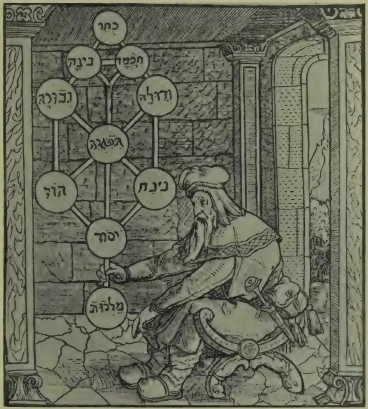
The Tree of Life woodcut from Portae Lucis, the Latin rendering of material by Joseph Gikatilla. De Givry reproduces it as figure 174.
Woodcut from the 1516 Augsburg edition of Joseph Gikatilla in the Latin rendering of Paulus Ricius, as reproduced by De Givry. · Image source ↗ · Public Domain
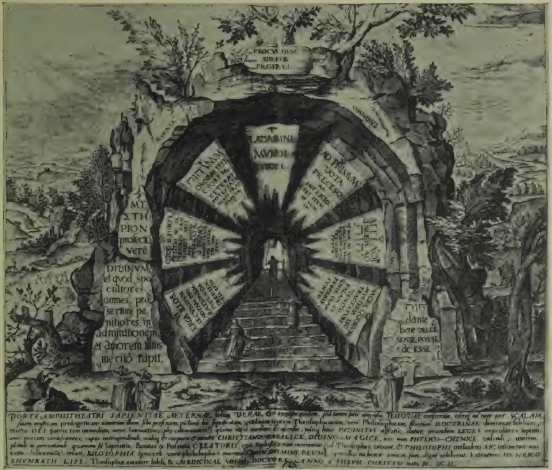
Heinrich Khunrath’s Door of the Sanctuary and Stairway of the Sages. The architecture makes the approach to wisdom the subject of the image.
Heinrich Khunrath, Amphitheatrum Sapientiae Aeternae, Hanau, 1609. As reproduced by De Givry. · Image source ↗ · Public Domain
The Tree of Life and the stairway
The Tree of Life shows the sefirot in relation to one another. Khunrath’s stairway asks the viewer to imagine approaching the sanctuary. Read alongside the books that carry them, the images show what translation preserved and what a later Christian author made of the material. [4][5][1][2]
In the library
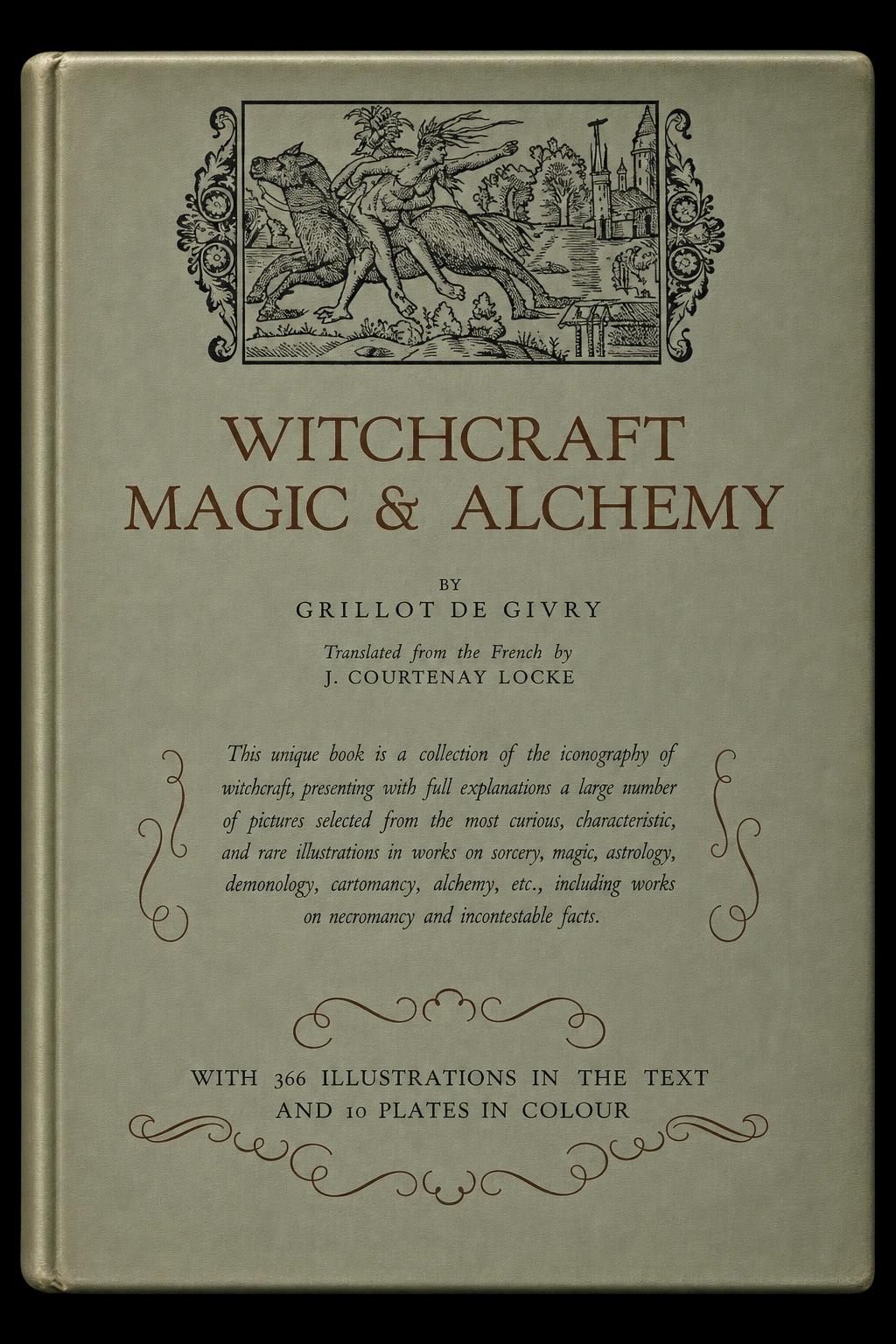
Witchcraft Magic and Alchemy
Reading note
The separately titled account draws on exact passages in the consulted Library edition.
Sources
See references (5)
- Portae Lucis by Joseph Gikatilla, Augsburg, 1516 ↗Center for Jewish Art, Hebrew University of Jerusalem. Catalogue description of the first edition and its illustrated title page.
- Amphitheatrum Sapientiae Aeternae Solius Verae ↗Heinrich Khunrath, Hanau, Wilhelm Antonius, 1609. Science History Institute Digital Collections.
- Witchcraft Magic & Alchemy, printed p. 206, Reader page 198Grillot de Givry, Witchcraft Magic & Alchemy, translated by J. Courtenay Locke. Boston and New York, Houghton Mifflin Company, 1931.Read this page in Witchcraft Magic and Alchemy ↗
- Witchcraft Magic & Alchemy, printed p. 207, Reader page 199Grillot de Givry, Witchcraft Magic & Alchemy, translated by J. Courtenay Locke. Boston and New York, Houghton Mifflin Company, 1931.Read this page in Witchcraft Magic and Alchemy ↗
- Witchcraft Magic & Alchemy, printed p. 209, Reader page 201Grillot de Givry, Witchcraft Magic & Alchemy, translated by J. Courtenay Locke. Boston and New York, Houghton Mifflin Company, 1931.Read this page in Witchcraft Magic and Alchemy ↗