Christian Altar
What is a Christian altar? Explore its purpose, furnishings, relics and Leadbeater’s account of consecrated gems and the Seven Rays.
In this article
What is a Christian altar?
In Christian worship an altar is a place set apart for sacred use. In the Roman Catholic Mass, it is the table at which the Eucharist is celebrated. A cross and candles may stand on or near it. The tabernacle houses the reserved sacrament and serves a different purpose. [1]
When an altar is dedicated, Roman Catholic instructions retain the tradition of placing authentic relics of saints beneath it. The practice links a place of worship with the memory of people the Church honours. [1][2]
The Science of the Sacraments by Charles W. Leadbeater
Charles W. Leadbeater describes an altar-stone fitted into the surface where the chalice and paten are placed. He discusses relics and proposes a set of stones for the Liberal Catholic altar. His table assigns a gemstone and possible substitutes to each of seven influences he calls Rays. [3][4][5][6][7][8][9]
Leadbeater relates the gems to other stones and to crosses placed around the church. The labelled photograph identifies furnishings such as the cross, candles, lamp and tabernacle. The table beside it shows where the book adds a scheme of seven spiritual influences. [8][10][11][12][13][14]
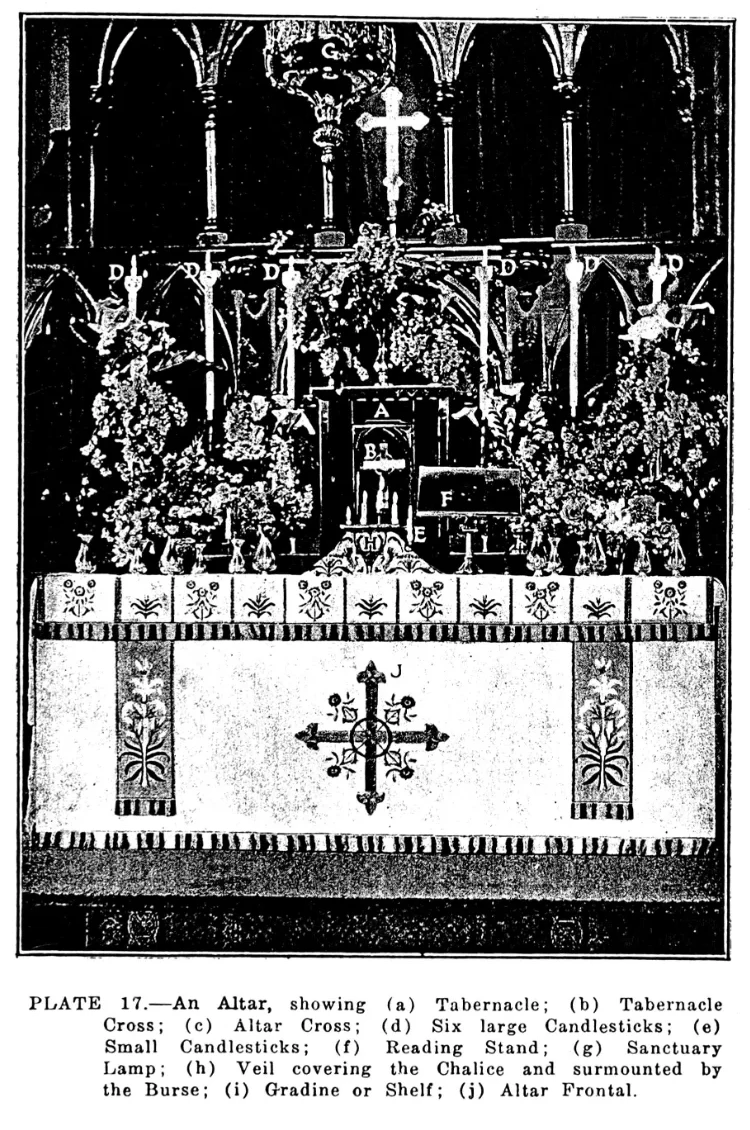
Plate 17, facing printed page 408. Labels identify the tabernacle, candles, reading stand, vessels and altar frontal.
The Science of the Sacraments by Charles W. Leadbeater, The St. Alban Press, 1920. Library facsimile. · Image source ↗ · Public Domain
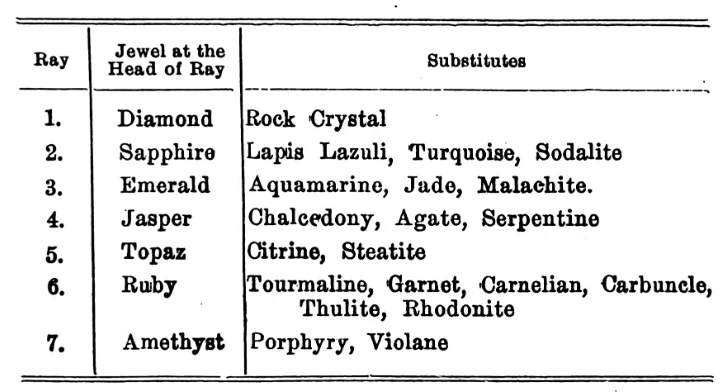
Printed page 407. Leadbeater lists stones for each Ray and gives substitutes where the first choice is unavailable.
The Science of the Sacraments by Charles W. Leadbeater, The St. Alban Press, 1920. Library facsimile. · Image source ↗ · Public Domain
See references (12)
- The Science of the Sacraments, Reader page 413
- The Science of the Sacraments, printed p. 401, Reader page 414
- The Science of the Sacraments, printed p. 402, Reader page 415
- The Science of the Sacraments, printed p. 403, Reader page 416
- The Science of the Sacraments, printed p. 406, Reader page 419
- The Science of the Sacraments, printed p. 407, Reader page 420
- The Science of the Sacraments, printed p. 408, Reader page 421
- The Science of the Sacraments, Reader page 422
- The Science of the Sacraments, printed p. 416, Reader page 430
- The Science of the Sacraments, printed p. 417, Reader page 431
- The Science of the Sacraments, printed p. 418, Reader page 432
- The Science of the Sacraments, printed p. 420, Reader page 434
Furnishings, relics and gems
The Roman Missal distinguishes the place of celebration from the place where the sacrament is reserved. It also gives relics a place in the altar’s dedication. Leadbeater describes distinct functions for the furnishings and adds to them his Liberal Catholic interpretation of the altar gems. [1][4][6][7][8]
See references (5)
In the library
The Science of the Sacraments
Reading note
The separately titled account draws on exact passages in the consulted Library edition.
Sources
See references (14)
- General Instruction of the Roman Missal, §§296–308 ↗United States Conference of Catholic Bishops, English text.
- Order of the Dedication of a Church and an Altar, music and rubrics ↗United States Conference of Catholic Bishops.
- The Science of the Sacraments, Reader page 413Charles W. Leadbeater, The Science of the Sacraments, The St. Alban Press, 1920. Exact Library edition IMJ-0615-E001.Read this page in The Science of the Sacraments ↗
- The Science of the Sacraments, printed p. 401, Reader page 414Charles W. Leadbeater, The Science of the Sacraments, The St. Alban Press, 1920. Exact Library edition IMJ-0615-E001.Read this page in The Science of the Sacraments ↗
- The Science of the Sacraments, printed p. 402, Reader page 415Charles W. Leadbeater, The Science of the Sacraments, The St. Alban Press, 1920. Exact Library edition IMJ-0615-E001.Read this page in The Science of the Sacraments ↗
- The Science of the Sacraments, printed p. 403, Reader page 416Charles W. Leadbeater, The Science of the Sacraments, The St. Alban Press, 1920. Exact Library edition IMJ-0615-E001.Read this page in The Science of the Sacraments ↗
- The Science of the Sacraments, printed p. 406, Reader page 419Charles W. Leadbeater, The Science of the Sacraments, The St. Alban Press, 1920. Exact Library edition IMJ-0615-E001.Read this page in The Science of the Sacraments ↗
- The Science of the Sacraments, printed p. 407, Reader page 420Charles W. Leadbeater, The Science of the Sacraments, The St. Alban Press, 1920. Exact Library edition IMJ-0615-E001.Read this page in The Science of the Sacraments ↗
- The Science of the Sacraments, printed p. 408, Reader page 421Charles W. Leadbeater, The Science of the Sacraments, The St. Alban Press, 1920. Exact Library edition IMJ-0615-E001.Read this page in The Science of the Sacraments ↗
- The Science of the Sacraments, Reader page 422Charles W. Leadbeater, The Science of the Sacraments, The St. Alban Press, 1920. Exact Library edition IMJ-0615-E001.Read this page in The Science of the Sacraments ↗
- The Science of the Sacraments, printed p. 416, Reader page 430Charles W. Leadbeater, The Science of the Sacraments, The St. Alban Press, 1920. Exact Library edition IMJ-0615-E001.Read this page in The Science of the Sacraments ↗
- The Science of the Sacraments, printed p. 417, Reader page 431Charles W. Leadbeater, The Science of the Sacraments, The St. Alban Press, 1920. Exact Library edition IMJ-0615-E001.Read this page in The Science of the Sacraments ↗
- The Science of the Sacraments, printed p. 418, Reader page 432Charles W. Leadbeater, The Science of the Sacraments, The St. Alban Press, 1920. Exact Library edition IMJ-0615-E001.Read this page in The Science of the Sacraments ↗
- The Science of the Sacraments, printed p. 420, Reader page 434Charles W. Leadbeater, The Science of the Sacraments, The St. Alban Press, 1920. Exact Library edition IMJ-0615-E001.Read this page in The Science of the Sacraments ↗