Painting Devas in Watchers of the Seven Spheres
Why did H. K. Challoner find devas difficult to paint? Explore the changing colours, forms and dimensions described in the introduction to her 1933 book.
In this article
How a changing vision becomes a picture
A devic portrait gives a visible form to a being a Theosophical author describes seeing in a vision. In H. K. Challoner’s 1933 Watchers of the Seven Spheres, the pictures accompany poems and dialogue. The introduction asks how a fixed image can convey something said to keep changing. [4][5][6][7]
Watchers of the Seven Spheres by H. K. Challoner
The title page of H. K. Challoner’s Watchers of the Seven Spheres announces eight colour plates. The frontispiece caption identifies a Master appearing in deva form. The writer of the introduction, credited as the author of The Initiate, says Challoner tried to convey thoughts in words and portray higher devas in paint under the guidance of Master Hilarion. [4][5][6]
The introduction compares the task to transferring orchestral music to a piano. Colours can fall outside ordinary vision in this account, and both shape and aura can change. The introducer invites readers who doubt the claimed origin of the material to read the text as poetry. [6][7]
Thought-Forms by Annie Besant and Charles W. Leadbeater
In Thought-Forms, Annie Besant and Charles W. Leadbeater illustrate forms they associate with music by Mendelssohn, Gounod and Wagner. The same church gives the three images a point of reference for comparing size, contour and colour. [2][1][3]
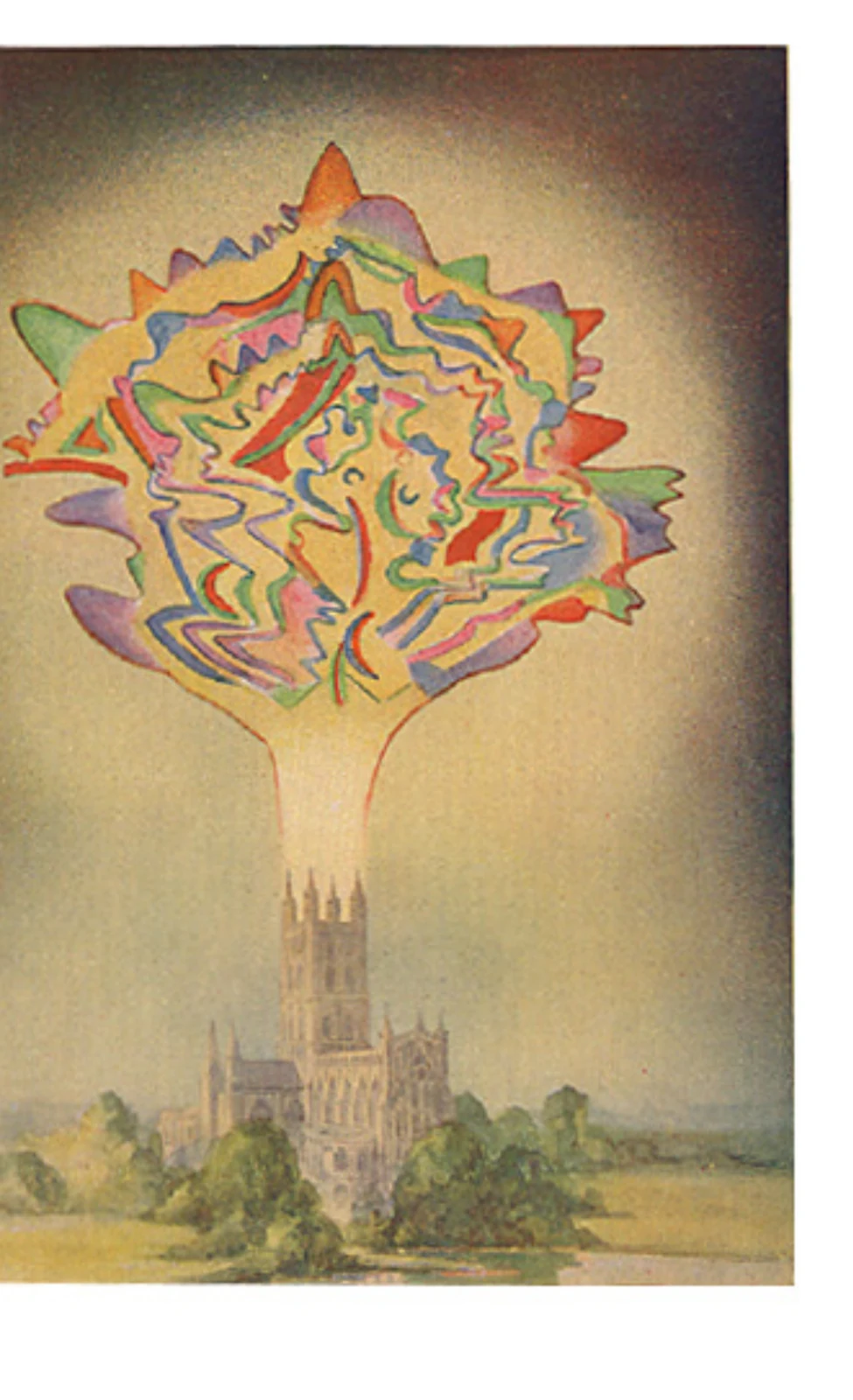
In the Gounod plate, a branching form rises above the church. The authors keep the building in view as a reference point across all three plates.
Annie Besant and C. W. Leadbeater, Thought-Forms (1901). Historical public-domain plate retained from the Library edition. The artists’ interpretation is part of the book’s account. · Image source ↗ · Public Domain
What the image can convey
Besant and Leadbeater keep one building in view to make the pictures comparable. Challoner’s introducer asks what a single picture loses when it fixes a changing experience. [6][7][2][1][3]
In the library
Thought-Forms
Reading note
Separately attributed primary Library account, cited on exact verified Reader leaves.
Watchers of the Seven Spheres
Reading note
The separately titled account draws on exact passages in the consulted Library edition.
Sources
See references (7)
- Thought-Forms, Reader page 63Exact source retained from the earlier attributed Thought-forms account.Read this page in Thought-Forms ↗
- Thought-Forms, Reader page 61Exact source retained from the earlier attributed Thought-forms account.Read this page in Thought-Forms ↗
- Thought-Forms, Reader page 65Exact source retained from the earlier attributed Thought-forms account.Read this page in Thought-Forms ↗
- Watchers of the Seven Spheres, Reader page 2H. K. Challoner, Watchers of the Seven Spheres, London, George Routledge & Sons, 1933. Lumitheca Library edition IMJ-0604-E001.Read this page in Watchers of the Seven Spheres ↗
- Watchers of the Seven Spheres, Reader page 3H. K. Challoner, Watchers of the Seven Spheres, London, George Routledge & Sons, 1933. Lumitheca Library edition IMJ-0604-E001.Read this page in Watchers of the Seven Spheres ↗
- Watchers of the Seven Spheres, printed p. xiv, Reader page 12H. K. Challoner, Watchers of the Seven Spheres, London, George Routledge & Sons, 1933. Lumitheca Library edition IMJ-0604-E001.Read this page in Watchers of the Seven Spheres ↗
- Watchers of the Seven Spheres, printed p. xv, Reader page 13H. K. Challoner, Watchers of the Seven Spheres, London, George Routledge & Sons, 1933. Lumitheca Library edition IMJ-0604-E001.Read this page in Watchers of the Seven Spheres ↗