Buddhic and Nirvanic consciousness
Buddhic and Nirvanic consciousness are stages in Theosophy. Compare Arundale’s account of waking awareness with Leadbeater’s planes and Buddhist nirvana.
In this article
Understanding the concept
Buddhic and Nirvanic consciousness are two forms of higher awareness described in Theosophy. Buddhic comes before Nirvanic in George S. Arundale’s account. The names belong to his arrangement of spiritual development, while Buddhist sources explain nirvana through liberation from greed, hatred and delusion. [2][3][11][12][13][1]
See references (6)
- Saṃyutta Nikāya 38.1, A Question About Extinguishment, segments 2.3–2.10
- Kundalini: An Occult Experience, printed p. 65, Reader page 67
- Kundalini: An Occult Experience, printed p. 83, Reader page 85
- C. W. Leadbeater, Man Visible and Invisible (John Lane, 1903), printed p. 20, PDF leaf 35
- C. W. Leadbeater, Man Visible and Invisible (John Lane, 1903), printed p. 21, PDF leaf 36
- C. W. Leadbeater, Man Visible and Invisible (John Lane, 1903), printed p. 22, PDF leaf 37
Kundalini: An Occult Experience by George S. Arundale
George S. Arundale regards Buddhic and later Nirvanic awareness as the aim of Kundalini. He describes higher consciousness as jewels set into ordinary waking awareness. He gives this change priority over clairvoyance because it is supposed to make intuition clearer and loosen the hold of private desire. [4][2][5]
Arundale uses increasing solidity to describe how mental, Buddhic and Nirvanic matter seem progressively more real to him. As consciousness expands, he changes the image from bodies with localized senses to a whole body capable of receiving impressions, and eventually to radiances. These are his ways of describing what a change in awareness might feel like. [6][3][7][8][9]
See references (8)
- Kundalini: An Occult Experience, printed p. 65, Reader page 67
- Kundalini: An Occult Experience, printed p. 83, Reader page 85
- Kundalini: An Occult Experience, printed p. 64, Reader page 66
- Kundalini: An Occult Experience, printed p. 66, Reader page 68
- Kundalini: An Occult Experience, Reader page 84
- Kundalini: An Occult Experience, printed p. 84, Reader page 86
- Kundalini: An Occult Experience, printed p. 86, Reader page 88
- Kundalini: An Occult Experience, Reader page 89
Man Visible and Invisible by Charles Webster Leadbeater
Charles Webster Leadbeater places Buddhi in relation to a fourth plane, distinct from the mental plane. Nirvana is a further attainment that he links with adeptship and the end of a human evolutionary cycle. His diagram of the three outpourings situates the planes within a larger account of descent and return. [11][12][13][14][15][16]
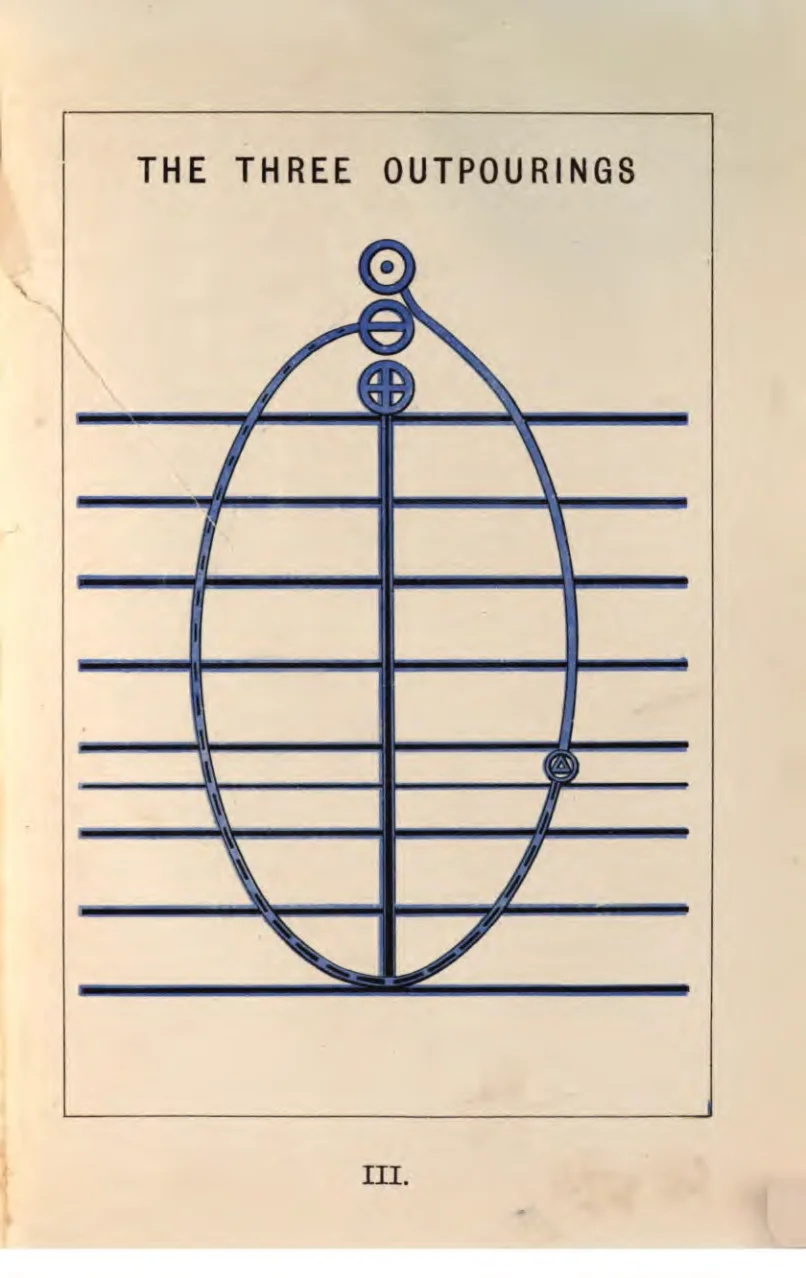
Plate III, The Three Outpourings, Man Visible and Invisible (1903). Leadbeater relates the bands to his planes of nature; the diagram belongs to his broader cosmology.
C. W. Leadbeater, Man Visible and Invisible, New York: John Lane, 1903. Public-domain historical plate; selected external scan differs from the Library edition. White canvas margins trimmed; complete printed plate retained. WebP conversion without recolouring. · Image source ↗ · Public Domain
See references (6)
- C. W. Leadbeater, Man Visible and Invisible (John Lane, 1903), printed p. 20, PDF leaf 35
- C. W. Leadbeater, Man Visible and Invisible (John Lane, 1903), printed p. 21, PDF leaf 36
- C. W. Leadbeater, Man Visible and Invisible (John Lane, 1903), printed p. 22, PDF leaf 37
- C. W. Leadbeater, Man Visible and Invisible (John Lane, 1903), printed p. 36, PDF leaf 51
- C. W. Leadbeater, Man Visible and Invisible (John Lane, 1903), printed p. 38, PDF leaf 53
- C. W. Leadbeater, Man Visible and Invisible (John Lane, 1903), Plate III, PDF leaf 54
Saṃyutta Nikāya 38.1, translated by Bhikkhu Sujato
In Saṃyutta Nikāya 38.1, the wanderer Jambukhādaka asks Sāriputta about nibbāna, rendered “extinguishment” by Bhikkhu Sujato. Sāriputta explains it as the ending of greed, hatred and delusion and identifies the noble eightfold path as the way to realize it. [1]
A hierarchy of awareness and the end of craving
Arundale distinguishes two stages of higher consciousness and describes how he believes they can change an individual’s waking life. Sāriputta’s answer identifies the tendencies that come to an end. The resemblance between the terms raises a question about what each author counts as liberation. [2][1][10][5]
Leadbeater’s diagram answers a further question about where the planes fit in his cosmology. Arundale’s image of jewels asks the reader to imagine what can become active in everyday awareness. [11][12][13][2]
See references (7)
- Saṃyutta Nikāya 38.1, A Question About Extinguishment, segments 2.3–2.10
- Kundalini: An Occult Experience, printed p. 65, Reader page 67
- Kundalini: An Occult Experience, printed p. 66, Reader page 68
- Kundalini: An Occult Experience, printed p. xv, Reader page 11
- C. W. Leadbeater, Man Visible and Invisible (John Lane, 1903), printed p. 20, PDF leaf 35
- C. W. Leadbeater, Man Visible and Invisible (John Lane, 1903), printed p. 21, PDF leaf 36
- C. W. Leadbeater, Man Visible and Invisible (John Lane, 1903), printed p. 22, PDF leaf 37
Read further in the library

Kundalini: An Occult Experience
Reading note
The separately titled account draws on exact passages in the consulted Library edition.

Man Visible and Invisible
Reading note
Selected passages and plates compared in a distinct 1903 John Lane scan. Exact external PDF leaves are cited; Library PageRefs are not inferred.
Sources
See references (16)
- Saṃyutta Nikāya 38.1, A Question About Extinguishment, segments 2.3–2.10 ↗Early Buddhist discourse reporting Sāriputta’s answer to Jambukhādaka. English translation by Bhikkhu Sujato; checked against SuttaCentral’s published Bilara text.Return to text ↑
- Kundalini: An Occult Experience, printed p. 65, Reader page 67George S. Arundale, Kundalini: An Occult Experience, The Theosophical Publishing House, Adyar, Madras, India, 1938. Consulted Library edition IMJ-0227-E001.Read this page in Kundalini: An Occult Experience ↗Return to text ↑
- Kundalini: An Occult Experience, printed p. 83, Reader page 85George S. Arundale, Kundalini: An Occult Experience, The Theosophical Publishing House, Adyar, Madras, India, 1938. Consulted Library edition IMJ-0227-E001.Read this page in Kundalini: An Occult Experience ↗Return to text ↑
- Kundalini: An Occult Experience, printed p. 64, Reader page 66George S. Arundale, Kundalini: An Occult Experience, The Theosophical Publishing House, Adyar, Madras, India, 1938. Consulted Library edition IMJ-0227-E001.Read this page in Kundalini: An Occult Experience ↗Return to text ↑
- Kundalini: An Occult Experience, printed p. 66, Reader page 68George S. Arundale, Kundalini: An Occult Experience, The Theosophical Publishing House, Adyar, Madras, India, 1938. Consulted Library edition IMJ-0227-E001.Read this page in Kundalini: An Occult Experience ↗Return to text ↑
- Kundalini: An Occult Experience, Reader page 84George S. Arundale, Kundalini: An Occult Experience, The Theosophical Publishing House, Adyar, Madras, India, 1938. Consulted Library edition IMJ-0227-E001.Read this page in Kundalini: An Occult Experience ↗Return to text ↑
- Kundalini: An Occult Experience, printed p. 84, Reader page 86George S. Arundale, Kundalini: An Occult Experience, The Theosophical Publishing House, Adyar, Madras, India, 1938. Consulted Library edition IMJ-0227-E001.Read this page in Kundalini: An Occult Experience ↗Return to text ↑
- Kundalini: An Occult Experience, printed p. 86, Reader page 88George S. Arundale, Kundalini: An Occult Experience, The Theosophical Publishing House, Adyar, Madras, India, 1938. Consulted Library edition IMJ-0227-E001.Read this page in Kundalini: An Occult Experience ↗Return to text ↑
- Kundalini: An Occult Experience, Reader page 89George S. Arundale, Kundalini: An Occult Experience, The Theosophical Publishing House, Adyar, Madras, India, 1938. Consulted Library edition IMJ-0227-E001.Read this page in Kundalini: An Occult Experience ↗Return to text ↑
- Kundalini: An Occult Experience, printed p. xv, Reader page 11George S. Arundale, Kundalini: An Occult Experience, The Theosophical Publishing House, Adyar, Madras, India, 1938. Consulted Library edition IMJ-0227-E001.Read this page in Kundalini: An Occult Experience ↗Return to text ↑
- C. W. Leadbeater, Man Visible and Invisible (John Lane, 1903), printed p. 20, PDF leaf 35 ↗Charles Webster Leadbeater, Man Visible and Invisible, New York: John Lane, 1903. Exact separately consulted PDF leaf; this scan is distinct from the Library edition.Return to text ↑
- C. W. Leadbeater, Man Visible and Invisible (John Lane, 1903), printed p. 21, PDF leaf 36 ↗Charles Webster Leadbeater, Man Visible and Invisible, New York: John Lane, 1903. Exact separately consulted PDF leaf; this scan is distinct from the Library edition.Return to text ↑
- C. W. Leadbeater, Man Visible and Invisible (John Lane, 1903), printed p. 22, PDF leaf 37 ↗Charles Webster Leadbeater, Man Visible and Invisible, New York: John Lane, 1903. Exact separately consulted PDF leaf; this scan is distinct from the Library edition.Return to text ↑
- C. W. Leadbeater, Man Visible and Invisible (John Lane, 1903), printed p. 36, PDF leaf 51 ↗Charles Webster Leadbeater, Man Visible and Invisible, New York: John Lane, 1903. Exact separately consulted PDF leaf; this scan is distinct from the Library edition.Return to text ↑
- C. W. Leadbeater, Man Visible and Invisible (John Lane, 1903), printed p. 38, PDF leaf 53 ↗Charles Webster Leadbeater, Man Visible and Invisible, New York: John Lane, 1903. Exact separately consulted PDF leaf; this scan is distinct from the Library edition.Return to text ↑
- C. W. Leadbeater, Man Visible and Invisible (John Lane, 1903), Plate III, PDF leaf 54 ↗Charles Webster Leadbeater, Man Visible and Invisible, New York: John Lane, 1903. Exact separately consulted PDF leaf; this scan is distinct from the Library edition.Return to text ↑