Buddhapāda
Buddhapāda are sacred images of the Buddha’s footprints. Compare two Japanese examples illustrated by Lafcadio Hearn and learn what their emblems signify.
In this article
Why the Buddha’s footprints are venerated
Buddhapāda are representations of the Buddha’s feet or footprints, revered as signs of his presence. Wheels and other auspicious emblems can identify the figure through his footprints alone. Japanese examples described by Lafcadio Hearn include both carved stones and temple paintings. [4][5][1][6][7][8][9][10][11][12]
See references (10)
- The Metropolitan Museum of Art: Tree and Serpent, visiting guide, Buddha footprints
- In Ghostly Japan, Reader page 116
- In Ghostly Japan, Reader page 121
- In Ghostly Japan, Reader page 117
- In Ghostly Japan, Reader page 118
- In Ghostly Japan, Reader page 125
- In Ghostly Japan, Reader page 126
- In Ghostly Japan, Reader page 120
- In Ghostly Japan, Reader page 122
- In Ghostly Japan, Reader page 123
Footprints in The Met’s exhibition account
The Metropolitan Museum of Art’s Tree and Serpent guide places footprints among the symbols used in early Buddhist art to evoke the Buddha’s presence. In the audio guide, Donald Lopez points to the wheel on the soles and to a paradox: a footprint recalls that someone was present and makes their absence visible. [1]
In Ghostly Japan by Lafcadio Hearn
In Footprints of the Buddha, Lafcadio Hearn names four Tokyo temples with footprint stones. He reproduces a tracing of the example at Dentsū-in and separately reproduces designs from the Jōdo work Shō-Ekō-Hō-Kwan. The drawings give the reader two patterns to compare. [4][6][10][5][11]
Hearn quotes a tradition about the Buddha’s final footprints on a stone in India, said to return after someone tries to erase them. In the Japanese designs, he records seven kinds of emblem and questions whether the markings on the toes always represent a manji. Some examples look more like flames or flowers to him. [7][13][5][11][12]
The scheme Hearn records includes a fish, a diamond mace, a conch, a flower vase, a wheel and Brahmā’s crown at the heel, alongside the toe signs. The conch calls to mind the Buddha’s voice in preaching, and the wheel the teaching’s power to overcome delusion. [12][14][8][5]
Hearn also records the inscription dating the Dentsū-in pedestal to the fifth month of Meiji 18 (1885). It gives a purpose for setting up the stone: to plant the seed of future awakening and advance Buddhism. Hearn finds the dedications more compelling than some of the emblem explanations he was given. [8][9][12]
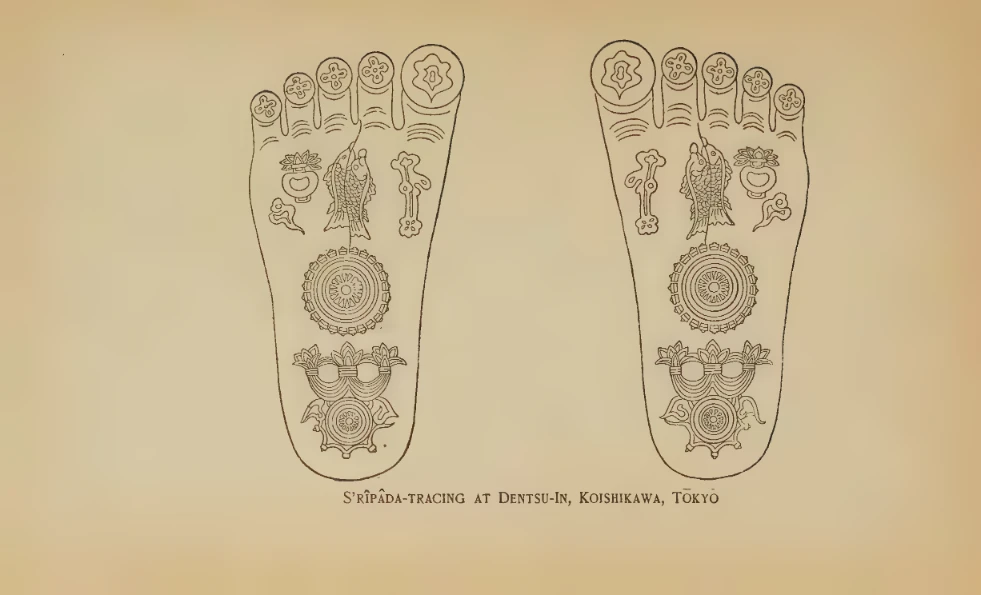
The tracing of the Dentsū-in footprints reproduced by Hearn. Compare the marks on the toes with the designs from the Jōdo book.
Lafcadio Hearn, In Ghostly Japan, Boston, 1899. Historical illustration from the exact consulted edition. Public domain; full source leaf retained, rendered upright. · Image source ↗ · Public Domain
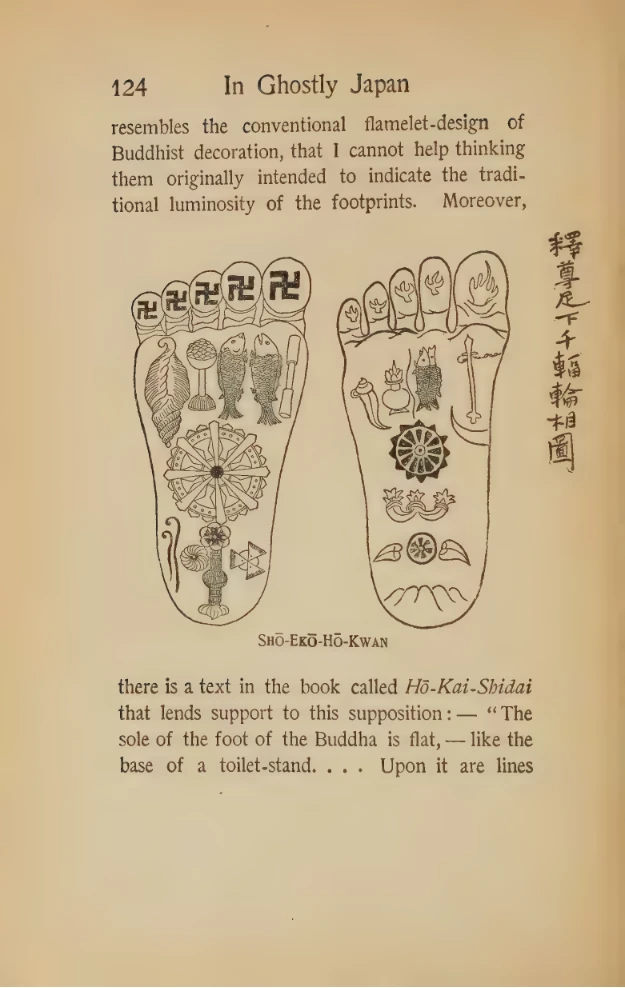
A design from Shō-Ekō-Hō-Kwan, reproduced by Hearn. The text around the illustration discusses whether the toe signs might resemble flames.
Lafcadio Hearn, In Ghostly Japan, Boston, 1899. Historical illustration from the exact consulted edition. Public domain; full source leaf retained. · Image source ↗ · Public Domain
See references (11)
- In Ghostly Japan, Reader page 116
- In Ghostly Japan, Reader page 121
- In Ghostly Japan, Reader page 117
- In Ghostly Japan, Reader page 118
- In Ghostly Japan, Reader page 125
- In Ghostly Japan, Reader page 126
- In Ghostly Japan, Reader page 120
- In Ghostly Japan, Reader page 122
- In Ghostly Japan, Reader page 123
- In Ghostly Japan, Reader page 119
- In Ghostly Japan, Reader page 124
What the prints preserve
The Met guide explains how the footprints evoke a person who is no longer physically present. Hearn’s drawings show how that idea takes different forms. The wheel remains readily recognisable, while the smaller marks on the toes invite closer looking. [7][10][9][1][5][11][12]
Read further in the library

In Ghostly Japan
Reading note
The separately titled account draws on exact passages in the consulted Library edition.
Sources
See references (14)
- The Metropolitan Museum of Art: Tree and Serpent, visiting guide, Buddha footprints ↗The museum’s own exhibition interpretation and Donald Lopez audio transcript, directly read for footprints as signs of presence and absence. The article does not infer a universal historical ban on human-form Buddha images.Return to text ↑
- Illustration in Lafcadio Hearn’s In Ghostly Japan, Tracing of the footprints at Dentsu-in, 1899 ↗Lafcadio Hearn, In Ghostly Japan, Boston, 1899. Historical illustration from the exact consulted edition. Public domain; full source leaf retained, rendered upright.
- Illustration in Lafcadio Hearn’s In Ghostly Japan, Footprint designs reproduced from Sho-Eko-Ho-Kwan, 1899 ↗Lafcadio Hearn, In Ghostly Japan, Boston, 1899. Historical illustration from the exact consulted edition. Public domain; full source leaf retained.
- In Ghostly Japan, Reader page 116Lafcadio Hearn, In Ghostly Japan, Little, Brown, and Company, Boston, 1899. Exact consulted Library edition IMJ-0654-E001, with title page visually checked. Persistent PageIDs and current Reader positions are verified from the supplied edition. Embedded stories, translations and quotations are attributed to Hearn’s presentation unless an original source has separately been consulted.Read this page in In Ghostly Japan ↗Return to text ↑
- In Ghostly Japan, Reader page 121Lafcadio Hearn, In Ghostly Japan, Little, Brown, and Company, Boston, 1899. Exact consulted Library edition IMJ-0654-E001, with title page visually checked. Persistent PageIDs and current Reader positions are verified from the supplied edition. Embedded stories, translations and quotations are attributed to Hearn’s presentation unless an original source has separately been consulted.Read this page in In Ghostly Japan ↗Return to text ↑
- In Ghostly Japan, Reader page 117Lafcadio Hearn, In Ghostly Japan, Little, Brown, and Company, Boston, 1899. Exact consulted Library edition IMJ-0654-E001, with title page visually checked. Persistent PageIDs and current Reader positions are verified from the supplied edition. Embedded stories, translations and quotations are attributed to Hearn’s presentation unless an original source has separately been consulted.Read this page in In Ghostly Japan ↗Return to text ↑
- In Ghostly Japan, Reader page 118Lafcadio Hearn, In Ghostly Japan, Little, Brown, and Company, Boston, 1899. Exact consulted Library edition IMJ-0654-E001, with title page visually checked. Persistent PageIDs and current Reader positions are verified from the supplied edition. Embedded stories, translations and quotations are attributed to Hearn’s presentation unless an original source has separately been consulted.Read this page in In Ghostly Japan ↗Return to text ↑
- In Ghostly Japan, Reader page 125Lafcadio Hearn, In Ghostly Japan, Little, Brown, and Company, Boston, 1899. Exact consulted Library edition IMJ-0654-E001, with title page visually checked. Persistent PageIDs and current Reader positions are verified from the supplied edition. Embedded stories, translations and quotations are attributed to Hearn’s presentation unless an original source has separately been consulted.Read this page in In Ghostly Japan ↗Return to text ↑
- In Ghostly Japan, Reader page 126Lafcadio Hearn, In Ghostly Japan, Little, Brown, and Company, Boston, 1899. Exact consulted Library edition IMJ-0654-E001, with title page visually checked. Persistent PageIDs and current Reader positions are verified from the supplied edition. Embedded stories, translations and quotations are attributed to Hearn’s presentation unless an original source has separately been consulted.Read this page in In Ghostly Japan ↗Return to text ↑
- In Ghostly Japan, Reader page 120Lafcadio Hearn, In Ghostly Japan, Little, Brown, and Company, Boston, 1899. Exact consulted Library edition IMJ-0654-E001, with title page visually checked. Persistent PageIDs and current Reader positions are verified from the supplied edition. Embedded stories, translations and quotations are attributed to Hearn’s presentation unless an original source has separately been consulted.Read this page in In Ghostly Japan ↗Return to text ↑
- In Ghostly Japan, Reader page 122Lafcadio Hearn, In Ghostly Japan, Little, Brown, and Company, Boston, 1899. Exact consulted Library edition IMJ-0654-E001, with title page visually checked. Persistent PageIDs and current Reader positions are verified from the supplied edition. Embedded stories, translations and quotations are attributed to Hearn’s presentation unless an original source has separately been consulted.Read this page in In Ghostly Japan ↗Return to text ↑
- In Ghostly Japan, Reader page 123Lafcadio Hearn, In Ghostly Japan, Little, Brown, and Company, Boston, 1899. Exact consulted Library edition IMJ-0654-E001, with title page visually checked. Persistent PageIDs and current Reader positions are verified from the supplied edition. Embedded stories, translations and quotations are attributed to Hearn’s presentation unless an original source has separately been consulted.Read this page in In Ghostly Japan ↗Return to text ↑
- In Ghostly Japan, Reader page 119Lafcadio Hearn, In Ghostly Japan, Little, Brown, and Company, Boston, 1899. Exact consulted Library edition IMJ-0654-E001, with title page visually checked. Persistent PageIDs and current Reader positions are verified from the supplied edition. Embedded stories, translations and quotations are attributed to Hearn’s presentation unless an original source has separately been consulted.Read this page in In Ghostly Japan ↗Return to text ↑
- In Ghostly Japan, Reader page 124Lafcadio Hearn, In Ghostly Japan, Little, Brown, and Company, Boston, 1899. Exact consulted Library edition IMJ-0654-E001, with title page visually checked. Persistent PageIDs and current Reader positions are verified from the supplied edition. Embedded stories, translations and quotations are attributed to Hearn’s presentation unless an original source has separately been consulted.Read this page in In Ghostly Japan ↗Return to text ↑