Brahman
Brahman is ultimate reality in Hindu philosophy. Read the Upanishadic lessons of the banyan seed and salt, and compare three Vedanta readings.
In this article
What is Brahman?
Brahman names ultimate reality in the Upanishads and in Vedānta. The texts ask how the world depends on it and how a person can know it. Vedānta schools give different accounts of how Brahman relates to individual selves and the world. Brahmā is the name of the creator deity. [5][6][2][7][1]
The seed and salt in Chandogya Upanishad 6.12–13
In Chāndogya Upanishad 6.12–13, a father asks his son to break open a banyan fruit and then one of its seeds. The boy sees nothing inside the seed. In the next lesson, salt dissolved in water can be tasted throughout even though the boy cannot find it by looking. Both lessons lead him from something he can test to a teaching about the Self. [1]
The visible tree in the teaching
James Forbes’s drawing, published as a lithograph in 1811, shows the spread of a banyan and its many trunks. Its size makes the Upanishad’s choice of a seed for the lesson all the more striking. [4][6]
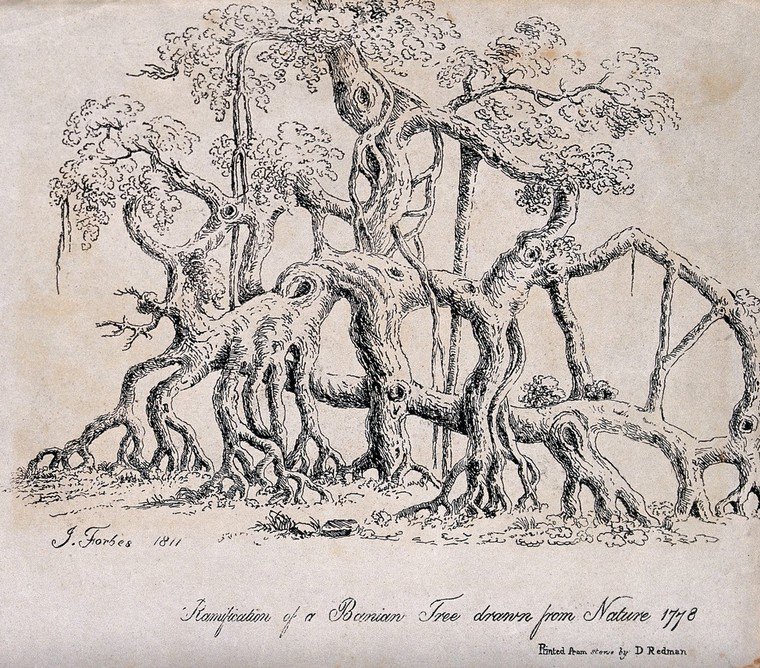
A banyan spreads through many trunks in this 1811 lithograph after a drawing by James Forbes.
Wellcome Collection, 20052i, image V0043038. W. Stoker after James Forbes; printed by D. Redman, 1811. Public Domain Mark; resized and converted to JPEG. · Image source ↗ · Public Domain
Indian Myth and Legend by Donald A. Mackenzie
In Indian Myth and Legend, Donald A. Mackenzie describes a movement from sacrificial speculation towards what he calls the World Soul. He reads the creation hymn of Rigveda 10.129 as part of that development, even though the hymn leaves its deepest question open. [8][9][10][5]
Mackenzie interprets Brahman as the reality present throughout existence and Atman as the Self. His abbreviated banyan lesson ties the great tree to a subtle basis that the pupil cannot see, and identifies that basis with the Self. [5][7][6]
He also relates a story of a primordial Self that recognises itself, fears and becomes a pair from whom creatures arise. In his excerpts from the Katha Upanishad, knowledge comes with the loosening of desire and the heart’s bonds. Mackenzie describes the goal as union with Brahman. [11][9][6][7]
The unresolved origin in Rigveda 10.129
Rigveda 10.129 asks how the world began. Ralph T. H. Griffith’s translation moves from an age before familiar distinctions, through warmth and desire, to the question of who could know the origin. The poem ends by wondering whether even the highest overseer knows. [3]
Vedanta differences in Swami Sivananda’s survey
Swami Sivananda contrasts Śaṅkara’s nondual reading, Rāmānuja’s account of Brahman with auspicious qualities, and Madhva’s lasting distinction between God and dependent selves. He writes from an Advaita perspective. The differences shape what each school takes liberation to mean. [2]
What is the Self’s relation to Brahman?
The Upanishadic seed and salt draw attention to something that can be present without being seen. Mackenzie takes identity with the Self as his guiding answer. Sivananda’s survey shows that readers of Vedānta also differ over what relation remains between the self and God after liberation. [6][1][7][2][10][5][3]
See references (7)
- Chandogya Upanishad 6.12–13, translated by S. Radhakrishnan
- Swami Sivananda, Brahma Sutras: survey of the Vedanta commentators
- Rigveda 10.129, verses 1–7, translated by Ralph T. H. Griffith
- Indian Myth and Legend, Reader page 168
- Indian Myth and Legend, Reader page 169
- Indian Myth and Legend, Reader page 170
- Indian Myth and Legend, Reader page 167
Read further in the library
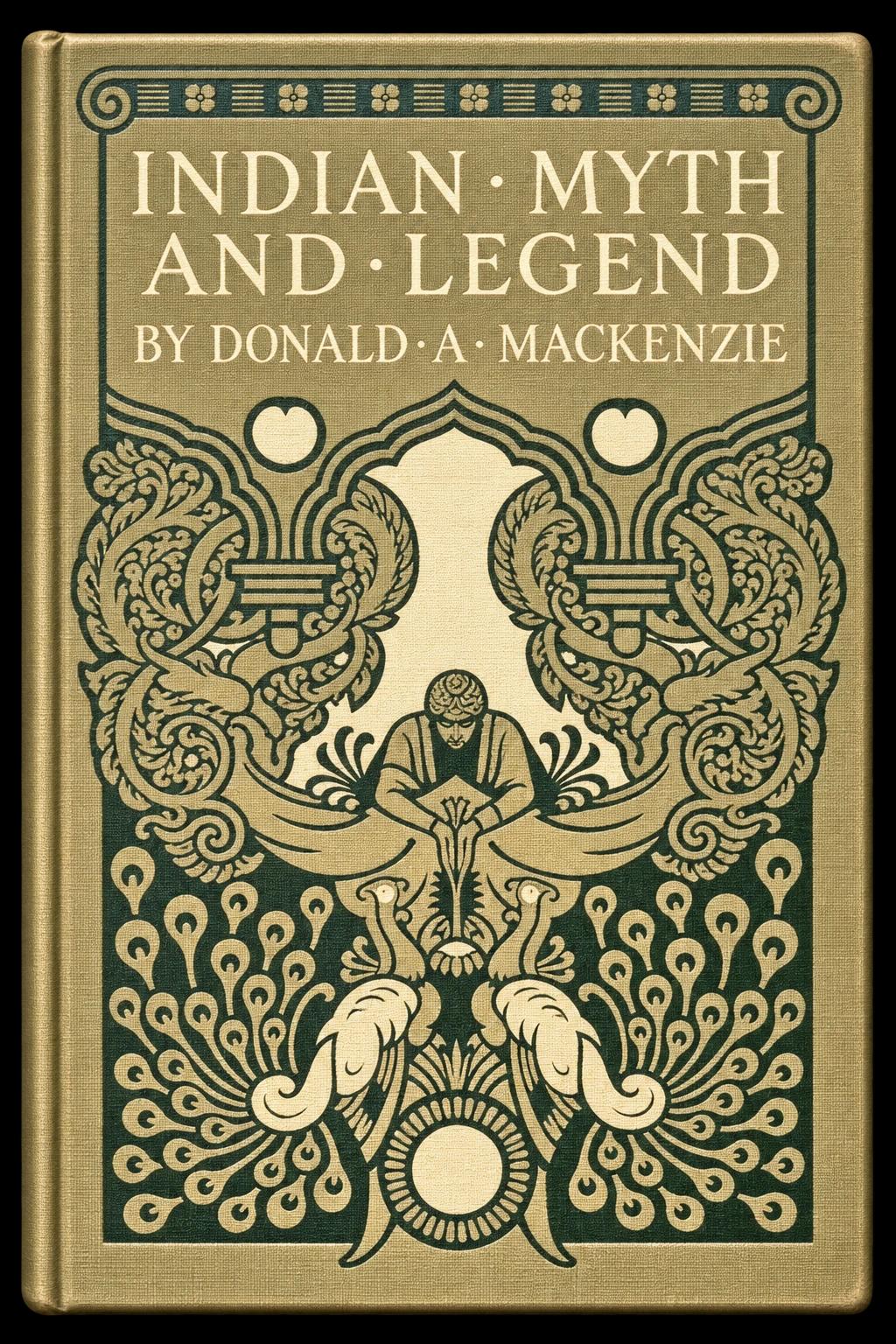
Indian Myth and Legend
Reading note
The separately titled account draws on exact passages in the consulted Library edition.
Sources
See references (11)
- Chandogya Upanishad 6.12–13, translated by S. Radhakrishnan ↗Only the nyagrodha-seed and dissolved-salt lessons, sections 6.12 and 6.13, directly consulted in Himalayan Academy’s hosted translation. Modern translation paraphrased; no entire-Upanishad reading claimed.Return to text ↑
- Swami Sivananda, Brahma Sutras: survey of the Vedanta commentators ↗Divine Life Society essay by Swami Sivananda. The introduction and sections on Sankara, Ramanuja, Madhva and reconciliation were consulted. This is Sivananda’s Advaita-oriented survey, not a claim to have read every original commentary.Return to text ↑
- Rigveda 10.129, verses 1–7, translated by Ralph T. H. Griffith ↗Complete seven-verse creation hymn directly read. Its questions are distinguished from Mackenzie’s later theological interpretation.Return to text ↑
- Banyan tree (Ficus benghalensis L.) with many trunks, 1811, after a drawing of 1778 ↗Wellcome Collection, 20052i, image V0043038. W. Stoker after James Forbes; printed by D. Redman, 1811. Public Domain Mark; resized and converted to JPEG.Return to text ↑
- Indian Myth and Legend, Reader page 168Donald A. Mackenzie, Indian Myth and Legend, Gresham Publishing Company Limited, London, undated consulted impression. Library edition IMJ-0649-E001. Persistent PageIDs and current Reader positions verified against the supplied PDF and cached Reader manifest. Embedded translations are Mackenzie’s presentation unless a separately consulted primary text is named.Read this page in Indian Myth and Legend ↗Return to text ↑
- Indian Myth and Legend, Reader page 169Donald A. Mackenzie, Indian Myth and Legend, Gresham Publishing Company Limited, London, undated consulted impression. Library edition IMJ-0649-E001. Persistent PageIDs and current Reader positions verified against the supplied PDF and cached Reader manifest. Embedded translations are Mackenzie’s presentation unless a separately consulted primary text is named.Read this page in Indian Myth and Legend ↗Return to text ↑
- Indian Myth and Legend, Reader page 170Donald A. Mackenzie, Indian Myth and Legend, Gresham Publishing Company Limited, London, undated consulted impression. Library edition IMJ-0649-E001. Persistent PageIDs and current Reader positions verified against the supplied PDF and cached Reader manifest. Embedded translations are Mackenzie’s presentation unless a separately consulted primary text is named.Read this page in Indian Myth and Legend ↗Return to text ↑
- Indian Myth and Legend, Reader page 158Donald A. Mackenzie, Indian Myth and Legend, Gresham Publishing Company Limited, London, undated consulted impression. Library edition IMJ-0649-E001. Persistent PageIDs and current Reader positions verified against the supplied PDF and cached Reader manifest. Embedded translations are Mackenzie’s presentation unless a separately consulted primary text is named.Read this page in Indian Myth and Legend ↗Return to text ↑
- Indian Myth and Legend, Reader page 166Donald A. Mackenzie, Indian Myth and Legend, Gresham Publishing Company Limited, London, undated consulted impression. Library edition IMJ-0649-E001. Persistent PageIDs and current Reader positions verified against the supplied PDF and cached Reader manifest. Embedded translations are Mackenzie’s presentation unless a separately consulted primary text is named.Read this page in Indian Myth and Legend ↗Return to text ↑
- Indian Myth and Legend, Reader page 167Donald A. Mackenzie, Indian Myth and Legend, Gresham Publishing Company Limited, London, undated consulted impression. Library edition IMJ-0649-E001. Persistent PageIDs and current Reader positions verified against the supplied PDF and cached Reader manifest. Embedded translations are Mackenzie’s presentation unless a separately consulted primary text is named.Read this page in Indian Myth and Legend ↗Return to text ↑
- Indian Myth and Legend, Reader page 165Donald A. Mackenzie, Indian Myth and Legend, Gresham Publishing Company Limited, London, undated consulted impression. Library edition IMJ-0649-E001. Persistent PageIDs and current Reader positions verified against the supplied PDF and cached Reader manifest. Embedded translations are Mackenzie’s presentation unless a separately consulted primary text is named.Read this page in Indian Myth and Legend ↗Return to text ↑