Atman
Ātman is the Self in Hindu philosophy. Explore the Gita’s account of a deathless self, the Upanishadic banyan lesson and the Buddhist teaching of not-self.
In this article
What is Ātman?
Ātman is the Sanskrit term for the Self. In the Bhagavad Gita, it names what endures through the body’s birth, change and death. Some Upanishadic and Vedānta readings ask how this Self relates to Brahman, the ultimate reality. Buddhist teachings on not-self approach personal identity differently. [1][5][6][7][8][9][2]
See references (7)
- Bhagavad Gita 2.20, translated and explained by Swami Mukundananda
- Panca Sutta, Samyutta Nikaya 22.59, translated by Thanissaro Bhikkhu
- Indian Myth and Legend, Reader page 199
- Indian Myth and Legend, Reader page 200
- Indian Myth and Legend, Reader page 168
- Indian Myth and Legend, Reader page 169
- Indian Myth and Legend, Reader page 170
The unborn self in Bhagavad Gita 2.20
Bhagavad Gita 2.20 describes the self as unborn and undying, even when its body is destroyed. Swami Mukundananda’s translation and commentary distinguish the continuing self from the successive changes of the body. [1]
Indian Myth and Legend by Donald A. Mackenzie
In Indian Myth and Legend, Donald A. Mackenzie ties Atman to Brahman and finds the Self present in human beings and other creatures. One creation story makes self-awareness dramatic: a primordial being says I, realises there is no one else to fear, and seeks a companion. [7][10][11]
In the banyan lesson, a father directs his son’s attention to the basis of a tree that cannot be seen by breaking open its fruit. In the Katha passages Mackenzie quotes, the eye cannot see the Self, and realising it is bound up with release from desire. [8][9]
In Mackenzie’s extracts from the Gita, seeing oneself in all beings belongs alongside action without attachment and devotion. In his condensed battle narrative, changing bodies is like exchanging worn clothes for new ones. [5][6][12]
See references (8)
- Indian Myth and Legend, Reader page 199
- Indian Myth and Legend, Reader page 200
- Indian Myth and Legend, Reader page 168
- Indian Myth and Legend, Reader page 169
- Indian Myth and Legend, Reader page 170
- Indian Myth and Legend, Reader page 165
- Indian Myth and Legend, Reader page 166
- Indian Myth and Legend, Reader page 374
A separate Buddhist account: Samyutta Nikaya 22.59
In SN 22.59, translated by Thanissaro Bhikkhu, the Buddha asks whether any of the five aggregates can be taken as self. Body, feeling, perception, mental fabrications and consciousness all change and cannot simply be made to obey one’s wishes. The discourse uses this examination to lead towards dispassion. [2]
The teaching’s natural and epic settings
The banyan print pictures the tree used in the Upanishadic lesson. The Kalighat print shows another scene with Krishna and Arjuna: Duryodhana sits near Krishna’s head, and Arjuna sits at his feet before the battle. [3][4][8]
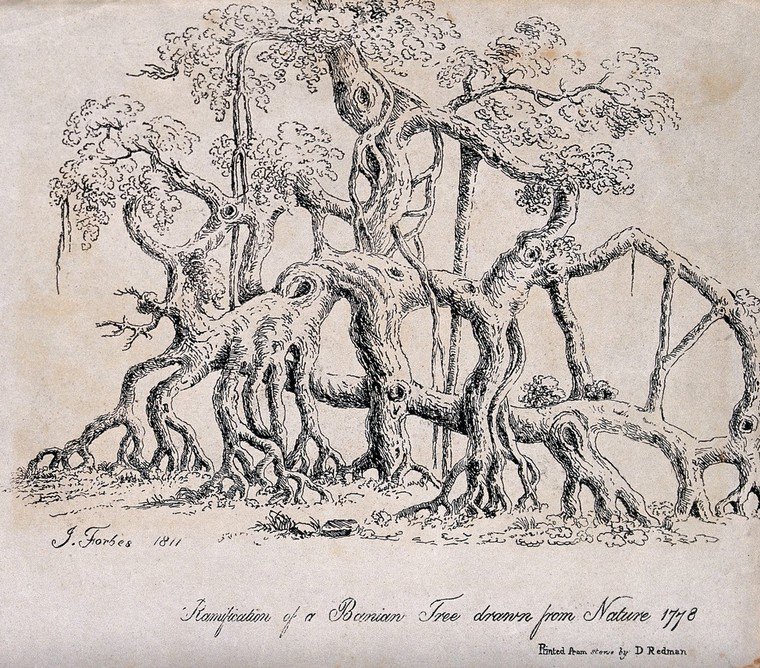
The banyan is the tree through which a father teaches his son about the Self in the Chāndogya Upanishad.
Wellcome Collection, 20052i, image V0043038. W. Stoker after James Forbes; printed by D. Redman, 1811. Public Domain Mark; resized and converted to JPEG. · Image source ↗ · Public Domain
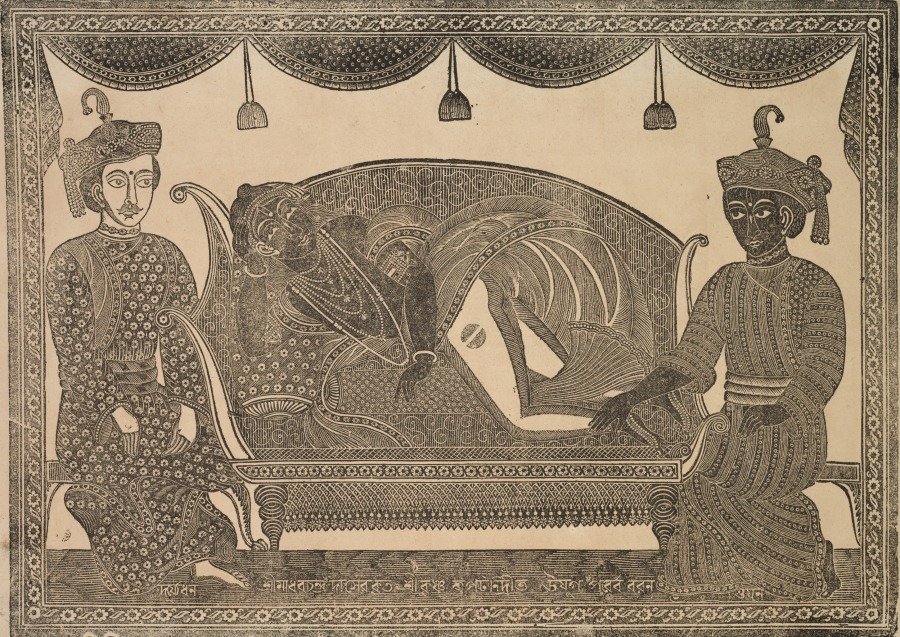
A Kalighat print shows Krishna with Arjuna and Duryodhana before the war, around 1890.
Cleveland Museum of Art, Gift of William E. Ward in memory of Evelyn Svec Ward, 2003.139. Shri Gobinda Chandra Roy, about 1890. CC0; resized and converted to JPEG. · Image source ↗ · CC0
What can be called the self?
The Gita asks Arjuna to see the self as enduring when the body dies. The Buddhist discourse asks what warrants taking any of our changing experience as self in the first place. Both make the question practical by relating the answer to how someone responds to change. [5][6][1][7][2]
Read further in the library
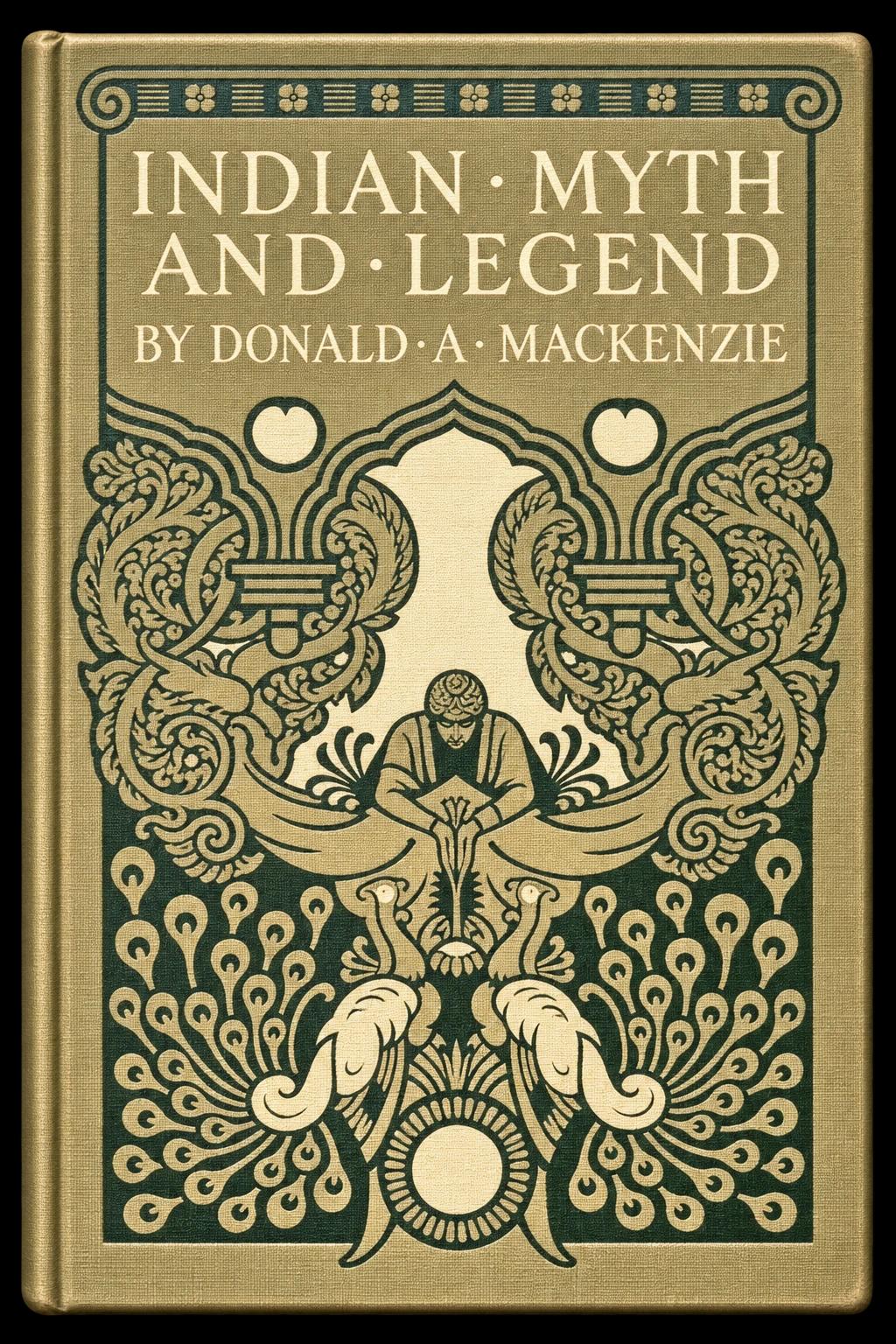
Indian Myth and Legend
Reading note
The separately titled account draws on exact passages in the consulted Library edition.
Sources
See references (12)
- Bhagavad Gita 2.20, translated and explained by Swami Mukundananda ↗Verse 2.20 and its short displayed commentary directly read. The teaching of an unborn self is attributed to this text and interpretation.Return to text ↑
- Panca Sutta, Samyutta Nikaya 22.59, translated by Thanissaro Bhikkhu ↗Main discourse directly read, including the five aggregates and concluding release. The translator’s separate note on consciousness outside the aggregates is not treated as part of the spoken discourse.Return to text ↑
- Banyan tree (Ficus benghalensis L.) with many trunks, 1811, after a drawing of 1778 ↗Wellcome Collection, 20052i, image V0043038. W. Stoker after James Forbes; printed by D. Redman, 1811. Public Domain Mark; resized and converted to JPEG.Return to text ↑
- Kalighat Painting, c. 1890 ↗Cleveland Museum of Art, Gift of William E. Ward in memory of Evelyn Svec Ward, 2003.139. Shri Gobinda Chandra Roy, about 1890. CC0; resized and converted to JPEG.Return to text ↑
- Indian Myth and Legend, Reader page 199Donald A. Mackenzie, Indian Myth and Legend, Gresham Publishing Company Limited, London, undated consulted impression. Library edition IMJ-0649-E001. Persistent PageIDs and current Reader positions verified against the supplied PDF and cached Reader manifest. Embedded translations are Mackenzie’s presentation unless a separately consulted primary text is named.Read this page in Indian Myth and Legend ↗Return to text ↑
- Indian Myth and Legend, Reader page 200Donald A. Mackenzie, Indian Myth and Legend, Gresham Publishing Company Limited, London, undated consulted impression. Library edition IMJ-0649-E001. Persistent PageIDs and current Reader positions verified against the supplied PDF and cached Reader manifest. Embedded translations are Mackenzie’s presentation unless a separately consulted primary text is named.Read this page in Indian Myth and Legend ↗Return to text ↑
- Indian Myth and Legend, Reader page 168Donald A. Mackenzie, Indian Myth and Legend, Gresham Publishing Company Limited, London, undated consulted impression. Library edition IMJ-0649-E001. Persistent PageIDs and current Reader positions verified against the supplied PDF and cached Reader manifest. Embedded translations are Mackenzie’s presentation unless a separately consulted primary text is named.Read this page in Indian Myth and Legend ↗Return to text ↑
- Indian Myth and Legend, Reader page 169Donald A. Mackenzie, Indian Myth and Legend, Gresham Publishing Company Limited, London, undated consulted impression. Library edition IMJ-0649-E001. Persistent PageIDs and current Reader positions verified against the supplied PDF and cached Reader manifest. Embedded translations are Mackenzie’s presentation unless a separately consulted primary text is named.Read this page in Indian Myth and Legend ↗Return to text ↑
- Indian Myth and Legend, Reader page 170Donald A. Mackenzie, Indian Myth and Legend, Gresham Publishing Company Limited, London, undated consulted impression. Library edition IMJ-0649-E001. Persistent PageIDs and current Reader positions verified against the supplied PDF and cached Reader manifest. Embedded translations are Mackenzie’s presentation unless a separately consulted primary text is named.Read this page in Indian Myth and Legend ↗Return to text ↑
- Indian Myth and Legend, Reader page 165Donald A. Mackenzie, Indian Myth and Legend, Gresham Publishing Company Limited, London, undated consulted impression. Library edition IMJ-0649-E001. Persistent PageIDs and current Reader positions verified against the supplied PDF and cached Reader manifest. Embedded translations are Mackenzie’s presentation unless a separately consulted primary text is named.Read this page in Indian Myth and Legend ↗Return to text ↑
- Indian Myth and Legend, Reader page 166Donald A. Mackenzie, Indian Myth and Legend, Gresham Publishing Company Limited, London, undated consulted impression. Library edition IMJ-0649-E001. Persistent PageIDs and current Reader positions verified against the supplied PDF and cached Reader manifest. Embedded translations are Mackenzie’s presentation unless a separately consulted primary text is named.Read this page in Indian Myth and Legend ↗Return to text ↑
- Indian Myth and Legend, Reader page 374Donald A. Mackenzie, Indian Myth and Legend, Gresham Publishing Company Limited, London, undated consulted impression. Library edition IMJ-0649-E001. Persistent PageIDs and current Reader positions verified against the supplied PDF and cached Reader manifest. Embedded translations are Mackenzie’s presentation unless a separately consulted primary text is named.Read this page in Indian Myth and Legend ↗Return to text ↑