Beatific Vision
The beatific vision is the direct contemplation of God in Heaven. Explore the Catholic teaching and Dante’s final vision of the Trinity.
In this article
What is the beatific vision?
The beatific vision is the direct contemplation of God that constitutes blessedness in Heaven. Catholic teaching explains it as something God makes possible by revealing himself and giving the blessed the capacity to see. The term describes a relation to God with a distinct place in Christian theology. [1]
Seeing and sharing divine life
The Catholic Catechism §§1024–1028 describes Heaven as communion with the Trinity and all the blessed. Its images of light, a feast and a holy city point towards that shared life. The beatific vision names the immediate encounter with God at its centre. [1]
The Divine Comedy by Dante Alighieri
In Dante Alighieri’s Paradise XXVIII, Beatrice tells Dante that the angels’ blessedness follows the depth of their sight, and that love follows what they see. The explanation prepares for the final canto, where Dante needs help to see what ordinary understanding cannot reach. [2][3]
In Paradise XXXIII, Bernard prays to Mary for Dante’s sight to clear and for his affections to remain sound afterwards. Beatrice and the saints join the prayer. The vision comes at the end of a chain of requests on the pilgrim’s behalf. [4][5]
Dante then describes the world’s multiplicity bound as one volume in love. He tries to convey three circles of equal extent and differing colour, with reflection and shared fire, and a human image within the circle. These are the poem’s images for the Trinity and the union of humanity with the divine. The images offer specific Christian meanings, rather than a statement that every religion teaches the same thing. [6][7]
Dante compares himself to a geometer who cannot see how to fit the human image within the circle. A flash brings understanding that his reasoning could not reach. The poem closes with his desire and will moving together in divine love, although he can remember only part of what he saw. [5][7]
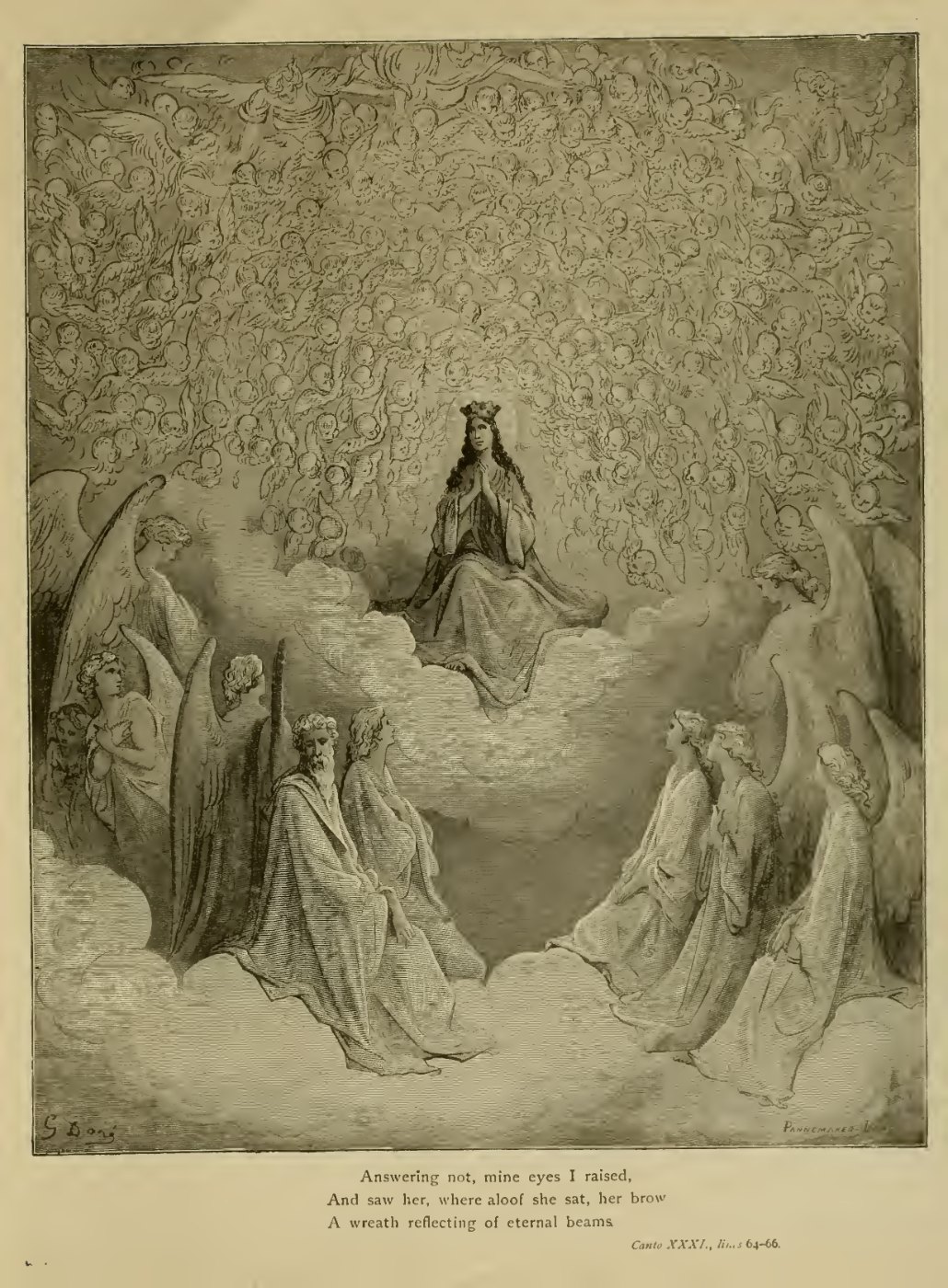
Doré’s Beatrice in the heavenly assembly, Paradise XXXI. The shared vision of the blessed precedes the pilgrim’s final contemplation. This plate depicts the assembly, rather than an attempted portrait of God.
Design by Gustave Doré. Purgatory and Paradise, Henry Francis Cary translation, Thompson & Thomas, Chicago, 1901. Public Domain. · Image source ↗ · Public Domain
See references (6)
- Purgatory and Paradise, Paradise XXVIII, Reader page 343
- Purgatory and Paradise, Paradise XXVIII, Reader page 344
- Purgatory and Paradise, Paradise XXXIII, Reader page 365
- Purgatory and Paradise, Paradise XXXIII, Reader page 366
- Purgatory and Paradise, Paradise XXXIII, Reader page 367
- Purgatory and Paradise, Paradise XXXIII, Reader page 368
Read further in the library
Purgatory and Paradise: The Vision of Dante
Reading note
A separately attributed account in the consulted Cary translation, with exact current Library Reader leaves.
Sources
See references (8)
- Catechism of the Catholic Church, 1023–1029: Heaven and the beatific vision ↗Catholic Church, official teaching on perfected communion and immediate contemplation of God.Return to text ↑
- Purgatory and Paradise, Paradise XXVIII, Reader page 343Dante Alighieri, The Divine Comedy, translated by Henry Francis Cary. Inferno: undated New Edition, Thompson & Thomas, Chicago. Purgatory and Paradise: New Edition, Thompson & Thomas, Chicago, 1901. Designs by Gustave Doré.Read this page in Purgatory and Paradise: The Vision of Dante ↗Return to text ↑
- Purgatory and Paradise, Paradise XXVIII, Reader page 344Dante Alighieri, The Divine Comedy, translated by Henry Francis Cary. Inferno: undated New Edition, Thompson & Thomas, Chicago. Purgatory and Paradise: New Edition, Thompson & Thomas, Chicago, 1901. Designs by Gustave Doré.Read this page in Purgatory and Paradise: The Vision of Dante ↗Return to text ↑
- Purgatory and Paradise, Paradise XXXIII, Reader page 365Dante Alighieri, The Divine Comedy, translated by Henry Francis Cary. Inferno: undated New Edition, Thompson & Thomas, Chicago. Purgatory and Paradise: New Edition, Thompson & Thomas, Chicago, 1901. Designs by Gustave Doré.Read this page in Purgatory and Paradise: The Vision of Dante ↗Return to text ↑
- Purgatory and Paradise, Paradise XXXIII, Reader page 366Dante Alighieri, The Divine Comedy, translated by Henry Francis Cary. Inferno: undated New Edition, Thompson & Thomas, Chicago. Purgatory and Paradise: New Edition, Thompson & Thomas, Chicago, 1901. Designs by Gustave Doré.Read this page in Purgatory and Paradise: The Vision of Dante ↗Return to text ↑
- Purgatory and Paradise, Paradise XXXIII, Reader page 367Dante Alighieri, The Divine Comedy, translated by Henry Francis Cary. Inferno: undated New Edition, Thompson & Thomas, Chicago. Purgatory and Paradise: New Edition, Thompson & Thomas, Chicago, 1901. Designs by Gustave Doré.Read this page in Purgatory and Paradise: The Vision of Dante ↗Return to text ↑
- Purgatory and Paradise, Paradise XXXIII, Reader page 368Dante Alighieri, The Divine Comedy, translated by Henry Francis Cary. Inferno: undated New Edition, Thompson & Thomas, Chicago. Purgatory and Paradise: New Edition, Thompson & Thomas, Chicago, 1901. Designs by Gustave Doré.Read this page in Purgatory and Paradise: The Vision of Dante ↗Return to text ↑
- Purgatory and Paradise, Paradise XXXI, Reader page 363Dante Alighieri, The Divine Comedy, translated by Henry Francis Cary. Inferno: undated New Edition, Thompson & Thomas, Chicago. Purgatory and Paradise: New Edition, Thompson & Thomas, Chicago, 1901. Designs by Gustave Doré.Read this page in Purgatory and Paradise: The Vision of Dante ↗