Babalon
Babalon is a Thelemic visionary figure associated with the cup and Crossing the Abyss. Compare Crowley’s Aethyrs with the imagery of Revelation 17.
In this article
Babalon and the cup
Babalon is a figure in Aleister Crowley’s Thelema associated with a cup, a beast and the surrender of the adept’s claims at the Abyss. Crowley draws on the imagery of Babylon in Revelation. In the twelfth Aethyr he calls the figure the Scarlet Woman and gives her cup a role in initiation. [1][2][3][5][6]
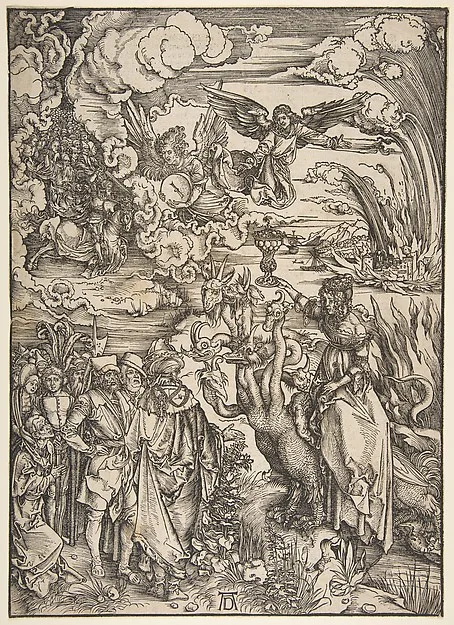
Albrecht Dürer illustrates the woman called Babylon in Revelation, with her cup and many-headed beast. The print shows the earlier biblical imagery that Crowley reinterprets.
The Metropolitan Museum of Art, Gift of Mrs. Felix M. Warburg, 1940, 40.139.6(15). Open Access. · Image source ↗ · CC0
Revelation 17, the woman called Babylon
Revelation 17 describes a richly dressed woman sitting on a scarlet beast and holding a golden cup. The text names her Babylon and interprets her as a city with power over rulers. The cup belongs to an account of corruption and judgement. [3]
The Vision and the Voice by Aleister Crowley
In the twelfth Aethyr of The Vision and the Voice, a charioteer holds a glowing cup and announces Babalon as the Scarlet Woman. The cup mingles the blood of the saints. Crowley interprets what the cup contains through compassion and the surrender of the self. [1]
Magick Without Tears by Aleister Crowley
In Magick Without Tears, Crowley quotes visions in which the Masters give what they have to fill Babalon’s cup. He also associates her with protection at the Abyss. [7][5][6]
The same letter places those images beside a warning about trying to keep attainments as private property. What a person brings to the cup matters because giving it up is part of how Crowley describes the crossing. [8][7][5][6]
How the cup changes from Babylon to Babalon
Revelation gives the cup to a city facing judgement. Crowley uses the image to picture surrender and compassion. In his later letter he turns that image towards a question about the adept: what can they give up that they still think is theirs? [3][1][5][6]
Read further in the library
Magick Without Tears
Reading note
The separately titled account draws on exact passages in the consulted Library edition.
Sources
See references (8)
- The Vision and the Voice, 12th Aethyr, LOE, the chariot and the cup ↗Aleister Crowley, The Vision and the Voice. Hermetic Library transcription.Return to text ↑
- The Vision and the Voice, 3rd Aethyr, ZON, Babalon and the crown ↗Aleister Crowley, The Vision and the Voice. Hermetic Library transcription.Return to text ↑
- Revelation 17:1–6, 15–18 ↗New American Bible, Revised Edition, Revelation 17. USCCB.Return to text ↑
- Albrecht Dürer, The Whore of Babylon, 1497–98 ↗The Metropolitan Museum of Art, Gift of Mrs. Felix M. Warburg, 1940, 40.139.6(15).
- Magick Without Tears, Reader page 80Aleister Crowley, Magick Without Tears, undated digital Library edition IMJ-0641-E001. Links use the current Library Reader sequence.Read this page in Magick Without Tears ↗Return to text ↑
- Magick Without Tears, Reader page 81Aleister Crowley, Magick Without Tears, undated digital Library edition IMJ-0641-E001. Links use the current Library Reader sequence.Read this page in Magick Without Tears ↗Return to text ↑
- Magick Without Tears, Reader page 79Aleister Crowley, Magick Without Tears, undated digital Library edition IMJ-0641-E001. Links use the current Library Reader sequence.Read this page in Magick Without Tears ↗Return to text ↑
- Magick Without Tears, Reader page 75Aleister Crowley, Magick Without Tears, undated digital Library edition IMJ-0641-E001. Links use the current Library Reader sequence.Read this page in Magick Without Tears ↗Return to text ↑