Illness of the astral body
J. S. M. Ward describes weakness and unresponsiveness in an astral hospital. Compare his account of his mother’s recovery with the care in Gone West.
In this article
Understanding illness of the astral body
Illness of the astral body is the name given to weakness, distress or unresponsiveness that an esoteric account places after physical death. In J. S. M. Ward’s A Subaltern in Spirit Land, the idea helps explain why the narrator’s mother still needs care after leaving her physical body. [1][2]
Ward gives the explanation to a doctor in the story. The account mixes exhaustion, awareness and beliefs about character, using the language of its time. [1][2]
A Subaltern in Spirit Land by J. S. M. Ward
J. S. M. Ward approaches the subject through his mother’s passage into the care of an astral hospital. After separation from the physical body, she remains unresponsive and is taken away by a group described as former doctors and nurses. H. J. L. admits that he has not previously encountered a similar case in these realms. [3][4][1]
The doctor distinguishes bodily disease from disorders of mind and spirit. His list includes categories called religious mania, hysteria and failure to awaken. These terms reveal how the account understands the problem, but their presence does not establish that the classifications are medically valid. [1]
Asked about Ward’s mother, the doctor attributes her state to exhaustion and to her final illness, then adds a judgment about character. That last explanation shows how the speaker’s moral assumptions enter his account of her condition. [2]
During a Requiem she seems to smile, though she does not wake. Later she is well enough to leave the hospital and live with Rex and H. J. L. The story gives comfort and recovery different moments. [2][5][6]
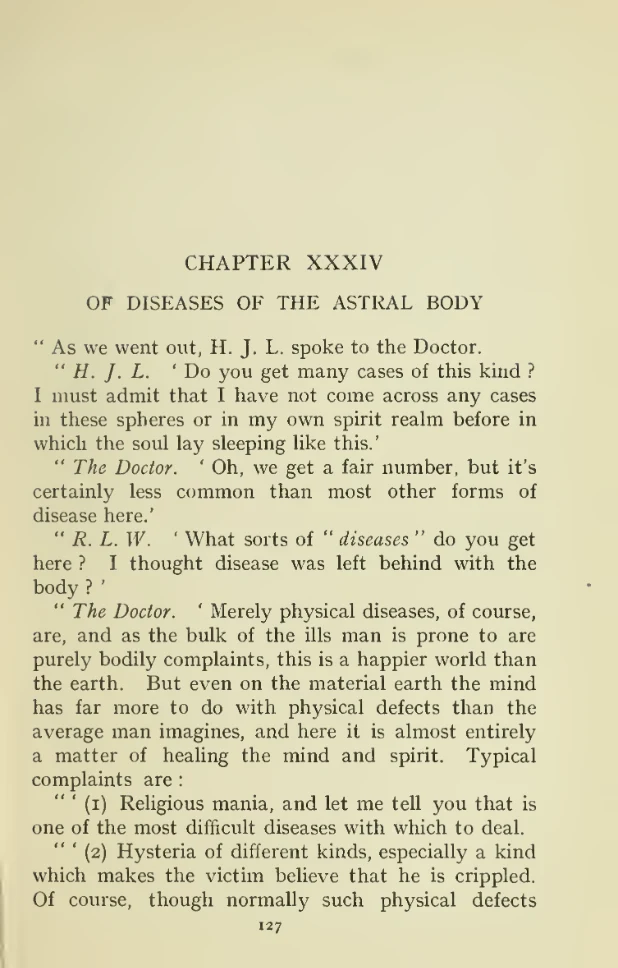
A Subaltern in Spirit Land (1920), printed p. 127, Library Reader page 142. A doctor in Ward’s narrative explains what the hospital treats.
J. S. M. Ward, A Subaltern in Spirit Land. William Rider & Son, 1920. Public-domain historical text and page image, extracted from the checksum-verified retained Library scan. · Image source ↗ · Public Domain
See references (6)
- A Subaltern in Spirit Land, printed p. 127, Reader page 142
- A Subaltern in Spirit Land, printed p. 128, Reader page 143
- A Subaltern in Spirit Land, printed p. 123, Reader page 138
- A Subaltern in Spirit Land, printed p. 124, Reader page 139
- A Subaltern in Spirit Land, printed p. 129, Reader page 144
- A Subaltern in Spirit Land, printed p. 147, Reader page 162
Gone West by J. S. M. Ward
In Gone West, the House of Refuge gives weakened newcomers individual assistance before they can join classes. Music and a supposed transfer of magnetic fluid are presented as forms of care. The emphasis is on strengthening a person sufficiently to resume development. [8][9][10]
Rest, care and rejoining others
Elsewhere in the sequel, Ward’s mother no longer needs ordinary sleep. Her earlier unresponsiveness occurs during a period of care. The two passages give rest different meanings at different stages of the story. [4][1][6][7]
The House of Refuge in Gone West prepares newcomers for classes. The sequel’s hospital distinguishes impairments and gives Ward’s mother continuing care before she rejoins her family. Both describe assistance during transition, and their explanations come from the guides or doctor who speak in each scene. [1][2][8][9][10][4]
See references (8)
- A Subaltern in Spirit Land, printed p. 127, Reader page 142
- A Subaltern in Spirit Land, printed p. 128, Reader page 143
- A Subaltern in Spirit Land, printed p. 124, Reader page 139
- A Subaltern in Spirit Land, printed p. 147, Reader page 162
- A Subaltern in Spirit Land, printed p. 148, Reader page 163
- Gone West, printed p. 46, Reader page 59
- Gone West, printed p. 47, Reader page 60
- Gone West, printed p. 50, Reader page 63
Read further in the library
A Subaltern in Spirit Land: A Sequel to Gone West
Reading note
The separately titled account draws on exact passages in the consulted Library edition.
Gone West
Reading note
Separately attributed comparison with exact previously researched Library passages.
Sources
See references (10)
- A Subaltern in Spirit Land, printed p. 127, Reader page 142J. S. M. Ward, A Subaltern in Spirit Land: A Sequel to Gone West. William Rider & Son, London, 1920. Narrated experiences and explanations are attributed to Ward and his reported spirit contributors, especially his brother Rex (R. L. W.) and H. J. L.Read this page in A Subaltern in Spirit Land: A Sequel to Gone West ↗Return to text ↑
- A Subaltern in Spirit Land, printed p. 128, Reader page 143J. S. M. Ward, A Subaltern in Spirit Land: A Sequel to Gone West. William Rider & Son, London, 1920. Narrated experiences and explanations are attributed to Ward and his reported spirit contributors, especially his brother Rex (R. L. W.) and H. J. L.Read this page in A Subaltern in Spirit Land: A Sequel to Gone West ↗Return to text ↑
- A Subaltern in Spirit Land, printed p. 123, Reader page 138J. S. M. Ward, A Subaltern in Spirit Land: A Sequel to Gone West. William Rider & Son, London, 1920. Narrated experiences and explanations are attributed to Ward and his reported spirit contributors, especially his brother Rex (R. L. W.) and H. J. L.Read this page in A Subaltern in Spirit Land: A Sequel to Gone West ↗Return to text ↑
- A Subaltern in Spirit Land, printed p. 124, Reader page 139J. S. M. Ward, A Subaltern in Spirit Land: A Sequel to Gone West. William Rider & Son, London, 1920. Narrated experiences and explanations are attributed to Ward and his reported spirit contributors, especially his brother Rex (R. L. W.) and H. J. L.Read this page in A Subaltern in Spirit Land: A Sequel to Gone West ↗Return to text ↑
- A Subaltern in Spirit Land, printed p. 129, Reader page 144J. S. M. Ward, A Subaltern in Spirit Land: A Sequel to Gone West. William Rider & Son, London, 1920. Narrated experiences and explanations are attributed to Ward and his reported spirit contributors, especially his brother Rex (R. L. W.) and H. J. L.Read this page in A Subaltern in Spirit Land: A Sequel to Gone West ↗Return to text ↑
- A Subaltern in Spirit Land, printed p. 147, Reader page 162J. S. M. Ward, A Subaltern in Spirit Land: A Sequel to Gone West. William Rider & Son, London, 1920. Narrated experiences and explanations are attributed to Ward and his reported spirit contributors, especially his brother Rex (R. L. W.) and H. J. L.Read this page in A Subaltern in Spirit Land: A Sequel to Gone West ↗Return to text ↑
- A Subaltern in Spirit Land, printed p. 148, Reader page 163J. S. M. Ward, A Subaltern in Spirit Land: A Sequel to Gone West. William Rider & Son, London, 1920. Narrated experiences and explanations are attributed to Ward and his reported spirit contributors, especially his brother Rex (R. L. W.) and H. J. L.Read this page in A Subaltern in Spirit Land: A Sequel to Gone West ↗Return to text ↑
- Gone West, printed p. 46, Reader page 59J. S. M. Ward, Gone West: Three Narratives of After-Death Experiences, third impression, William Rider & Son, London, 1920, as reproduced in Geoff Cutler’s December 2009 digital transcription. Ward’s introduction is distinct from the supplied 1974 foreword.Read this page in Gone West ↗Return to text ↑
- Gone West, printed p. 47, Reader page 60J. S. M. Ward, Gone West: Three Narratives of After-Death Experiences, third impression, William Rider & Son, London, 1920, as reproduced in Geoff Cutler’s December 2009 digital transcription. Ward’s introduction is distinct from the supplied 1974 foreword.Read this page in Gone West ↗Return to text ↑
- Gone West, printed p. 50, Reader page 63J. S. M. Ward, Gone West: Three Narratives of After-Death Experiences, third impression, William Rider & Son, London, 1920, as reproduced in Geoff Cutler’s December 2009 digital transcription. Ward’s introduction is distinct from the supplied 1974 foreword.Read this page in Gone West ↗Return to text ↑