Anu in Hawaiian temples
Anu is the 1888 volume’s term for an enclosure from which an oracle spoke. Explore its role in a Hawaiian heiau and the related term anuʻu.
In this article
Where did the oracle speak?
Anu is the word used in the 1888 book The Legends and Myths of Hawaii for an enclosure in a Hawaiian heiau from which an oracle speaks. It gives the voice a place within the temple and keeps its source hidden from the people listening. [4][5][6]
Descriptions of larger heiau also name an oracle tower, the anuʻu or lananuʻu mamao. The Hawaiʻi Division of State Parks identifies it as one of several wooden or thatched structures that once stood inside the stone walls of Poliʻahu Heiau. [1][2][4]
See references (5)
The Legends and Myths of Hawaii by David Kalākaua
In his introduction to David Kalākaua’s volume, Rollin Mallory Daggett describes the anu as a small wicker enclosure in the part of the temple reserved for priests. The glossary identifies it by what takes place there: the oracle issues its words from inside. [4][7]
In the ʻUmi story, Hākau asks to hear the oracle after other signs fail to satisfy him. The lamps go out, a kapa screen is drawn aside and a voice answers him. After Hākau leaves, Nunu emerges from the inner court. The narrator identifies him as the voice. [8][5][6]
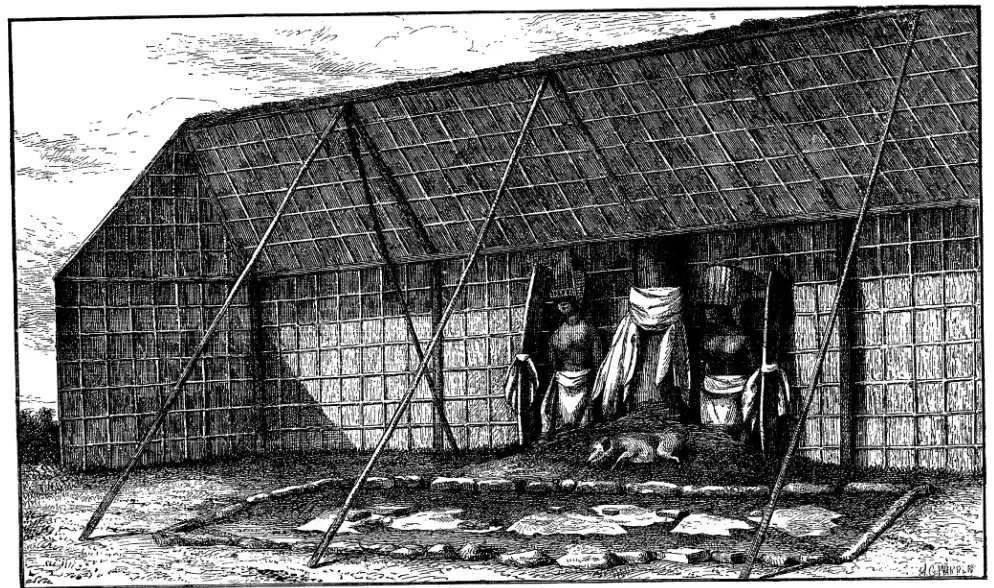
Interior of an Ancient Temple, an engraving in the 1888 volume. Its caption gives no labels for individual structures.
The Legends and Myths of Hawaii, Charles L. Webster & Company, 1888. Public domain. Cropped from the Library scan. · Image source ↗ · Public Domain
The wicker enclosure and the oracle tower
The account of Hākau shows what a listener could experience: darkness, a screen and a voice from within. The State Parks description places an elevated oracle tower among the other buildings in a luakini, a major temple. It gives a view of how a place for an oracle fit within the wider enclosure. [4][5][1][2]
Read further in the library
The Legends and Myths of Hawaii
Reading note
The separately titled account draws on exact passages in the consulted Library edition.
Sources
See references (8)
- Poliʻahu Heiau, oracle tower and other structures ↗Hawaiʻi Department of Land and Natural Resources, Division of State Parks, “Luakini Heiau,” illustration key for the anuʻu or lananuʻu mamao.Return to text ↑
- A Cultural History of Three Traditional Hawaiian Sites, chapter 1, placement of features ↗Linda W. Greene, National Park Service, A Cultural History of Three Traditional Hawaiian Sites on the West Coast of Hawaiʻi Island, 1993, chapter 1, subsection (d).Return to text ↑
- Interior of an Ancient Temple ↗The Legends and Myths of Hawaii, Charles L. Webster & Company, 1888. Public domain. Cropped from the Library scan.
- The Legends and Myths of Hawaii, printed p. 45, Reader page 46David Kalākaua, The Legends and Myths of Hawaii, edited with an introduction by Rollin Mallory Daggett, Charles L. Webster & Company, 1888. Exact Library edition IMJ-0646-E001. When the introduction or a signed editorial passage is used, its author is identified in the article.Read this page in The Legends and Myths of Hawaii ↗Return to text ↑
- The Legends and Myths of Hawaii, Reader page 300David Kalākaua, The Legends and Myths of Hawaii, edited with an introduction by Rollin Mallory Daggett, Charles L. Webster & Company, 1888. Exact Library edition IMJ-0646-E001. When the introduction or a signed editorial passage is used, its author is identified in the article.Read this page in The Legends and Myths of Hawaii ↗Return to text ↑
- The Legends and Myths of Hawaii, Reader page 301David Kalākaua, The Legends and Myths of Hawaii, edited with an introduction by Rollin Mallory Daggett, Charles L. Webster & Company, 1888. Exact Library edition IMJ-0646-E001. When the introduction or a signed editorial passage is used, its author is identified in the article.Read this page in The Legends and Myths of Hawaii ↗Return to text ↑
- The Legends and Myths of Hawaii, Reader page 529David Kalākaua, The Legends and Myths of Hawaii, edited with an introduction by Rollin Mallory Daggett, Charles L. Webster & Company, 1888. Exact Library edition IMJ-0646-E001. When the introduction or a signed editorial passage is used, its author is identified in the article.Read this page in The Legends and Myths of Hawaii ↗Return to text ↑
- The Legends and Myths of Hawaii, Reader page 299David Kalākaua, The Legends and Myths of Hawaii, edited with an introduction by Rollin Mallory Daggett, Charles L. Webster & Company, 1888. Exact Library edition IMJ-0646-E001. When the introduction or a signed editorial passage is used, its author is identified in the article.Read this page in The Legends and Myths of Hawaii ↗Return to text ↑