Anointing of the Sick
What is anointing of the sick? Learn how prayer and oil are used, what viaticum means, and how Leadbeater distinguishes the two rites.
In this article
What is anointing of the sick?
Anointing of the sick is a Christian rite in which a priest prays with a sick person and anoints them with oil. The Roman Catholic rite may be celebrated in a home, hospital or church. In Eastern Orthodoxy it is also called holy unction and is connected with the prayer of the gathered Church. [1][3]
Viaticum is the Eucharist received as Communion when someone is near death. A dying person may receive both viaticum and anointing. Viaticum gives Communion for the passage through death, while anointing uses prayer and oil. [1][2]
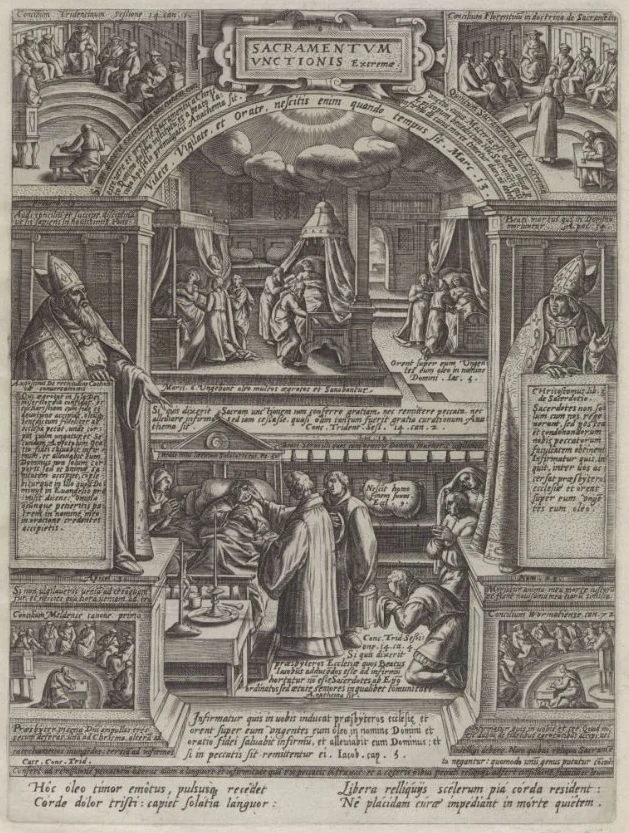
Philips Galle depicts anointing at the bedside in his 1576 series on the seven sacraments.
Philips Galle, Sacramentum Unctionis Extremae, 1576. Rijksmuseum, RP-P-2004-577. · Image source ↗ · Public Domain
The Science of the Sacraments by Charles W. Leadbeater
Charles W. Leadbeater calls the rite Holy Unction. His Liberal Catholic account gives it a place during serious illness as well as at the approach of death. He explains the effects he believes it has through his account of the person’s subtle bodies. [5][6][7]
Leadbeater calls viaticum provision for the journey ahead. When Communion is needed, he says a Host consecrated earlier can be brought to the person. The consecrated bread and the oil serve different rites. [8][9][6][7]
See references (5)
- The Science of the Sacraments, printed p. 381, Reader page 394
- The Science of the Sacraments, printed p. 382, Reader page 395
- The Science of the Sacraments, printed p. 383, Reader page 396
- The Science of the Sacraments, printed p. 200, Reader page 212
- The Science of the Sacraments, printed p. 201, Reader page 213
Two rites near the end of life
The Catholic Catechism connects viaticum with the passage from death to eternal life. Leadbeater also imagines a passage and explains it in terms of leaving the physical body. Both distinguish the Communion a person receives from the oil used in anointing. [1][2][6][7]
In the library
The Science of the Sacraments
Reading note
The separately titled account draws on exact passages in the consulted Library edition.
Sources
See references (9)
- Catechism of the Catholic Church, §§1517–1519 ↗Holy See, Catechism of the Catholic Church, English edition.
- Catechism of the Catholic Church, §§1524–1525 ↗Holy See, Catechism of the Catholic Church, English edition.
- The Orthodox Faith, Holy Unction ↗Orthodox Church in America, The Orthodox Faith, vol. II.
- Philips Galle, Sacramentum Unctionis Extremae, 1576 ↗Philips Galle, Sacramentum Unctionis Extremae, 1576. Rijksmuseum, RP-P-2004-577.
- The Science of the Sacraments, printed p. 381, Reader page 394Charles W. Leadbeater, The Science of the Sacraments, The St. Alban Press, 1920. Exact Library edition IMJ-0615-E001.Read this page in The Science of the Sacraments ↗
- The Science of the Sacraments, printed p. 382, Reader page 395Charles W. Leadbeater, The Science of the Sacraments, The St. Alban Press, 1920. Exact Library edition IMJ-0615-E001.Read this page in The Science of the Sacraments ↗
- The Science of the Sacraments, printed p. 383, Reader page 396Charles W. Leadbeater, The Science of the Sacraments, The St. Alban Press, 1920. Exact Library edition IMJ-0615-E001.Read this page in The Science of the Sacraments ↗
- The Science of the Sacraments, printed p. 200, Reader page 212Charles W. Leadbeater, The Science of the Sacraments, The St. Alban Press, 1920. Exact Library edition IMJ-0615-E001.Read this page in The Science of the Sacraments ↗
- The Science of the Sacraments, printed p. 201, Reader page 213Charles W. Leadbeater, The Science of the Sacraments, The St. Alban Press, 1920. Exact Library edition IMJ-0615-E001.Read this page in The Science of the Sacraments ↗